The obligation of medical device makers is not simply ensuring that deliveries are made on schedule. Products need to adhere to certain quality standards, operate correctly when needed, and be trackable along their entire journey through the distribution chain. Failure at any point will cause dissatisfied customers, returned goods, regulatory violations, and missed out on sales.
For companies operating within the Philippines, such as in Manila, that make, import, distribute, or sell medical devices, the standard of choice is ISO 13485. The system sets up best practices for organizations that want to manage their obligations around quality management. And since customer demands keep changing over time, this could provide some competitive edge too.
What is ISO 13485 Certification
ISO 13485:2016 is an internationally recognized standard for Quality Management Systems designed specifically for organizations engaged in medical devices and related operations. Its purpose is to specify controls on activities impacting the quality, safety, traceability, and regulatory compliance of products.
The scope includes various stages of the product lifecycle, design and development, procurement, manufacturing, process verification, storage, distribution, servicing, nonconformity and complaint management, etc., depending on your business processes.
An organization may implement a QMS conforming to the standard and pursue certification from a certification body. Your QMS needs to align with organizational operations and applicable regulations.
Why Should Companies Get ISO 13485 Certification in Manila
The city of Manila houses businesses providing medical devices, health care supplies, diagnostic equipment, and services. The companies require reliable quality systems in order to cater to their health care clients, deal with foreign vendors, and comply with agreements.
Here are seven reasons why getting certified under ISO 13485 could be beneficial for them.
1. Maintain Consistent Medical Device Quality
Medical device consumers expect consistency in terms of quality throughout each manufacturing batch. However, this goal cannot be met when there are inconsistencies in the work instructions, insufficient inspection processes, and lack of change control.
ISO 13485 addresses this issue by providing documented process controls for production, inspections, testing, release, and many other quality-impacting processes. Employees know what is expected of them, while managers have visibility into problem areas within the process.
At the Manila-based medical device manufacturer, these controls ensure that quality issues can be identified and prevented before becoming major problems. ISO 13485 doesn’t eliminate defects, but it gives organizations a system for doing so.
2. Support Applicable Regulatory Requirements
MedTech organizations have to know what regulatory obligations exist for each market they wish to enter. Regulatory obligations vary depending on the classification of the device, its purpose, manufacturing operations performed, and country of sale.
ISO 13485 gives organizations a quality management structure for achieving regulatory compliance. This includes control over documentation, change management, retention of traceability records, and complaint handling, among other areas covered in the standard’s requirements.
In the Philippines, organizations need to meet the requirements set forth by the Food and Drug Administration, relating to either their establishments or devices. Obtaining ISO 13485 certification doesn’t exempt them from obtaining licenses, registrations, notifications, approvals, or certifications required by the FDA.
Organizations wishing to sell into the US market need to pay special attention to the FDA’s QMSR, which becomes mandatory starting February 2, 2026. The regulation refers to ISO 13485:2016, meaning organizations that manufacture in the US will be required to adopt it soon.
3. Build Trust With International Buyers and Business Partners
Healthcare device makers rely heavily on partnerships with international suppliers, healthcare providers, wholesalers, and contract manufacturers. During this process, organizations may evaluate the quality systems of prospective suppliers and request documentation of third-party certification.
Third-party ISO 13485 certification could assist a business operating out of Manila in communicating its commitment to quality control procedures and clear lines of accountability. Third parties will provide a benchmark against which to judge supplier ability.
Certifications do not ensure contracts or exempt customers from conducting audits. Still, they help streamline the process of assessing supplier qualifications.
4. Improve Product Traceability and Record-Keeping
When a product fails an inspection or a customer reports a problem, the company needs reliable records to understand what happened. It may need to identify the affected batch, review production details, check supplied components, and determine which customers received the product.
ISO 13485 requires appropriate identification, traceability, and record controls based on the applicable requirements and risks. Companies can use these controls to connect materials, production activities, inspection results, product release, and distribution records.
Better traceability helps organisations investigate complaints, identify affected products, and support recalls or other corrective measures when necessary. It also makes it easier to provide evidence during customer and certification audits.
5. Strengthen Supplier and Outsourced Process Controls
Medical device quality depends partly on the materials, components, and services a company receives from external providers. A problem with a critical component, sterilisation service, packaging material, or testing provider can affect the finished device.
ISO 13485 requires organisations to evaluate and control suppliers according to defined criteria and the risks associated with purchased products and services.
For example, a Manila-based manufacturer may establish supplier approval procedures, define purchasing specifications, review incoming materials, and monitor supplier performance. Where appropriate, it can also set clear quality requirements for outsourced processes.
These measures help companies identify supplier problems earlier and maintain greater control over the quality of incoming materials and external services.
6. Reduce the Risk of Recurring Quality Problems
Persistent nonconformities, customer complaints, and ineffective corrective actions require wasting both time and effort. Addressing the issue alone doesn’t necessarily solve anything if there is an ongoing root cause behind it.
ISO 13485 mandates that organizations conduct investigations into nonconformities, establish the cause if possible, and take appropriate corrective actions based on the problem. Additionally, organizations must assess whether the corrective actions are effective.
Maintaining an effective corrective and preventive action process allows a company to detect recurring issues within its operations, allocate accountability appropriately, and verify whether corrective actions have been successful.
This leads to improved efficiency and less unnecessary work. Management is also provided with better insight into ongoing quality issues.
7. Create Opportunities in New Markets
A quality management system ISO 13485 may become useful to discuss when dealing with foreign buyers who have certain quality expectations during supplier selection.
There are many scenarios when certification could be valuable. Manufacturers may be looking for contract manufacturing deals, exporters can showcase compliance capabilities to potential buyers abroad, and brand owners want reliable partners in their supply chains who manufacture devices according to global standards.
Still, certification is not everything needed for successful market entry. All product-related regulatory obligations should be met regardless.
The actual benefit will be achieved if a good QMS is implemented to help with this process.
Which Companies in Manila Should Consider ISO 13485 Certification
ISO 13485 is relevant to organisations whose activities fall within the standard’s scope and affect medical device quality. Depending on their responsibilities and customer requirements, the following businesses may benefit:
- Medical device manufacturers: Companies involved in manufacturing, assembling, or producing medical devices.
- Medical equipment suppliers: Businesses supplying equipment and components to healthcare providers and other customers.
- Importers and distributors: Organisations responsible for purchasing, storing, handling, and distributing medical devices.
- Contract manufacturers: Companies producing devices or components for other medical device brands.
- Sterilisation and packaging providers: Service providers whose activities affect device safety, cleanliness, or packaging integrity.
- Medical device servicing companies: Businesses involved in installation, maintenance, repair, or other services covered by the applicable requirements.
- Medical technology developers: Companies involved in designing and developing medical devices, including eligible startups preparing for commercial production.
- Critical component suppliers: Businesses supplying materials or components that can affect the quality or safety of finished devices.
The exact scope depends on the organisation’s activities, regulatory responsibilities, and intended certification boundaries. Not every company in the healthcare sector automatically needs ISO 13485 certification.
What is the Current Version of ISO 13485
October 2026 is when ISO 13485:2016 became the latest revision of this document. In other words, it received confirmation from ISO in 2025, meaning organizations shouldn’t automatically assume that there’s already been another revision released since then.
Organizations must keep implementing their QMS according to the requirements outlined in ISO 13485:2016 and stay informed about any upcoming revisions.
Additionally, organizations selling into many different markets need to verify whether there are other standards to comply with. An ISO certificate does not mean compliance with all the regulations around the world regarding medical devices.
How Can Companies Prepare for ISO 13485 Certification
Preparation should begin with a clear understanding of the company’s activities, product risks, and applicable requirements. The following steps provide a practical starting point:
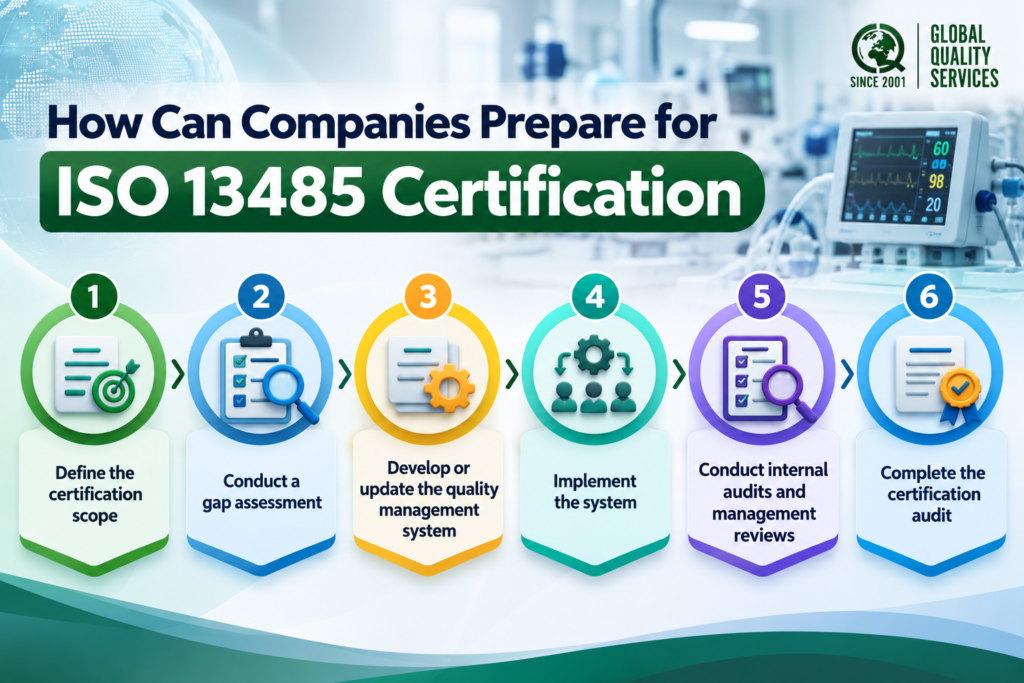
- Define the certification scope: Identify the sites, products, services, and activities that the quality management system will cover.
- Conduct a gap assessment: Compare existing procedures and records against the applicable ISO 13485 requirements.
- Develop or update the quality management system: Establish the required procedures, responsibilities, risk controls, and records.
- Implement the system: Train employees and generate evidence that the procedures are followed in daily operations.
- Conduct internal audits and management reviews: Evaluate the system, address findings, and check readiness for the certification assessment.
- Complete the certification audit: Arrange the assessment with a suitable certification body and address any nonconformities identified.
Get ISO 13485 Certification Support in Manila
Implementing a medical device quality management system demands meticulous planning, appropriate documentation, and proper implementation. With the help of Global Quality Services, you can gain insight into ISO 13485 standards, find your areas of weakness, document policies, and prepare yourself for certification.
If you produce medical devices, distribute components, or carry out distribution processes, you should begin by evaluating your current situation and determining your certification scope. Get in touch with Global Quality Services to learn more about our ISO 13485 consultancy and certification services in Manila.
Frequently Asked Questions
1. Is ISO 13485 certification mandatory in the Philippines?
No, it’s not. Certification is neither a panacea nor a worldwide replacement for licensing and approval according to local Philippine FDA regulations. Requirements may vary based on the particular regulation or law, the type of product, business activity, procurement terms, and customer agreement. Companies need to figure out their exact set of requirements individually.
2. How does ISO 13485 certification help medical device companies?
Certification enables businesses to implement controlled systems for managing product quality, risks, traceability, suppliers, complaints, and corrective measures. It could even help companies prove qualification to customers or show completion of third-party assessments in line with the standards.
3. Does ISO 13485 certification guarantee approval to sell medical devices internationally?
Not necessarily. While certification proves compliance with relevant quality management system requirements in the certified scope, manufacturers must comply with all product registration, documentation, safety, labeling, and other regulations in every intended target market.
4. Has ISO 13485 been updated for 2026?
The current version of the standard is ISO 13485:2016 through October 2026. An important regulatory update related to the topic is the US FDA QMSR, which became mandatory on February 2, 2026, adopting ISO 13485:2016. Manufacturers need to consult official ISO and regulatory documents for further updates.