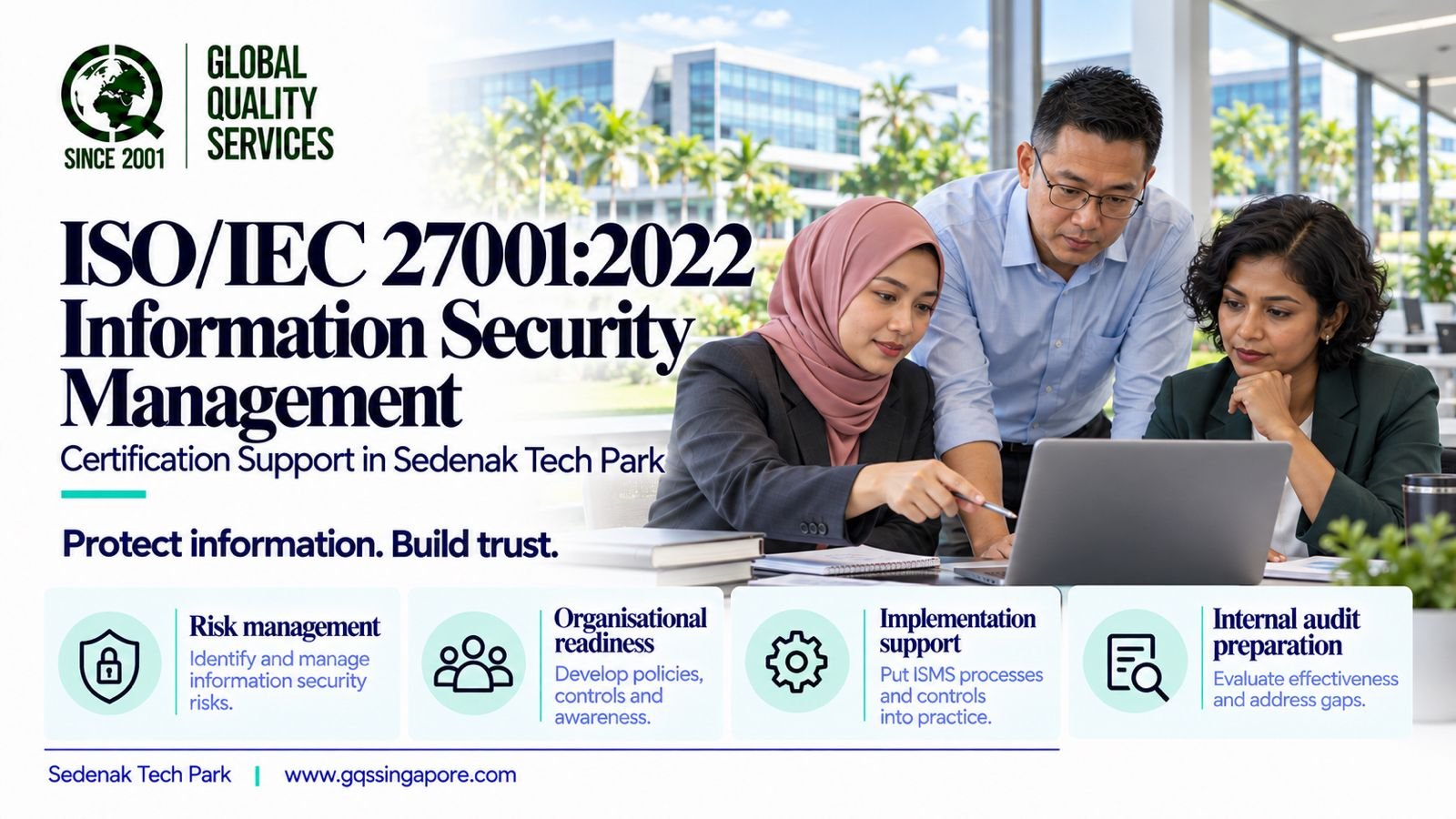
Sedenak Tech Park (STeP), located in Kulai, Johor, is a growing hub for data centers, cloud computing, and digital infrastructure in Malaysia. As businesses expand their data storage, hosting, artificial intelligence, and enterprise technology operations in this area, information security becomes central to business continuity and customer trust.
ISO 27001 Certification in Sedenak Tech Park, Malaysia, enables organizations to demonstrate that their information security management system (ISMS) has been assessed against the requirements of ISO/IEC 27001:2022. This international standard establishes a systematic approach to identifying information security risks, implementing appropriate controls and continually improving how sensitive information is protected.
For data center operators, cloud service providers, managed service companies, and technology businesses in Sedenak, an effective ISMS can address risks involving customer data, privileged system access, third-party services, operational records, and confidential business information.
Global Quality Services (GQS) provides certification-related services for organizations seeking ISO 27001 Certification in Malaysia. The certification scope is based on the organization’s operations, information assets, locations, and applicable requirements.
Why ISO 27001 Certification Is Important in Sedenak Tech Park
Sedenak Tech Park forms part of Johor’s expanding digital infrastructure ecosystem. Its focus on data center development and connectivity makes information security relevant to organizations that host workloads, maintain digital services, and manage access to critical systems.
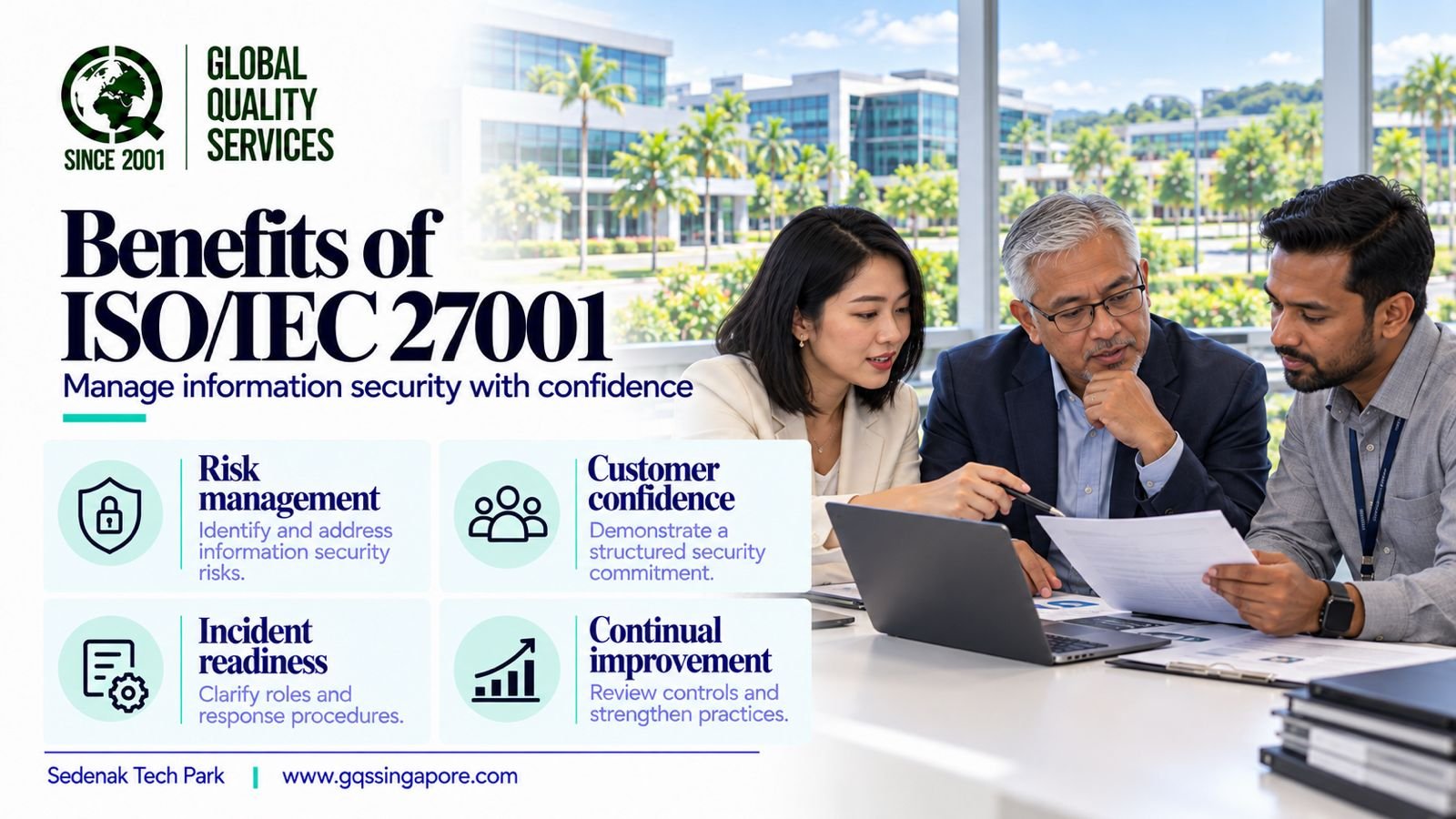
Information security management is not limited to preventing cyberattacks. It also involves controlling access to information, managing suppliers, responding to incidents and maintaining the confidentiality, integrity and availability of data.
Protect Data Center and Cloud Operations
Data center environments manage servers, storage systems, network infrastructure, and customer workloads. A security incident affecting these assets can expose confidential information or disrupt services.
ISO 27001 establishes a risk-based framework for managing information security responsibilities, access permissions, operational procedures and incident response. The relevant controls depend on the organization’s role and the scope of its ISMS.
Manage Customer Data and Confidential Information
Colocation providers, cloud hosting businesses and managed IT service providers may handle customer information, system configurations, service records and other sensitive data.
An information security management system helps organizations define how this information is classified, accessed, transferred, stored and protected throughout its lifecycle.
Strengthen Supplier and Third-Party Risk Management
Technology businesses often depend on external cloud platforms, telecommunications providers, maintenance contractors, software vendors and infrastructure suppliers.
ISO 27001 addresses supplier-related information security risks through appropriate evaluation, contractual controls and ongoing oversight. These measures help organizations understand how third-party relationships may affect their security obligations.
Support Enterprise Procurement and Customer Assurance
Enterprise customers may assess information security controls before selecting a data center operator, cloud provider or technology supplier. ISO 27001 Certification can provide independent evidence that the defined ISMS has been assessed against an internationally recognized standard.
Certification does not guarantee that security incidents will never occur, but it demonstrates that the organization’s information security management system has undergone the applicable conformity assessment.
Who Needs ISO 27001 Certification in Sedenak Tech Park?
ISO 27001 applies to organizations of all sizes and across industries. In Sedenak Tech Park and the wider Kulai technology corridor, it is particularly relevant to businesses whose services depend on protecting digital information and maintaining secure technology operations.
Data Center Operators
Data center businesses manage physical infrastructure and digital environments that support enterprise applications, cloud platforms and customer workloads.
An ISMS can address relevant risks involving privileged access, information security incidents, supplier relationships, operational records and the protection of information handled within the defined certification scope.
Cloud Computing and Hosting Providers
Cloud service providers and hosting companies may manage customer environments, virtual infrastructure, backups, and administrative access.
ISO 27001 helps establish a structured approach to assess these risks and implement appropriate information security controls across in-scope services.
IT Managed Service Providers
Managed service providers may access customer networks, administer systems, monitor infrastructure and maintain technical records. Their responsibilities can create security risks if access rights, credentials or service processes are not adequately controlled.
An ISMS helps define responsibilities for access management, incident reporting, supplier oversight, and protecting customer information.
AI and Digital Infrastructure Companies
Businesses supporting artificial intelligence, data processing and high-performance computing may handle sensitive datasets, proprietary configurations and business-critical workloads.
ISO 27001 can provide a management framework for evaluating information security risks associated with these assets. It does not, by itself, certify AI accuracy, model safety, or compliance with every AI-related regulation.
Technology and Enterprise Service Companies
Software companies, IT support providers, technology developers and other digital businesses may require ISO 27001 to address customer security expectations and formal supplier assessment requirements.
The standard can be applied to a clearly defined scope that reflects the organization’s actual services, systems, locations, and information security responsibilities.
What Does ISO 27001 Certification Cover?
ISO/IEC 27001:2022 specifies requirements for establishing, implementing, maintaining and continually improving an information security management system. The standard considers organizational processes, people, technology, and relevant physical environments, rather than treating information security as purely technical.
Information Security Risk Assessment
The organization identifies its information assets, evaluates relevant threats and vulnerabilities, and determines the risks that require treatment.
For a data center or cloud service provider in Sedenak, this assessment may consider customer information, server administration, network access, backups, supplier dependencies, and operational systems.
Access Control and Identity Management
Access controls help ensure that only authorized users can access information and systems. Based on systems. Depending on the risk assessment, relevant measures may include user access reviews, authentication requirements, privileged access restrictions, and timely removal of access when responsibilities change.
Asset and Information Management
An ISMS establishes how information assets are identified, classified and protected. This can include digital records, customer data, system configurations, business documents and other information relevant to the organization’s operations.
Incident Management and Business Continuity
Organizations need defined processes to report, assess, and respond to information security incidents.
Relevant controls may address incident escalation, recovery arrangements, backups, business continuity planning, and lessons learned after an incident.
ISO 27001 complements operational resilience measures but does not independently guarantee uninterrupted power, cooling, or physical infrastructure availability at a data center.
Supplier and Cloud Security
External services can introduce risks outside an organization’s direct operational control. The ISMS addresses relevant supplier relationships and establishes controls appropriate to the risks identified.
Internal Audits and Continual Improvement
ISO 27001 requires the organization to evaluate its ISMS through monitoring, internal audits, management reviews, and corrective action. These activities help determine whether the system remains suitable, adequate and effective as operations change.
ISO 27001 Certification for Data Centers in Sedenak Tech Park
Data center operators have information security requirements that can extend across physical facilities, administrative systems, customer environments and external service providers. Therefore, carefully defining the ISMS scope is particularly important.
Depending on the organization’s role, an ISO 27001 assessment may consider:
- Physical access management: Controls governing access to relevant buildings, rooms and restricted areas within the certification scope.
- Privileged access security: Procedures for administering servers, network devices, cloud platforms and other critical systems.
- Customer information protection: Controls for managing information entrusted to the organization by customers and business partners.
- Change management: Procedures for evaluating and controlling changes that may affect information security.
- Backup and recovery arrangements: Measures for protecting information and addressing relevant recovery risks.
- Supplier security: Evaluation of information security risks arising from outsourced services and infrastructure dependencies.
- Incident response: Processes for identifying, reporting, investigating, and responding to security incidents.
- Operational documentation: Records demonstrating that relevant security procedures are implemented and monitored.
The scope of certification should be defined carefully. An ISO 27001 certificate covering a data center operator’s specified services does not automatically certify every tenant, customer workload, building system, or external supplier associated with the facility.
ISO 27001 Certification Process in Sedenak Tech Park
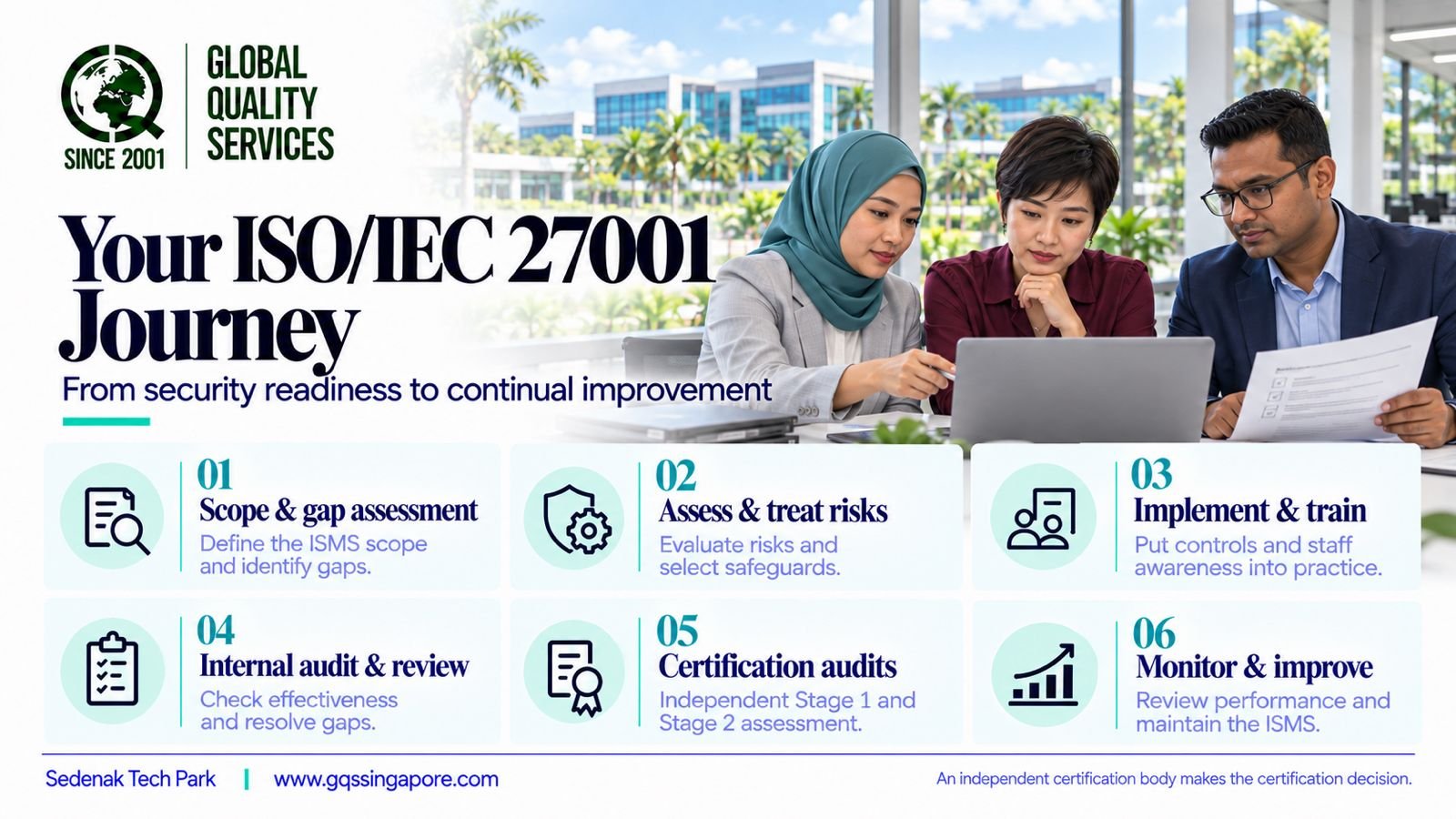
The certification process involves defining the ISMS scope, assessing the organization’s information security risks, implementing the applicable requirements and completing the required certification audits.
Step 1: Define the Certification Scope
Identify the business activities, services, information assets, systems, locations and relevant interfaces to be included in the ISMS.
A data center operator may define a scope around specified data center services and related operational processes. A managed service provider may instead focus on its in-scope IT management and customer support services.
Step 2: Conduct an Information Security Risk Assessment
Evaluate the threats and vulnerabilities that could affect the confidentiality, integrity and availability of information.
The organization determines appropriate risk-treatment measures based on its operational context, contractual responsibilities, and applicable requirements.
Step 3: Implement the ISMS
Establish the policies, procedures, responsibilities and records required by ISO 27001. Implement the selected controls and maintain evidence that the system operates as intended.
The Statement of Applicability documents the applicable controls and the reasons for their inclusion or exclusion, as required by the standard.
Step 4: Complete the Stage 1 Audit
The certification body reviews relevant documented information, the proposed scope, and the organization’s readiness for the next stage.
This assessment helps establish whether the management system is sufficiently prepared for the Stage 2 audit.
Step 5: Complete the Stage 2 Audit
The certification body evaluates theISMS’s implementation and effectiveness against the requirements of ISO/IEC 27001:2022.
Audit activities may include personnel interviews, record reviews, and examination of evidence relating to risk management, access control, incident response, and other applicable processes.
Step 6: Address Nonconformities
If nonconformities are identified, the organization must complete the required corrective actions and provide supporting evidence in accordance with the certification body’s procedures.
Certification is granted only after the required assessment and certification decision requirements have been satisfied.
Step 7: Maintain the Certified ISMS
After certification, the organization must continue to operate and improve its ISMS. Surveillance audits and recertification activities are required under the applicable certification program.
Changes to infrastructure, suppliers, services, systems and information security risks should be evaluated as part of ongoing management system maintenance.
ISO 27001 Certification and Malaysian Data Protection Requirements
Organizations operating in Sedenak Tech Park may need to consider Malaysia’s Personal Data Protection Act 2010 (Act 709), as amended, alongside applicable sector-specific, contractual and other legal requirements.
The Personal Data Protection (Amendment) Act 2024 introduced changes to Malaysia’s personal data protection framework, with provisions commencing in stages during 2025. Businesses should assess which obligations apply to their specific activities and current legal responsibilities.
ISO 27001 can help organizations establish controls to protect personal data and manage relevant information security risks. However, ISO 27001 Certification does not automatically demonstrate compliance with every requirement of Malaysia’s PDPA.
Data center operators, cloud providers and managed service companies should consider their role in processing or hosting personal data, their contractual responsibilities and the applicable requirements for protecting that information.
Areas Covered Around Sedenak Tech Park, Kulai, Johor
Sedenak Tech Park is situated in the Kulai district of Johor, within a wider industrial and digital infrastructure region connected to the Johor-Singapore economic corridor. Businesses operating at or near the park may include data center operators, technology service providers, industrial businesses, and companies supporting digital infrastructure.
Relevant nearby locations for ISO 27001 certification inquiries include:
- Sedenak: Data center campuses, digital infrastructure and related technology operations.
- Kulai: Industrial businesses, technology facilities and supporting commercial services.
- Senai: Manufacturing, logistics, electronics and businesses managing operational data.
- Skudai: Technology-related businesses, professional services and education-linked organizations.
- Johor Bahru: Corporate offices, IT service providers, and companies that handle customer and commercial information.
- Iskandar Malaysia: A wider economic region encompassing multiple industrial, digital and commercial sectors.
The relevant certification scope depends on theorganization’ss actual operations and the locations included in its ISMS. Companies with multiple facilities should identify the applicable sites, systems, and operational interfaces during scope definition.
Why Choose Global Quality Services for ISO 27001 Certification in Sedenak Tech Park?
Selecting a certification service provider involves understanding the standard, defining the intended scope and identifying the evidence needed to demonstrate conformity.
Global Quality Services provides certification-related services for organizations seeking ISO management system certifications, subject to the applicable service scope and certification arrangements.
- Scope-focused assessment: The intended certification scope is considered in relation to the organization’s services, information assets, and operating environment.
- Requirements-based audits: The assessment evaluates conformity with the applicable requirements of ISO/IEC 27001:2022.
- Documented audit findings: Results identify relevant conformity issues and nonconformities for action through the established certification process.
- Relevance to digital infrastructure: The defined ISMS scope can reflect applicable information security risks involving cloud services, data centers, IT systems, and external providers.
- Ongoing conformity: Surveillance and recertification activities support continued evaluation of the certified management system.
Organizations confirm the certification body’s accreditation, certification scope and recognition requirements where these are specified by customers, regulators or procurement arrangements. Certification remains subject to a satisfactory assessment and formal certification decision.
Frequently Asked Questions
Is ISO 27001 Certification relevant to data centers at the Centersenk Tech Park?
Yes. ISO 27001 is relevant to data center operators and related technology businesses that need a structured approach to information security risk management. Its applicability depends on the organization’s role, services, and defined ISMS scope. Certification does not automatically cover every tenant or customer using a data center.
Can a cloud service provider in Kulai obtain ISO 27001 Certification?
Yes. Cloud service providers can pursue ISO 27001 Certification for a defined scope covering their relevant services, systems, locations and information security processes. The assessment considers applicable requirements and the controls the organization selects through its risk treatment process.
Does ISO 27001 Certification guarantee a data center?
27001 focuses on information security management. Although the ISMS may address availability-related risks and relevant business continuity arrangements, certification does not guarantee uninterrupted power, cooling, connectivity, or service availability.
Is ISO 27001 Certification mandatory for businesses in Sedenak Tech Park?
ISO 27001 Certification is not automatically mandatory for every organization in the park. It may be required by customers, contractual arrangements, procurement criteria, or other applicable obligations. Businesses may also pursue certification to demonstrate their approach to information security management.
What is the difference between ISO 27001 and SOC 2?
ISO 27001 is an international standard that specifies requirements for an information security management system and can be accredited. SOC 2 is an attestation engagement based on applicable Trust Services Criteria and performed by a qualified independent CPA firm. Customer expectations and the nature of the services offered influence which assurance approach is appropriate.