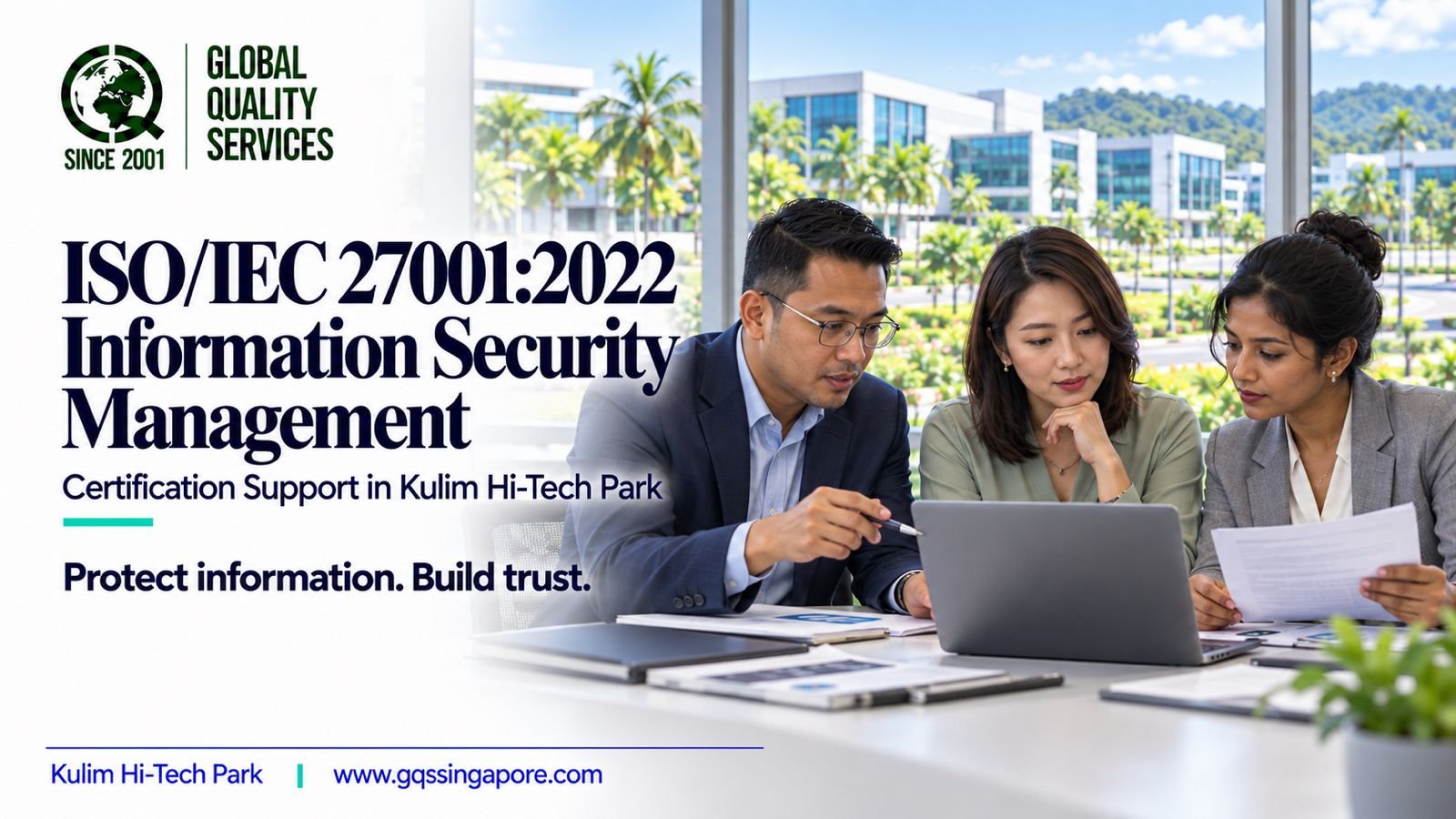
Businesses operating in Kulim Hi-Tech Park handle information essential to manufacturing, technology development, research, supply chain coordination,, and customer operations. Semiconductor production data, engineering designs, intellectual property, supplier records, and proprietary manufacturing processes all require appropriate protection. As businesses expand their digital operations and work with international customers, a structured approach to information security becomes increasingly important.
ISO 27001 certification provides a recognized framework for managing information security risks through an Information Security Management System (ISMS). For organizations in Kulim Hi-Tech Park, it establishes a systematic approach to protecting sensitive information, assessing security risks, assigning responsibilities, and continually improving information security controls.
GQS Global Quality Services Pte Ltd provides ISO certification services for organizations seeking independent assessment of their management systems. Businesses in Kulim can explore ISO 27001 certification to demonstrate that their information security management practices have been assessed against an internationally recognized standard.
Whether your organization manufactures semiconductor components, develops electronic products, supplies engineering services or manages confidential information for global customers, ISO 27001 can provide a structured basis for managing information security across relevant business activities.
What Is ISO 27001 Certification?
ISO/IEC 27001:2022 is an international standard that specifies requirements for establishing, implementing, maintaining, and continually improving an Information Security Management System.
An ISMS is a coordinated management framework for identifying information security risks and determining how those risks should be treated. It covers more than IT infrastructure. Depending on the organization’s scope, it can address digital information, physical records, employee responsibilities, third-party relationships, operational processes and business continuity arrangements.
The standard is based on protecting three essential aspects of information security:
- Confidentiality: Information is accessible only to authorized individuals or systems.
- Integrity: Information remains accurate, complete and protected against unauthorized alteration.
- Availability: Information and systems remain accessible to authorized users when required.
ISO 27001 does not prescribe an identical set of controls for every business. Instead, organizations assess their risks, determine appropriate treatments and establish controls suited to their operations.
Certification involves an independent assessment of the ISMS against the applicable requirements of ISO/IEC 27001:2022. It demonstrates conformity within the defined certification scope, rather than guaranteeing that security incidents will never occur.
Why ISO 27001 Certification Matters in Kulim Hi-Tech Park
Kulim Hi-Tech Park is an established high-technology industrial hub in Kedah, Malaysia. Its industry ecosystem includes semiconductor manufacturing, wafer fabrication, advanced electronics, machinery, automation, advanced materials, medical technology, and research and development.
These activities depend on information that may have commercial, technical or contractual significance. A manufacturer may manage confidential product specifications, while an engineering company may hold customer designs and a technology provider may process sensitive operational data.
As organizations exchange information across suppliers, production facilities, and international business networks, information security weaknesses can affect more than one department. These weaknesses can disrupt operations, expose intellectual property, or undermine customer confidence.
ISO 27001 certification is relevant to Kulim businesses because it connects information security decisions with organizational responsibilities, operational risks and business objectives.
Information Security for Semiconductor and Electronics Manufacturers
Semiconductor and electronics businesses may manage chip designs, production parameters, equipment configurations, test results, engineering documentation and proprietary process information. Unauthorized access or changes to these records can create commercial and operational risks.
An ISO 27001-based ISMS provides a structured approach to identifying critical information assets, assessing threats and establishing appropriate controls.
Protection for Advanced Manufacturing Operations
Manufacturing environments increasingly depend on connected systems, digital production records, automated equipment and data exchange between operational and corporate networks.
Organizations can assess the information security risks associated with these systems and define responsibilities for access management, incident response, supplier relationships and information handling within their ISMS scope.
Greater Confidence in Customer and Supplier Relationships
Manufacturers serving multinational customers may be asked to demonstrate how they manage confidential information and information security risks.
ISO 27001 certification provides independent evidence of conformity with a recognized information security management standard. Customers may still impose additional security requirements, but certification can form part of an organization’s broader assurance arrangements.
Information Security for Research and Development
Research and development activities can involve unpublished technical findings, prototypes, test data, product designs and commercially sensitive intellectual property.
An ISMS provides a systematic way to identify these information assets, evaluate risks and establish controls that reflect the organization’s research and development activities.
Benefits of ISO 27001 Certification in Kulim Hi-Tech Park
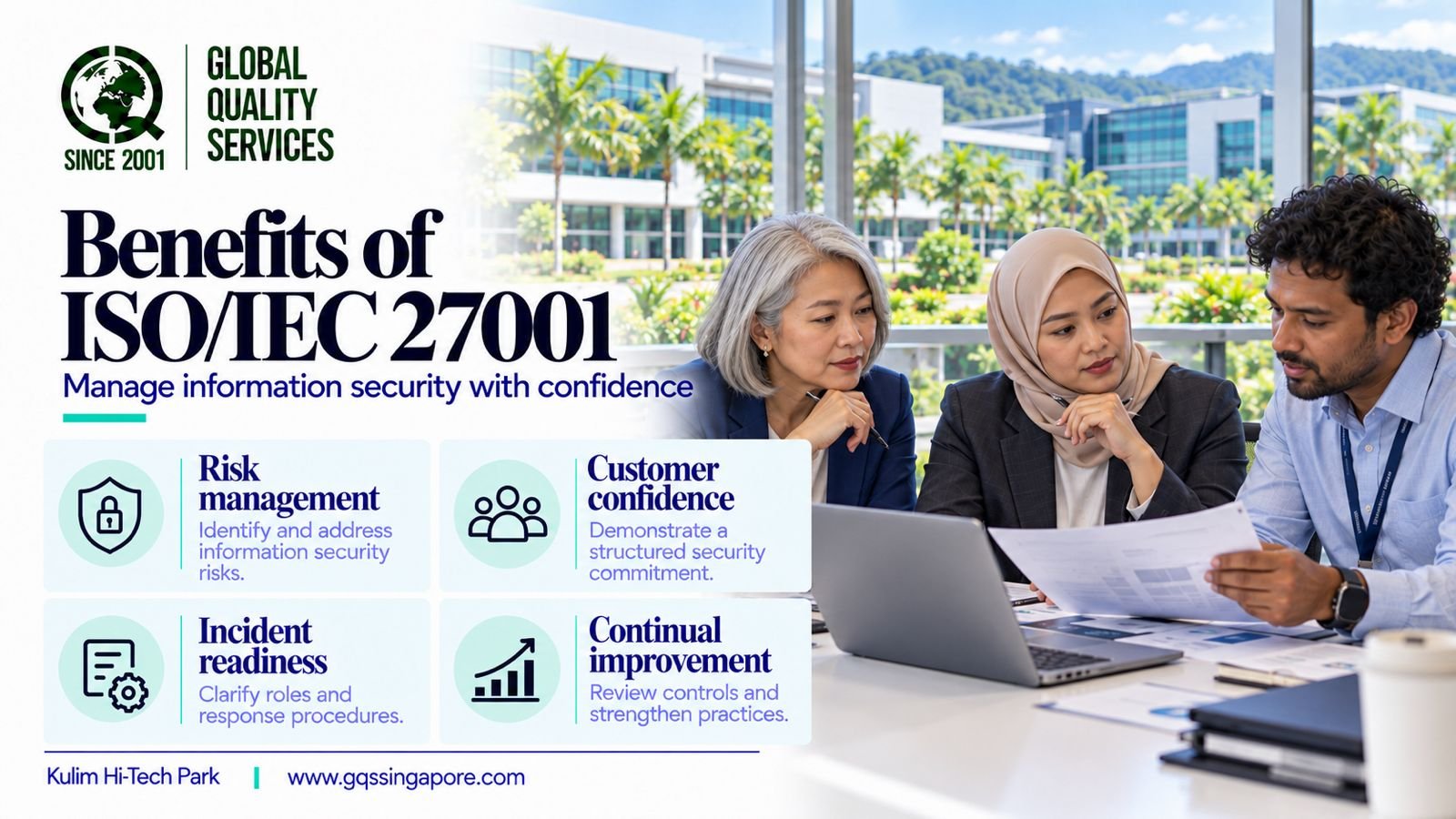
ISO 27001 certification is not simply a cybersecurity credential. When implemented effectively, it links information security to business processes, management decisions,, and continual improvement.
1. Identify and Manage Information Security Risks
The standard requires organizations to assess information security risks and determine how to treat them. This allows businesses to prioritize risks according to their potential impact rather than relying on isolated security measures.
For a Kulim manufacturer, this could include assessing risks associated with production data, supplier access, engineering files, business applications and employee accounts.
2. Protect Intellectual Property and Confidential Data
Manufacturers, technology companies and research organizations may hold information that gives them a commercial advantage. An ISMS establishes a framework for classifying, accessing, storing, transferring, and protecting such information.
The specific controls depend on the organization’s risk assessment and certification scope.
3. Strengthen Customer and Business Partner Confidence
An independently assessed ISO 27001 certificate can demonstrate that an organization’s ISMS has been evaluated against recognized requirements.
This can be relevant when customers assess suppliers, when businesses compete for contracts involving sensitive information, or when organizations need to demonstrate formal information security management arrangements.
4. Establish Clear Security Responsibilities
Information security involves employees, management, IT teams, operational departments and external service providers. ISO 27001 encourages organizations to define responsibilities, establish policies, and maintain processes to manage security-related activities.
Clear ownership makes it easier to identify gaps and ensure risks receive appropriate attention.
5. Improve Incident Preparedness and Response
Security incidents may involve unauthorized access, data loss, malware, system disruption, or accidental disclosure of confidential information.
An ISMS establishes a management framework for preparing for incidents, defining response responsibilities, retaining relevant records and evaluating lessons learned. It cannot eliminate every incident, but it can provide a more systematic approach to managing them.
6. Manage Information Security Across the Supply Chain
Manufacturing businesses frequently exchange information with component suppliers, logistics providers, maintenance contractors, technology vendors and customers.
ISO 27001 provides a basis for assessing relevant supplier risks and establishing suitable information security requirements within business relationships.
7. Support Continual Improvement
Information security risks change as organizations adopt new technologies, expand operations, introduce suppliers and modify business processes.
Regular monitoring, internal audits, management reviews, and corrective actions help organizations evaluate ISMS performance and identify areas for improvement.
Who Needs ISO 27001 Certification in Kulim Hi-Tech Park?
ISO 27001 is applicable to organizations of different sizes and sectors. Its relevance depends on the information an organization manages, the risks it faces and the requirements of its customers and stakeholders.
In Kulim Hi-Tech Park, the standard may be particularly relevant to the following businesses.
Semiconductor and wafer fabrication companies: Organizations that manage engineering data, production records, process information, and proprietary manufacturing knowledge.
- Electronics manufacturers: Businesses that handle product specifications, testing records, customer information, and supplier documentation.
- Automation and machinery providers: Companies managing equipment configurations, technical documentation, software and customer production data.
- Advanced materials and industrial technology businesses: Organizations protecting research findings, technical specifications, intellectual property and confidential commercial records.
- Medical technology and life sciences companies: Businesses managing sensitive technical, operational or personal information within their defined ISMS scope.
- IT and software service providers: Companies responsible for hosting, processing, storing or accessing customer information.
- Research and development organizations: Teams that manage experimental data, product development records, prototypes, and confidential research outputs.
- Manufacturing suppliers and service providers: Businesses seeking to demonstrate structured information security management to customers and supply chain partners.
Certification is not limited to large multinational companies. Small and medium-sized businesses can also establish an ISMS appropriate to their operations and pursue certification when it aligns with their business requirements.
Key Requirements of ISO 27001:2022
ISO 27001 sets requirements in Clauses 4 to 10. Organizations must address the applicable requirements rather than exclude clauses simply because they are inconvenient.
Understanding the Organization and Its Context
The organization determines the internal and external factors that affect its information security objectives. It identifies relevant interested parties, defines the ISMS scope and considers the information security requirements that apply to its activities.
For a business in Kulim, the scope may include manufacturing operations, corporate functions, engineering activities, information systems, or selected business locations.
Leadership and Information Security Policy
Top management must demonstrate leadership and commitment to the ISMS. This includes establishing an information security policy, assigning responsibilities ,and ensuring that information security objectives align with organizational priorities.
Information Security Risk Assessment and Treatment
The organization establishes a risk assessment process, identifies relevant risks and evaluates their significance. It then determines appropriate risk treatment actions and retains the required documented information.
Support and Operational Controls
The ISMS requires appropriate resources, competence, awareness, communication and documented information. Organizations must also plan and control the processes needed to meet information security requirements and implement their risk treatment decisions.
Performance Evaluation
Organizations monitor and evaluate the effectiveness of their ISMS. Internal audits and management reviews provide structured opportunities to determine whether the system meets the standard’s requirements and the organization’s own objectives.
Continual Improvement
The organization addresses nonconformities, implements corrective actions, and continually improves the suitability, adequacy, and effectiveness of its ISMS.
Annex A Information Security Controls
ISO 27001:2022 includes a reference set of information security controls in Annex A. Organizations use the risk assessment and treatment process to determine relevant controls and document their decisions in the Statement of Applicability.
Depending on the organization’s risks, relevant controls may address access management, asset management, supplier relationships, incident management, physical security, secure development and business continuity.
Not every control isapplieso every organization. Control selection must be justified through the organization’s risk treatment process and the requirements of the standard.
ISO 27001 Certification Process with Global Quality Services
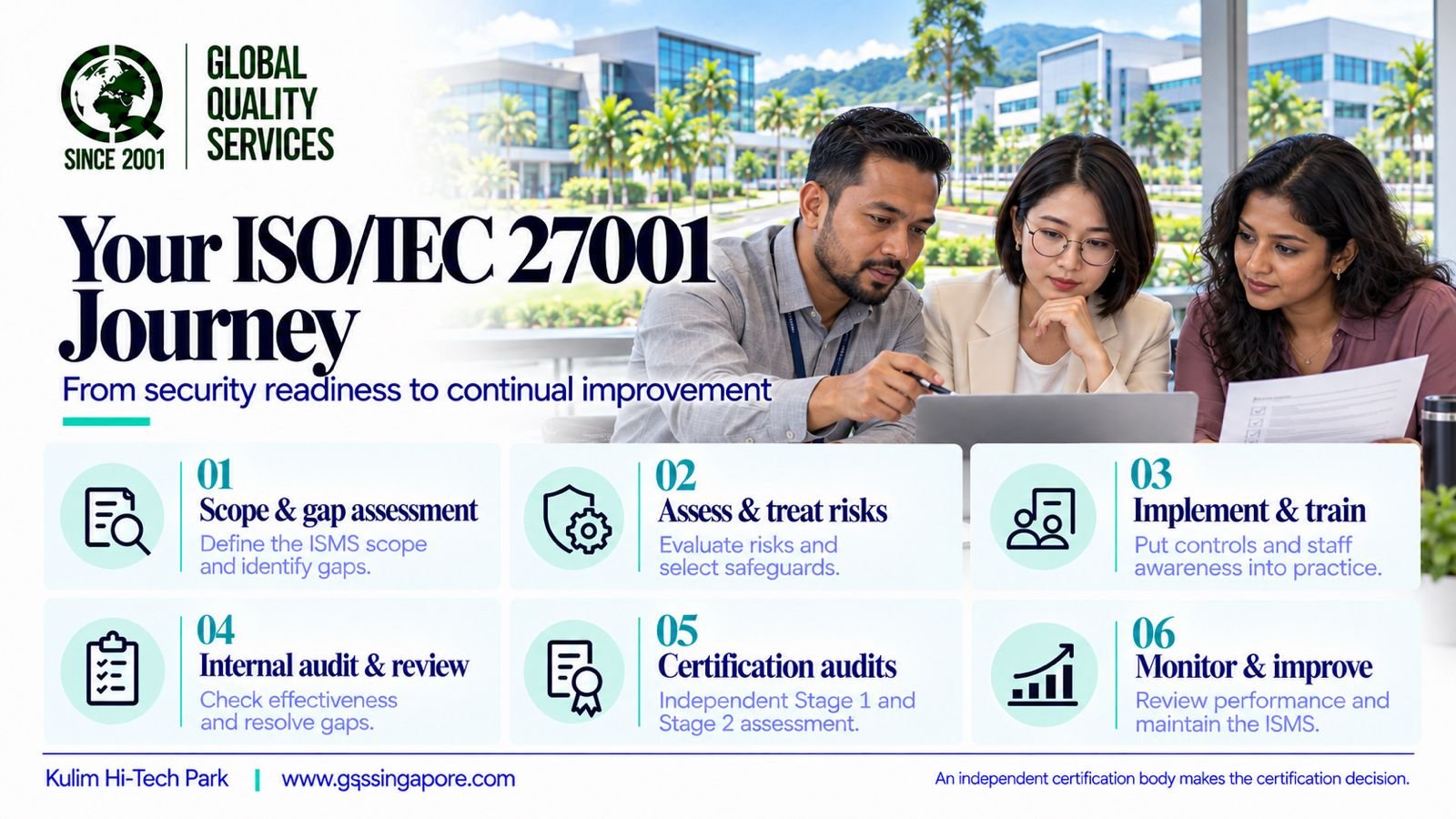
The certification process evaluates whether an organization’s ISMS meets the applicable requirements of ISO/IEC 27001:2022. The duration and assessment arrangements depend on the organization’s size, scope, complexity, and readiness.
Step 1: Define the ISMS Scope
Identify the business activities, functions, locations, information assets and relevant systems included in the proposed certification scope.
For a Kulim Hi-Tech Park business, the scope may cover a manufacturing facility, an engineering department, a technology service operation or multiple connected functions. The scope must accurately represent the activities being assessed.
Step 2: Review Certification Readiness
Evaluate the organization’s existing information security management arrangements against the standard’s requirements.
This review may consider risk assessment methods, information security policies, assigned responsibilities, documented processes, and existing controls. Any gaps identified should be addressed before the certification assessment.
Step 3: Conduct Risk Assessment and Treatment
The organization identifies information security risks within its ISMS scope and determines how to treat them.
It selects relevant controls, records the rationale for including or excluding them as required, and prepares the Statement of Applicability. The selected controls must be implemented as appropriate to the organization’s risk treatment decisions.
Step 4: Implement and Operate the ISMS
The organization puts the defined policies, procedures, controls, and responsibilities into operation. Relevant employees must understand their roles, and the organization must retain evidence that its management system is functioning.
Step 5: Complete Internal Audit and Management Review
Before certification, the organization evaluates whether its ISMS meets the applicable requirements and operates effectively.
Internal audits identify potential nonconformities, while management reviews assess system performance and decisions that require management attention.
Step 6: Undergo the Certification Assessment
The certification assessment typically involves two stages.
- Stage 1 evaluates the ISMS documentation, scope, readiness, and the organization’s understanding of its activities.
- Stage 2 evaluates the ISMS implementation and effectiveness against the applicable requirements. The assessment may include interviews, document reviews, records, and examination of relevant operational processes.
The exact assessment arrangements depend on the certification program and the organization’s circumstances.
Step 7: Address Nonconformities and Certification Decision
If nonconformities are identified, the organization must address them according to the certification body’s procedures.
A certification decision is made only after the applicable requirements for certification have been satisfied. Completing an audit does not automatically mean that a certificate will be issued.
Step 8: Maintain the Certified ISMS
After certification, the organization continues to monitor risks, maintain controls, review performance and address nonconformities.
Surveillance assessments and recertification are conducted according to the applicable certification arrangements. Changes to the organization’s operations, systems or scope should also be evaluated for their effect on the ISMS.
ISO 27001 and Malaysia’s Personal Data Protection Requirements
Businesses operating in Malaysia may process personal data relating to employees, customers, suppliers and other individuals. The Personal Data Protection Act 2010 (Act 709), together with applicable amendments and requirements, is relevant to personal data processed in connection with commercial transactions within its scope.
ISO 27001 and Malaysia’s personal data protection requirements serve different purposes. ISO 27001 provides a framework for managing information security risks, while compliance with applicable data protection laws requires organizations to meet the relevant legal obligations.
For organizations in Kulim Hi-Tech Park, integrating information security management with appropriate privacy practices can support a more consistent approach to handling personal data and protecting business information.
ISO 27001 certification does not automatically establish compliance with every legal or regulatory obligation. Organizations should assess their specific legal responsibilities separately.
ISO 27001 Certification for Kulim Hi-Tech Park and Nearby Industrial Areas
Businesses based in Kulim and surrounding industrial areas may consider ISO 27001 certification when their operations involve sensitive business information, proprietary technology, or customer security requirements.
Relevant locations and business areas include:
- Kulim Hi-Tech Park Industrial Zones: Manufacturing, semiconductor, electronics, engineering and advanced technology operations.
- Kulim Hi-Tech Park SME Park: Small and medium-sized businesses serving manufacturing and technology supply chains.
- Kulim Industrial Estate: Industrial and manufacturing businesses that manage operational records, customer information, and supplier data.
- Kulim town and surrounding commercial areas: Corporate offices, professional service providers and technology-related businesses.
- The wider Kedah industrial region: Organizations with connected production, engineering or support operations that may fall within a defined ISMS scope.
The appropriate certification scope depends on the organization’s actual activities, information security risks, and operational boundaries. A location’s inclusion should be confirmed as part of the certification arrangements.
Why Choose Global Quality Services for ISO 27001 Certification Services?
Selecting a certification provider requires clarity about the applicable standard, assessment scope, audit process, and certification decision.
Global Quality Services Pte Ltd provides certification services for organizations seeking formal management system assessments. For ISO 27001, the assessment should be based on ISO/IEC 27001:2022 and the information security management activities covered by the proposed scope.
Protecting sensitive information is an important consideration for businesses operating in advanced manufacturing and technology environments. A structured ISMS can establish clear responsibilities for managing information security risks, protecting confidential business information, and evaluating the effectiveness of security controls.
If your organization operates in Kulim Hi-Tech Park and is considering ISO 27001 certification, contact GQS Global Quality Services Pte Ltd to discuss your activities, proposed certification scope, and assessment requirements.
Frequently Asked Questions
1. Is ISO 27001 certification required for semiconductor manufacturers in Kulim Hi-Tech Park?
ISO 27001 certification is not a universal legal requirement for every semiconductor manufacturer. However, a business may pursue certification to demonstrate its information security management arrangements to customers, business partners, or other stakeholders. Specific contractual or sector requirements may also influence whether certification is necessary.
2. Can a manufacturing company include production systems and office IT within the same ISO 27001 certification scope?
Potentially, yes. The scope can include relevant production-related information systems and office IT, provided the boundaries, interfaces, risks,s and responsibilities are appropriately defined and assessed. The organization must determine the applicable controls through its risk assessment and meet the requirements for the complete certified scope.
3. What is the difference between ISO 27001 certification and a cybersecurity assessment?
ISO 27001 certification evaluates whether an organization’s Information Security Management System conforms to the standard’s requirements. A cybersecurity assessment may focus on technical vulnerabilities, penetration testing, network security, or specific system weaknesses. These activities can complement one another, but a technical assessment alone does not establish conformity with ISO 27001.
4. Can a company in Kulim obtain ISO 27001 certification if it outsources its IT infrastructure?
Yes. Outsourcing IT infrastructure does not automatically prevent an organization from obtaining ISO 27001 certification. The organization must identify and manage relevant information security risks associated with its service providers, define responsibilities, and ensure that applicable requirements are met within the ISMS scope. Outsourcing does not remove the organization’s responsibility for managing its own information security risks.
5. How much does ISO 27001 certification cost in Kulim Hi-Tech Park?
The cost depends on factors such as the number of employees, number of locations, complexity of information systems, scope of certification and assessment requirements. Manufacturing environments with multiple connected operations may require different assessment arrangements from smaller office-based businesses. Request a quotation based on your organization’s proposed scope to establish the applicable costs and timeline.