Food safety inspection is an important operational requirement for food manufacturers, processors, ingredient suppliers and packaging facilities operating in Malaysia’s developing industrial zones. In Chuping Valley Industrial Area (CVIA), Perlis, the growing focus on green manufacturing and halal industries makes effective food hygiene, contamination prevention and process control particularly relevant for businesses handling food-related materials and products.
Developed across approximately 2,482 acres, CVIA is a strategic industrial development under the Northern Corridor Economic Region (NCER). Its development targets include more than RM2.5 billion in contributions to Malaysia’s Gross National Income, over RM4.5 billion in private investment and approximately 12,000 employment opportunities. As the industrial ecosystem develops, businesses involved in food production, agricultural processing, ingredient handling and associated supply chains need inspection practices that address operational hygiene and product safety risks.
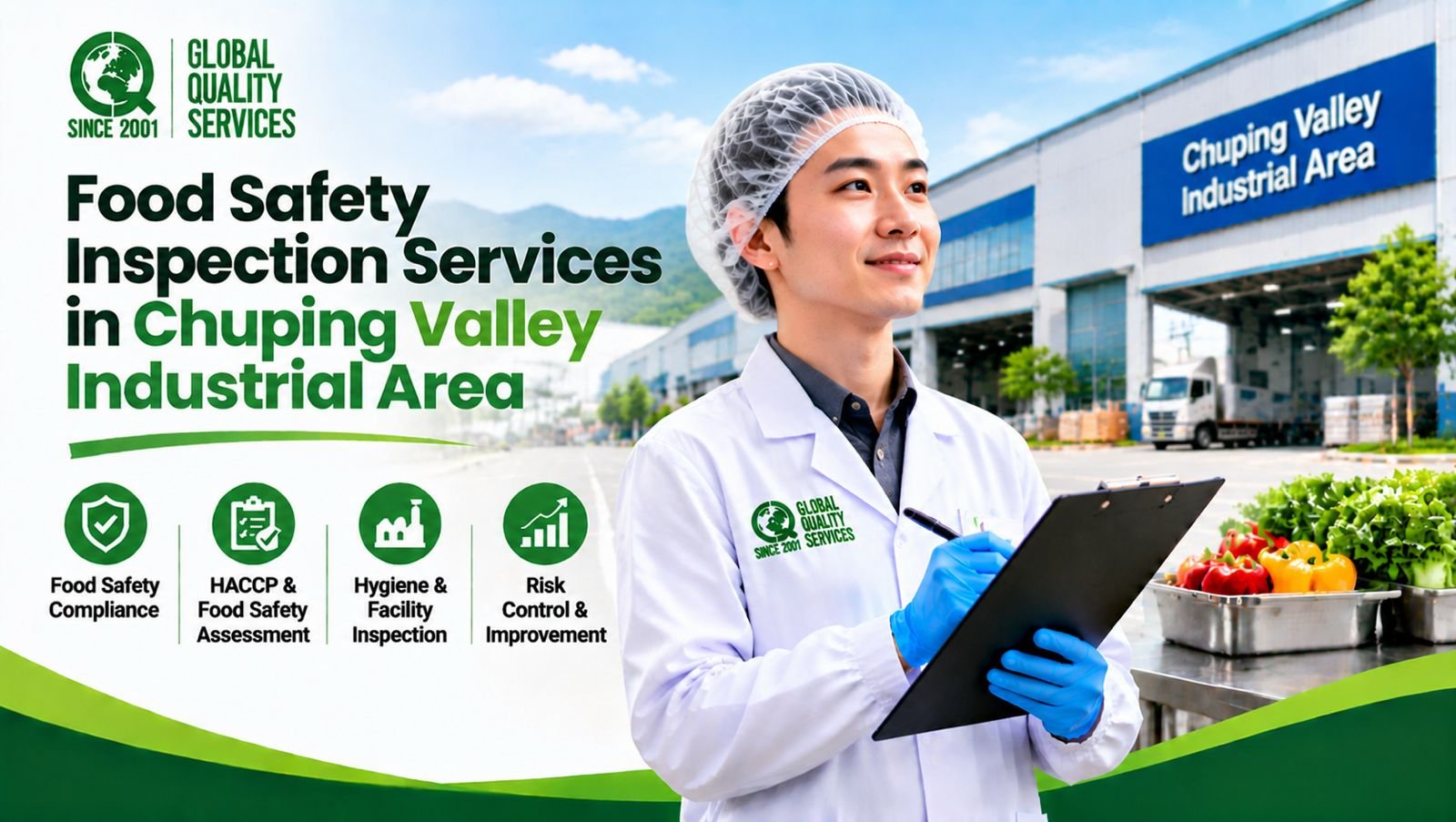
Global Quality Services (GQS) provides Food Safety Inspection Services in Chuping Valley Industrial Area for businesses seeking independent assessments of food handling practices, processing environments, sanitation controls, storage conditions and documented food safety procedures. Our inspections examine operational conditions and identify potential gaps that may affect food safety, product integrity and regulatory compliance.
Why Is Food Safety Inspection Important in Chuping Valley Industrial Area?
CVIA is positioned as a major industrial development with dedicated focus clusters covering green manufacturing, halal industries, renewable energy generation and electric vehicles. Its location near Padang Besar also connects the development with regional trade routes serving Malaysia, Thailand and wider Southeast Asian markets.
For businesses involved in food-related manufacturing and supply chains, these developments create a need for reliable hygiene management and contamination prevention throughout production and distribution activities.
Food safety risks can arise from several operational sources. Poorly maintained processing equipment, inadequate cleaning schedules, improper temperature management, pest activity and uncontrolled movement between raw and finished product areas can compromise product safety.
Malaysia’s Ministry of Health reported that 94,117 food premises were inspected in 2024. Of these, 88,821 premises, representing approximately 94%, achieved cleanliness assessment scores above 75%. A further 1,950 premises were ordered to close under Section 11 of the Food Act 1983 for failing to meet established cleanliness standards.
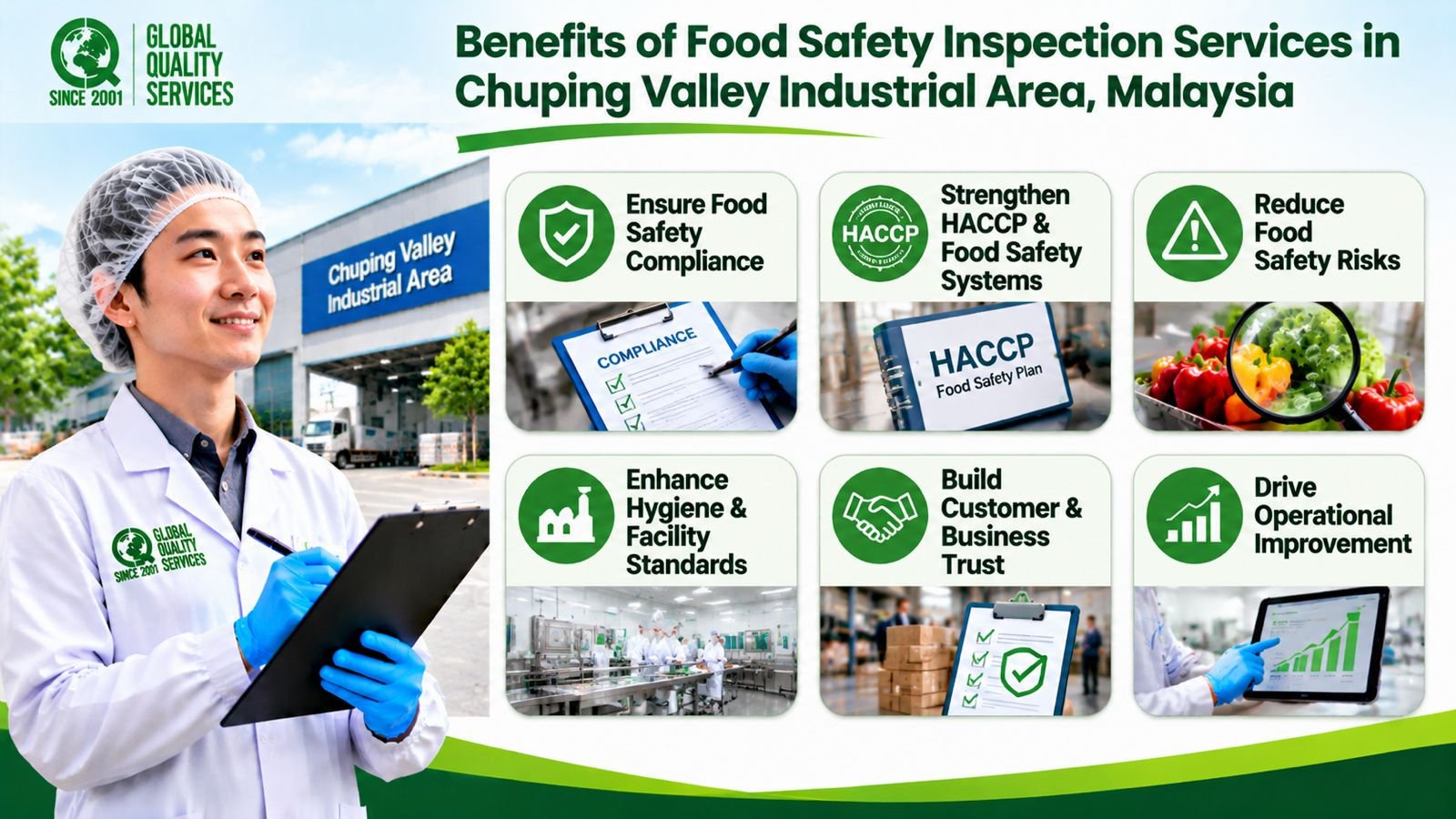
These figures demonstrate the importance of maintaining consistent hygiene conditions rather than relying solely on occasional internal checks. For businesses in Chuping Valley, independent food safety inspections provide an opportunity to evaluate whether established procedures are followed in actual operating conditions.
Our Food Safety Inspection Services in Chuping Valley Industrial Area
Global Quality Services conducts food safety inspections covering important operational areas within food manufacturing, processing, packaging and storage facilities. The inspection scope can be defined according to the facility’s activities, product categories and identified operational risks.
Food Processing and Manufacturing Inspection
Food processing environments require controlled production conditions to prevent contamination and maintain product integrity. Our inspections examine processing equipment, production surfaces, material handling arrangements and the separation of different production activities.
Particular attention is given to the movement of raw materials, work-in-progress products and finished goods. Inspectors examine whether production layouts and operating practices reduce opportunities for cross-contamination.
Food Hygiene and Sanitation Inspection
Cleaning and sanitation procedures are essential for controlling biological, chemical and physical contamination risks. Our inspections examine the condition of production areas, floors, walls, drainage systems, food-contact surfaces and cleaning equipment.
The assessment also considers cleaning schedules, sanitation records, chemical storage arrangements and the availability of documented cleaning procedures. Areas that may harbour food residues, moisture or microbial contamination are examined according to the agreed inspection scope.
Raw Material and Ingredient Handling Inspection
The quality and condition of incoming materials influence the safety of finished food products. Inspections examine receiving areas, ingredient identification, packaging integrity, storage conditions and material segregation.
Where applicable, inspectors review supplier documentation, incoming material records, batch identification and traceability arrangements. Particular attention is given to damaged packaging, expired ingredients, unsuitable storage conditions and the potential mixing of incompatible materials.
Food Storage and Temperature Control Inspection
Temperature management is particularly important for facilities handling chilled, frozen and temperature-sensitive food products.
Our inspections examine cold rooms, refrigeration equipment, freezers, storage racks and temperature-monitoring arrangements. Inspectors review available temperature records, equipment condition and practices used to prevent temperature deviations during storage and handling.
The assessment can also cover stock rotation, product identification, expiry-date controls and separation of raw and ready-to-eat products.
Food Packaging and Labelling Inspection
Packaging operations must protect food products from contamination while maintaining product identification and traceability.
The inspection covers packaging materials, filling and sealing equipment, packaging-area hygiene and finished-product handling. Where included in the agreed scope, label checks examine product identification, ingredient declarations, allergen information, date marking and storage instructions against applicable requirements.
Pest Control and Waste Management Inspection
Pest activity and unmanaged waste can introduce contamination into food production environments. Our inspectors examine pest-control arrangements, monitoring records, waste segregation practices and the condition of waste collection areas.
The inspection also considers potential pest-entry points, standing water, poorly maintained drainage and waste accumulation near production or storage areas.
Food Safety Standards and Regulatory Requirements Relevant to Malaysian Facilities
Food safety inspections in Chuping Valley should consider the regulatory requirements and food safety frameworks relevant to the facility’s activities. The applicable requirements depend on the type of food operation, products handled and intended markets.
Food Act 1983: Malaysia’s Food Act 1983 establishes the principal legal framework for controlling food safety and quality. It addresses requirements relating to food preparation, handling, storage, sale and the prevention of unsafe or unsuitable food products entering the market.
Food Hygiene Regulations 2009: These regulations establish hygiene requirements for food premises, owners and food handlers. They cover important operational areas, including food preparation, handling, storage, packaging and transportation.
Food Regulations 1985: These regulations establish specific requirements relating to food standards, ingredients, additives and product labelling. Their relevance is particularly important for manufacturers responsible for product formulation and packaging information.
MS 1480 – Food Safety According to HACCP System: This Malaysian Standard provides a framework for applying Hazard Analysis and Critical Control Point principles. It addresses the identification of food safety hazards, determination of critical control points, monitoring and corrective actions.
MS 1514 – Good Manufacturing Practice: This standard addresses good manufacturing practices for food production facilities. Its principles include hygiene, facility conditions, equipment maintenance, process controls and contamination prevention.
ISO 22000 – Food Safety Management Systems: ISO 22000 provides an internationally recognised framework for managing food safety hazards throughout the food chain. It combines management-system requirements with prerequisite programmes and HACCP-based operational controls.
An independent inspection can examine relevant operational practices and available evidence against agreed criteria. However, an inspection does not itself constitute HACCP, GMP or ISO 22000 certification, nor does it replace statutory inspections conducted by Malaysian authorities.
What Do Our Inspectors Examine During a Food Safety Inspection?
The inspection covers physical operating conditions as well as the documented controls used to manage food safety risks.
For a food manufacturing or processing facility, the assessment may include:
- Facility hygiene: Condition of production floors, walls, ceilings, drains and food-contact surfaces.
- Equipment condition: Cleanliness, maintenance, suitability and condition of processing machinery.
- Personnel hygiene: Handwashing arrangements, protective clothing and hygiene practices.
- Process controls: Handling practices, production flow and measures to prevent cross-contamination.
- Temperature management: Refrigeration performance, monitoring records and storage conditions.
- Ingredient traceability: Identification, batch records, supplier information and incoming material checks.
- Pest management: Monitoring arrangements, pest-entry risks and treatment records.
- Waste handling: Waste segregation, collection arrangements and disposal practices.
- Documentation: Cleaning schedules, inspection records, corrective action reports and relevant operating procedures.
The final inspection scope depends on the facility’s activities and the requirements agreed before the inspection.
How Does the Food Safety Inspection Process Work?
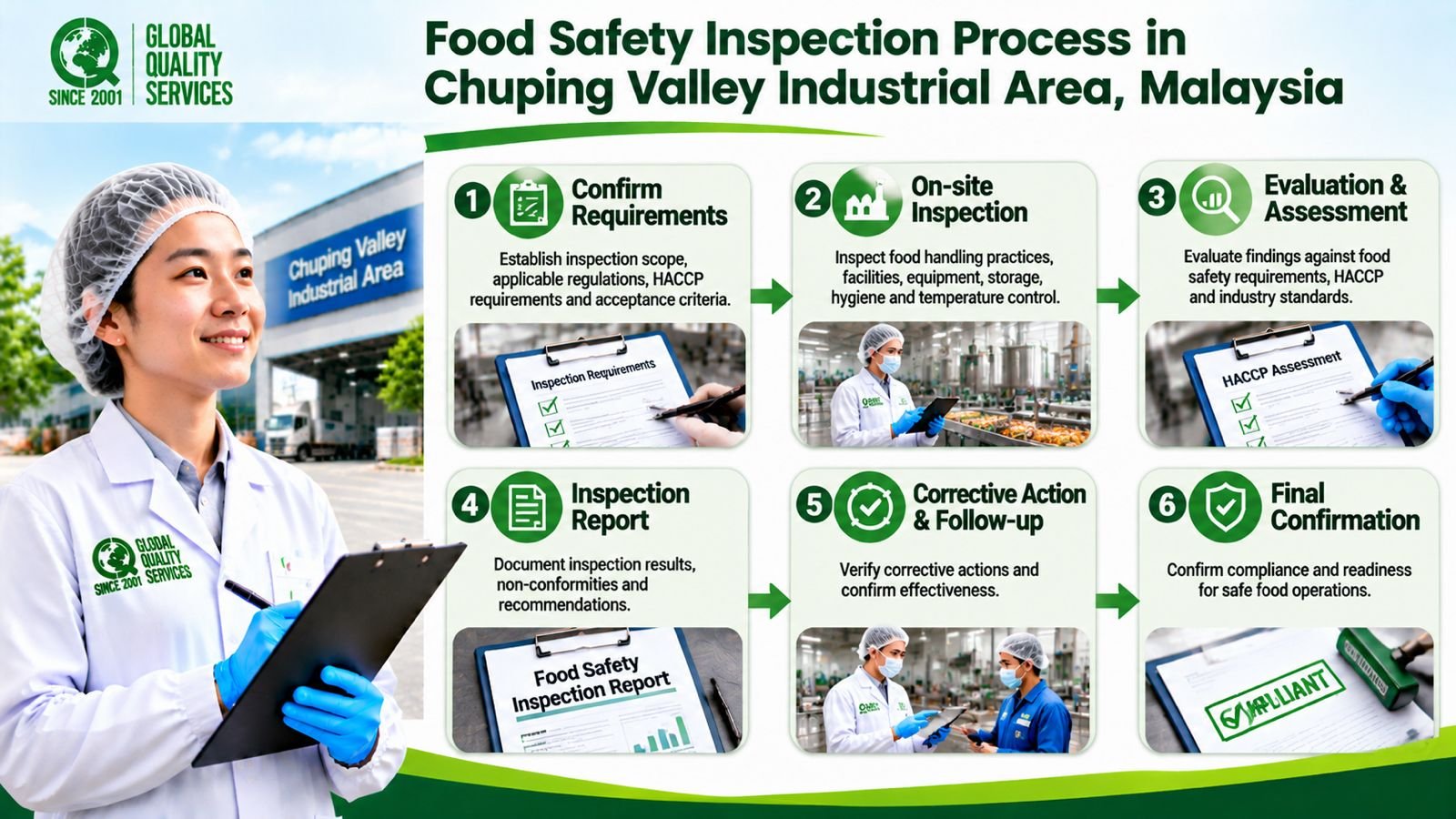
Global Quality Services follows a structured inspection approach to maintain consistency, objectivity and traceability throughout the assessment.
1. Inspection Scope and Facility Information
The process begins with identifying the facility’s activities, food product categories, production processes and areas requiring inspection. Relevant requirements and inspection criteria are established before the site visit.
2. On-Site Inspection
Inspectors examine the facility’s physical conditions, production practices, hygiene arrangements, equipment and storage operations. Observations are recorded against the agreed inspection criteria.
3. Documentation and Record Review
Available food safety records are examined to establish whether documented procedures reflect actual operating practices. This may include sanitation records, temperature logs, pest-control reports, supplier records and traceability documentation.
4. Findings and Nonconformity Identification
Observed conditions are documented with relevant evidence. Where inspection criteria are not met, findings are recorded with details of the affected areas, processes or procedures.
5. Inspection Report
GQS prepares an inspection report presenting the inspection scope, observations, supporting evidence and identified gaps. The report provides the facility with a structured record of the conditions observed during the inspection.
Who Can Benefit from Food Safety Inspection Services in Chuping Valley?
Food safety inspections are relevant to businesses whose operations involve food products, ingredients, processing environments or associated storage and packaging activities.
In and around Chuping Valley Industrial Area, the service may be relevant to:
- Food and beverage manufacturing facilities.
- Agricultural and food-processing businesses.
- Halal food production and handling facilities.
- Food ingredient and raw material suppliers.
- Food packaging and processing operations.
- Cold storage and temperature-controlled warehouses.
- Food distribution and logistics facilities.
- Contract manufacturing and private-label food producers.
Facilities involved in green manufacturing and halal-related supply chains may also require inspections of material segregation, production hygiene and traceability arrangements where these activities fall within their operations.
Why Choose Global Quality Services for Food Safety Inspection?
Global Quality Services provides independent third-party inspection services focused on objective observations, documented findings and defined inspection criteria.
Our approach considers the actual operating environment rather than relying exclusively on written procedures. This allows inspection reports to reflect observed facility conditions, equipment status, hygiene practices and available food safety records.
For businesses in Chuping Valley, inspection activities can be planned around the facility’s production layout, product handling requirements and operational risks. The inspection scope is established before the assessment to ensure that relevant areas are covered.
GQS focuses on maintaining impartiality throughout third-party inspection assignments. Findings are documented objectively, without treating the inspection as a certification or implementation activity.
Food safety controls require regular attention as production activities, equipment, suppliers and product handling arrangements change. For businesses operating in Chuping Valley Industrial Area, independent inspection provides a documented assessment of facility hygiene, processing conditions, storage practices and food safety controls.
Global Quality Services offers Food Safety Inspection Services in Chuping Valley, Perlis, Malaysia, with inspection scopes based on the nature of the operation and applicable requirements.
Frequently Asked Questions
1. What is covered under Food Safety Inspection Services in Chuping Valley Industrial Area?
The inspection can cover food processing conditions, facility hygiene, equipment cleanliness, raw material handling, temperature controls, packaging practices, pest management, waste disposal and food safety documentation. The final scope depends on the facility’s activities and agreed inspection criteria.
2. Which food safety regulations are relevant to businesses in Chuping Valley?
Relevant Malaysian requirements include the Food Act 1983, Food Regulations 1985 and Food Hygiene Regulations 2009. Facilities may also use frameworks such as HACCP, MS 1480, MS 1514 and ISO 22000, depending on their operations and food safety management requirements.
3. Can food manufacturing and halal production facilities undergo food safety inspections?
Yes. Food manufacturing and halal production facilities can undergo independent inspections covering hygiene, ingredient handling, production controls, material segregation and traceability. Halal certification requirements are separate and are not replaced by a food safety inspection.
4. Does a food safety inspection provide HACCP or ISO 22000 certification?
No. A third-party food safety inspection provides an assessment against defined inspection criteria and documents the findings. HACCP and ISO 22000 certification involve separate assessment and certification processes conducted by appropriately recognised certification bodies.
5. Does Global Quality Services provide food safety inspection services outside Chuping Valley?
Yes. Inspection requirements can also be discussed for food manufacturing, processing, storage and packaging facilities in other industrial and commercial locations across Malaysia, subject to the agreed service scope and project arrangements.