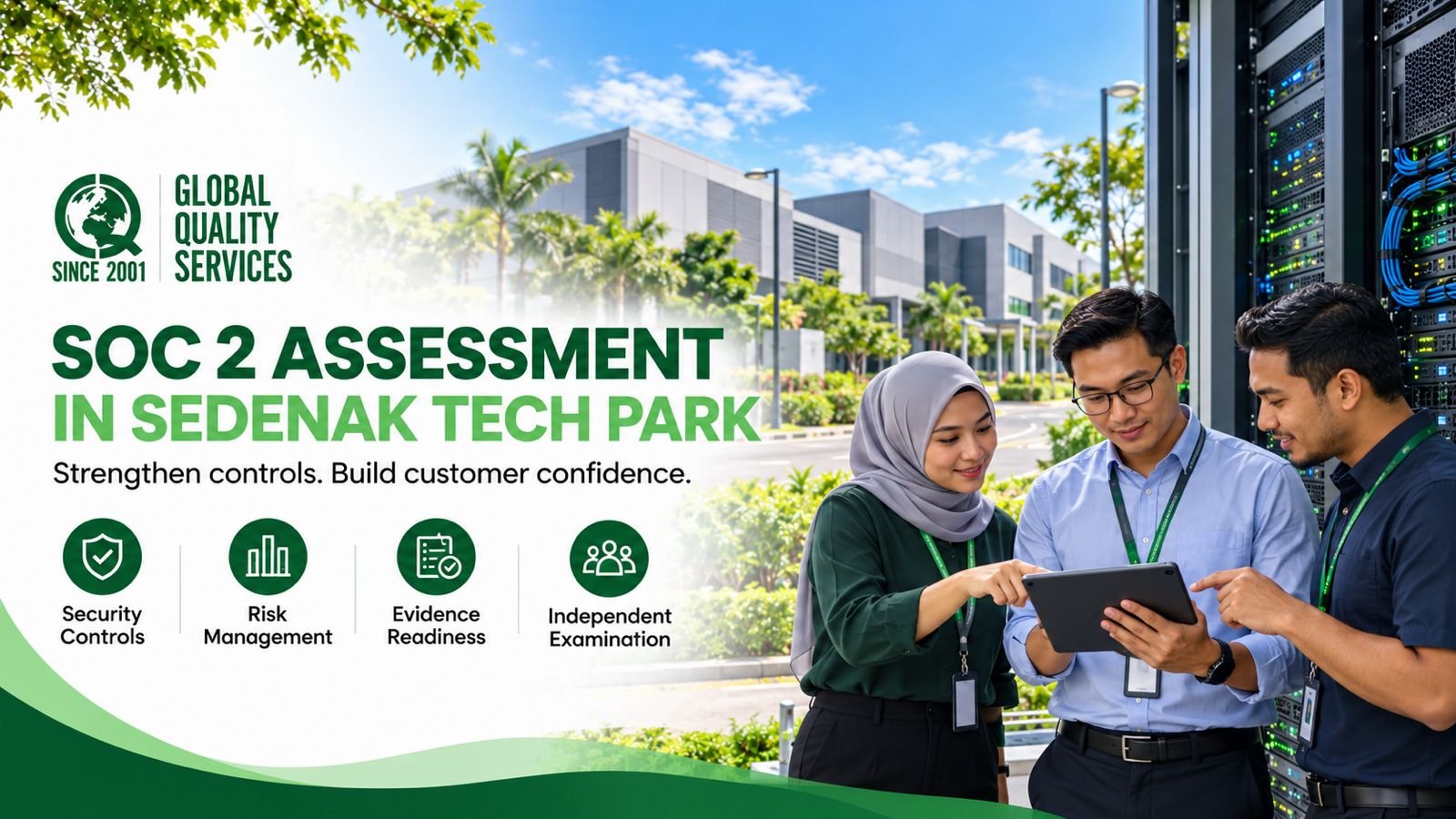
Businesses that operate data centers, cloud platforms, and digital infrastructure services must show that their systems and information security controls meet customer expectations. For organizations in Sedenak Tech Park (STeP), Malaysia, a SOC 2 report can provide customers and business partners with independent assurance that security and other relevant controls are designed and operated effectively.
Located within Ibrahim Technopolis (IBTEC) in Johor, Sedenak Tech Park is being developed as a large-scale data center hub with infrastructure designed to support digital businesses. As data center capacity, cloud services, and connected technology operations expand, enterprise customers may scrutinize service providers more closely for data protection, system availability, access controls, and operational resilience.
Global Quality Services (GQS) provides SOC 2 readiness support to help organizations assess their existing controls, identify documentation gaps, and prepare for an independent examination. Our approach focuses on the organization’s systems, services, and customer requirements rather than applying a generic compliance checklist.
Why Sedenak Tech Park Is Becoming an Important Data Center Hub in Malaysia
Sedenak Tech Park is designed to accommodate large-scale data center developments and digital infrastructure operations. Its infrastructure and connectivity make it relevant for organizations building and operating technology services for regional and international markets.
Key factors shaping the local business environment include:
- Data Center Development: Sedenak Tech Park is planned as a dedicated data center hub, creating opportunities for operators providing colocation, hosting, and infrastructure services.
- Cloud and Digital Infrastructure: Growing demand for cloud computing and online business systems increases the importance of documented security controls and reliable service delivery.
- Connectivity and Regional Access: Its location in Johor provides access to regional business networks and connectivity routes serving customers across Southeast Asia.
- Enterprise Customer Expectations: Organizations supplying technology services to large businesses may need to demonstrate how they manage access, protect confidential information, and monitor security risks.
- Scalable Technology Operations: Large infrastructure environments require coordinated procedures for change management, incident handling, system monitoring, and business continuity.
For businesses serving customers with formal vendor security requirements, SOC 2 readiness can help them clearly understand their control environment and identify areas for improvement.
Which Businesses in Sedenak Tech Park Should Consider SOC 2 Assessment?
SOC 2 is particularly relevant to service organizations whose customers depend on their systems to process, store, transmit, or protect information. Businesses in Sedenak Tech Park may consider readiness assessment when responding to enterprise procurement requirements or expanding their technology services into new markets.
Data Center and Colocation Operators
Organizations that provide data center space, infrastructure management, and colocation services may need to show how they control logical access, manage operational risks, monitor systems, and protect customer information within the agreed service scope.
Cloud Computing and Hosting Providers
Cloud platforms and hosting companies can use SOC 2 reporting to provide customers with independent information about controls governing infrastructure security, service availability, and data confidentiality.
Managed IT and Infrastructure Service Providers
Companies managing customer networks, servers, cloud environments, or outsourced IT operations may need documented procedures for privileged access, incident response, change management, and third-party services.
Software and SaaS Companies
Software providers that store customer information or deliver business-critical applications may pursue SOC 2 readiness to respond to vendor security questionnaires and meet contractual expectations.
Data Processing and Technology Service Companies
Organizations handling business records, analytics data, or customer transactions may need to demonstrate that their systems operate according to defined security and processing controls.
Businesses Supporting International Customers
Companies entering contracts with overseas enterprises may encounter SOC 2 report requests during supplier assessments. Preparing for an examination can help them understand the evidence and control requirements involved.
What Does a SOC 2 Assessment Cover?
SOC 2 examinations evaluate controls against the relevant AICPA Trust Services Criteria. The categories included in an examination depend on the organization’s services, systems, risks, and reporting objectives.
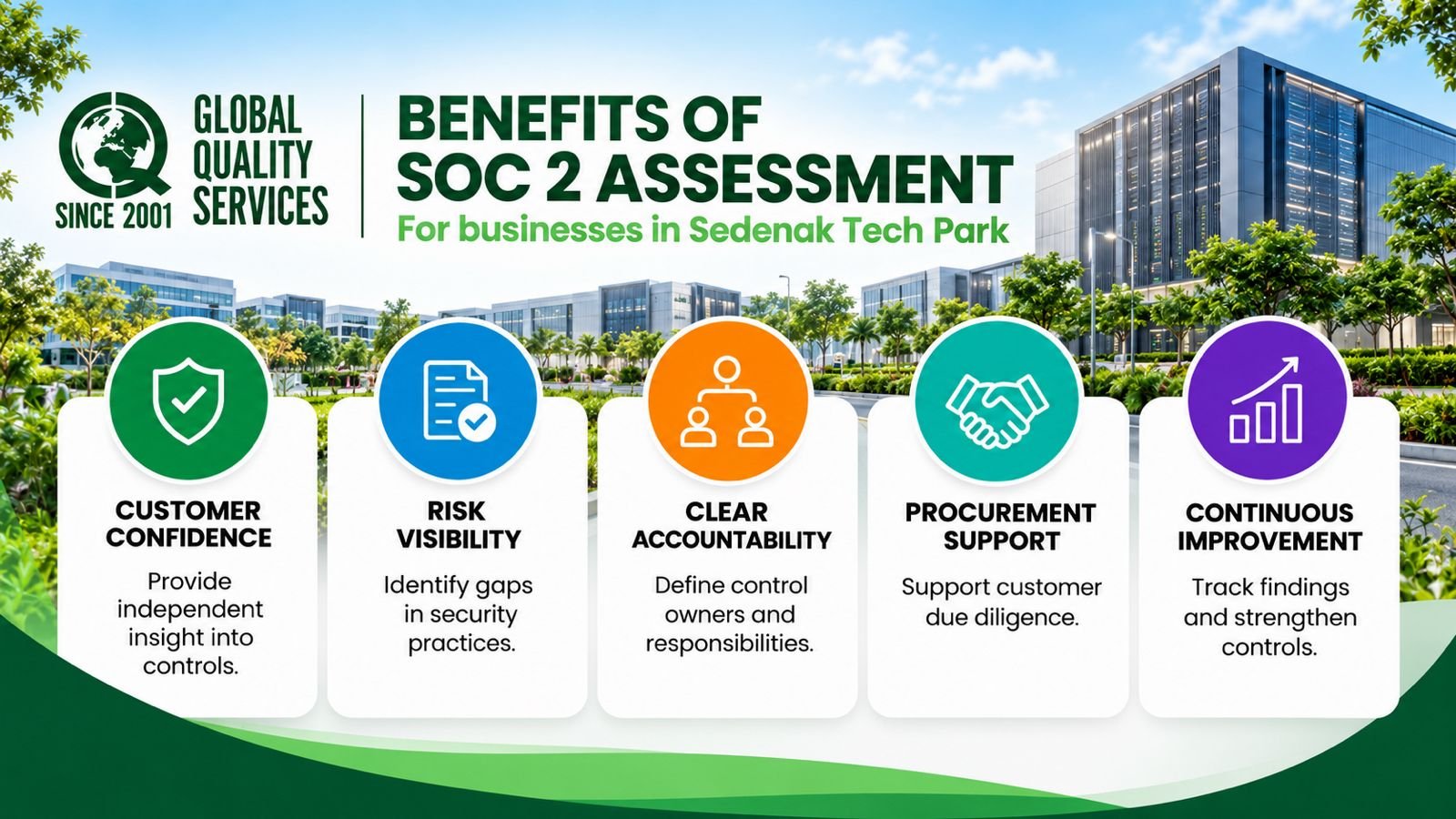
The five Trust Services Criteria categories are:
- Security: Controls designed to protect systems and information against unauthorized access and other security threats.
- Availability: Controls addressing whether systems and services remain available according to defined operational commitments.
- Processing Integrity: Controls concerning whether system processing is complete, valid, accurate, timely, and authorized.
- Confidentiality: Controls intended to protect information designated as confidential.
- Privacy: Controls concerning the collection, use, retention, disclosure, and disposal of personal information.
Security is the core category, while the other categories are included when relevant to the organization’s commitments and the scope of its examination.
SOC 2 reporting also has two main types:
- SOC 2 Type I: Examines the design of relevant controls at a specified point in time.
- SOC 2 Type II: Examines control design and the operating effectiveness of controls over a defined period.
The appropriate report depends on customer requirements, the maturity of the control environment, and the organization’s readiness to provide evidence.
Our SOC 2 Assessment and Readiness Process for Sedenak Tech Park Businesses
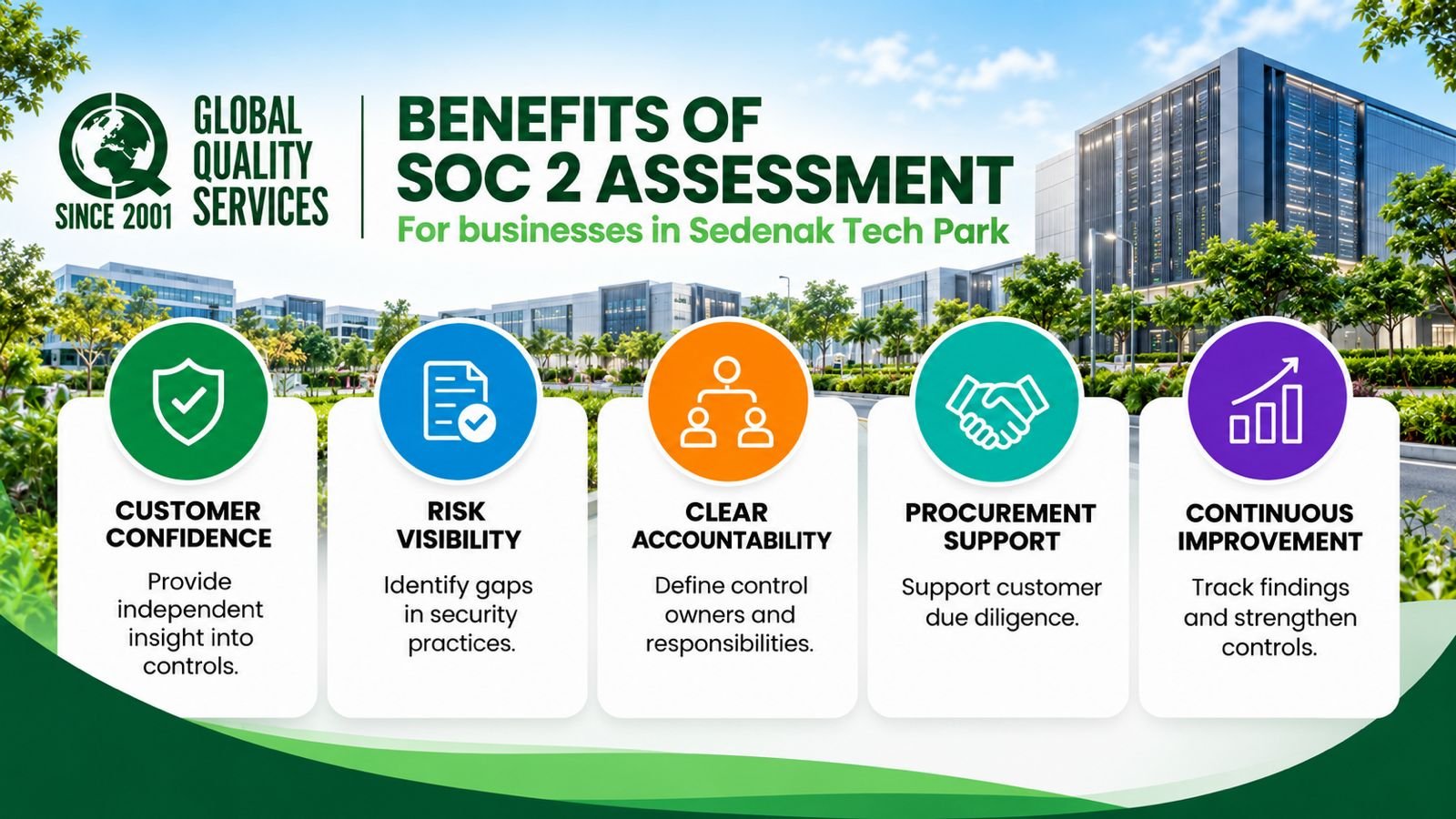
Preparing for SOC 2 requires an understanding of the systems being examined, the risks associated with the services provided, and the controls needed to address those risks. GQS can support organizations through a structured readiness process.
Step 1: Define the Scope and Review Existing Controls
The process begins by identifying the services, systems, infrastructure, and business processes proposed for inclusion in the SOC 2 examination. We review the existing control environment to identify potential gaps against the selected Trust Services Criteria.
Step 2: Assess Security Policies and Documentation
We review relevant policies, procedures, and supporting records to identify missing documentation or inconsistencies. Depending on the organization’s scope, this may include access management, incident response, change management, risk assessment, and business continuity documentation.
Step 3: Identify Control Gaps and Improvement Priorities
The readiness review identifies areas where existing controls may not adequately address the organization’s stated requirements. Findings can be prioritized according to their potential impact, the systems involved, and the evidence needed to demonstrate that controls are functioning as intended.
Step 4: Review Evidence and Control Records
SOC 2 examinations rely on evidence, not simply written policies. Relevant records may include access reviews, system logs, incident tickets, change approvals, risk assessments, and monitoring reports. We help organizations identify the evidence they may need to prepare for the independent examination.
Step 5: Prepare for the Independent SOC 2 Examination
Before engaging the independent service auditor, the organization should review outstanding readiness findings, confirm the proposed scope, and ensure that relevant controls and supporting records are available. The service auditor conducts the examination and issues the SOC 2 report.
Common SOC 2 Readiness Challenges for Sedenak Tech Park Businesses
Data center and technology service providers may operate complex environments involving infrastructure teams, cloud platforms, customer systems, and external vendors. These arrangements can make it difficult to establish consistent controls across the entire service environment.
Common challenges include:
- Unclear Examination Scope: Organizations may struggle to determine which systems, services, locations, and supporting processes belong within the proposed examination.
- Inconsistent Access Controls: Privileged accounts, administrator permissions, and periodic access reviews may not be managed consistently across teams and platforms.
- Incomplete Evidence: Security policies may exist, but organizations may lack sufficient records to demonstrate that the procedures operate consistently.
- Change Management Gaps: Infrastructure and software changes may not always have documented approvals, testing records, or evidence of review.
- Third-Party Dependencies: Cloud providers, infrastructure partners, and other service organizations may introduce risks that require appropriate oversight.
- Business Continuity and Availability: Organizations may need clearer evidence of backup arrangements, recovery procedures, incident handling, and continuity testing.
- Preparation for Type II Reporting: Businesses seeking a Type II report must be prepared to demonstrate control operation throughout the period covered by the examination.
Identifying these issues before the examination can help organizations prioritize improvements and reduce avoidable delays during the readiness process.
Factors That Influence SOC 2 Assessment and Readiness Costs in Sedenak Tech Park
SOC 2 readiness costs vary according to the organization’s operating environment and the amount of preparation required. A business with established security policies and reliable control records may need a different level of work from an organization building its control framework for the first time.
Important cost factors include:
- Scope of Services: The number of systems, applications, business processes, and locations included in the proposed examination.
- Infrastructure Complexity: The complexity of data center operations, cloud environments, network architecture, and supporting technology.
- Existing Control Maturity: The condition of current policies, procedures, security controls, and evidence records.
- Selected Trust Services Criteria: The categories relevant to the organization’s services and customer commitments.
- Type I or Type II Reporting: The selected report type and the preparation needed to demonstrate control design or operating effectiveness.
- Remediation Requirements: The time and resources needed to address gaps in access management, monitoring, documentation, or other controls.
- Independent Auditor Fees: The service auditor’s fees depend on the scope, complexity, and nature of the examination.
A reliable estimate should be based on an initial review of the proposed scope and the organization’s current level of readiness. Readiness support fees and independent service auditor fees should be considered separately.
How Does Global Quality Services Support SOC 2 Assessment in Sedenak Tech Park?
Global Quality Services provides readiness-oriented support for organizations preparing for SOC 2 examinations. Our work focuses on helping businesses understand their control gaps, review relevant documentation, and organize the information required for an independent examination.
SOC 2 Gap Assessment
We review the proposed scope and existing controls to identify areas that may require attention before the independent examination begins.
Security Documentation Review
We assess relevant policies and procedures to identify missing information, unclear responsibilities, or inconsistencies between documented practices and actual operations.
Control Improvement Planning
We help organizations prioritize identified gaps and develop a practical plan for addressing issues relevant to their selected Trust Services Criteria.
Evidence Preparation
We help teams identify relevant records and organize supporting evidence for review. This may include access reviews, change records, incident documentation, risk assessments, and monitoring reports, depending on the agreed scope.
Type I and Type II Readiness
We explain the preparation considerations associated with the selected report type so that organizations can plan the necessary documentation, control implementation, and evidence collection.
Examination Preparation
We help organizations review outstanding readiness actions and prepare the relevant documentation for the independent service auditor. The auditor remains responsible for conducting the examination and issuing the report.
In addition to SOC 2 readiness, organizations may also need to consider information security and privacy frameworks relevant to their operations, such as ISO/IEC 27001, ISO/IEC 27701, and Malaysia’s Personal Data Protection Act (PDPA). These address different requirements and should be evaluated according to the organization’s services, contractual obligations, and applicable legal responsibilities.
Prepare Your Business for SOC 2 Assessment in Sedenak Tech Park
As Sedenak Tech Park develops its role in Malaysia’s data center and digital infrastructure sector, technology service providers may encounter increasing customer expectations around security, confidentiality, and operational reliability. A structured SOC 2 readiness assessment can help organizations identify control gaps, organize supporting evidence, and prepare for an independent examination.
Global Quality Services can support your organization with readiness reviews, documentation assessments, and control gap identification based on your proposed SOC 2 scope.
Contact Global Quality Services to discuss your SOC 2 readiness requirements in Sedenak Tech Park, Malaysia.
Frequently Asked Questions
1. Is SOC 2 mandatory for businesses operating in Sedenak Tech Park?
SOC 2 is not a universal legal requirement for businesses operating in Sedenak Tech Park. However, enterprise customers, technology partners, or procurement teams may request a SOC 2 report before entering into or renewing a business relationship.
2. What is the difference between SOC 2 Type I and Type II?
A Type I report examines the design of relevant controls at a specific point in time. A Type II report examines both control design and operating effectiveness over a defined period. The appropriate option depends on customer expectations and the organization’s readiness.
3. How long does it take to prepare for a SOC 2 examination?
The preparation period depends on the organization’s scope, existing controls, documentation, and outstanding improvement actions. Businesses with established security processes may require less preparation than those developing their controls and evidence from the beginning.
4. What documents are needed for SOC 2 readiness?
Depending on the scope, relevant records may include information security policies, risk assessments, access reviews, incident response procedures, change management records, vendor assessments, business continuity plans, and system monitoring evidence.
5. Does SOC 2 readiness ensure compliance with Malaysia’s PDPA?
No. SOC 2 readiness does not automatically establish compliance with Malaysia’s Personal Data Protection Act. Organizations must assess their applicable legal obligations separately. SOC 2 privacy-related controls may be relevant to that work, but the examination has a different purpose and scope.
6. Can GQS issue a SOC 2 certificate or report?
No. SOC 2 is an independent examination that results in a report rather than a certification. GQS’s role on this page is readiness support. The independent service auditor conducts the examination and issues the report.
7. How much does SOC 2 readiness cost in Sedenak Tech Park?
The cost depends on the examination scope, infrastructure complexity, selected Trust Services Criteria, existing control maturity, and the level of improvement required. A scope review can help establish the likely readiness work and distinguish it from independent auditor fees.