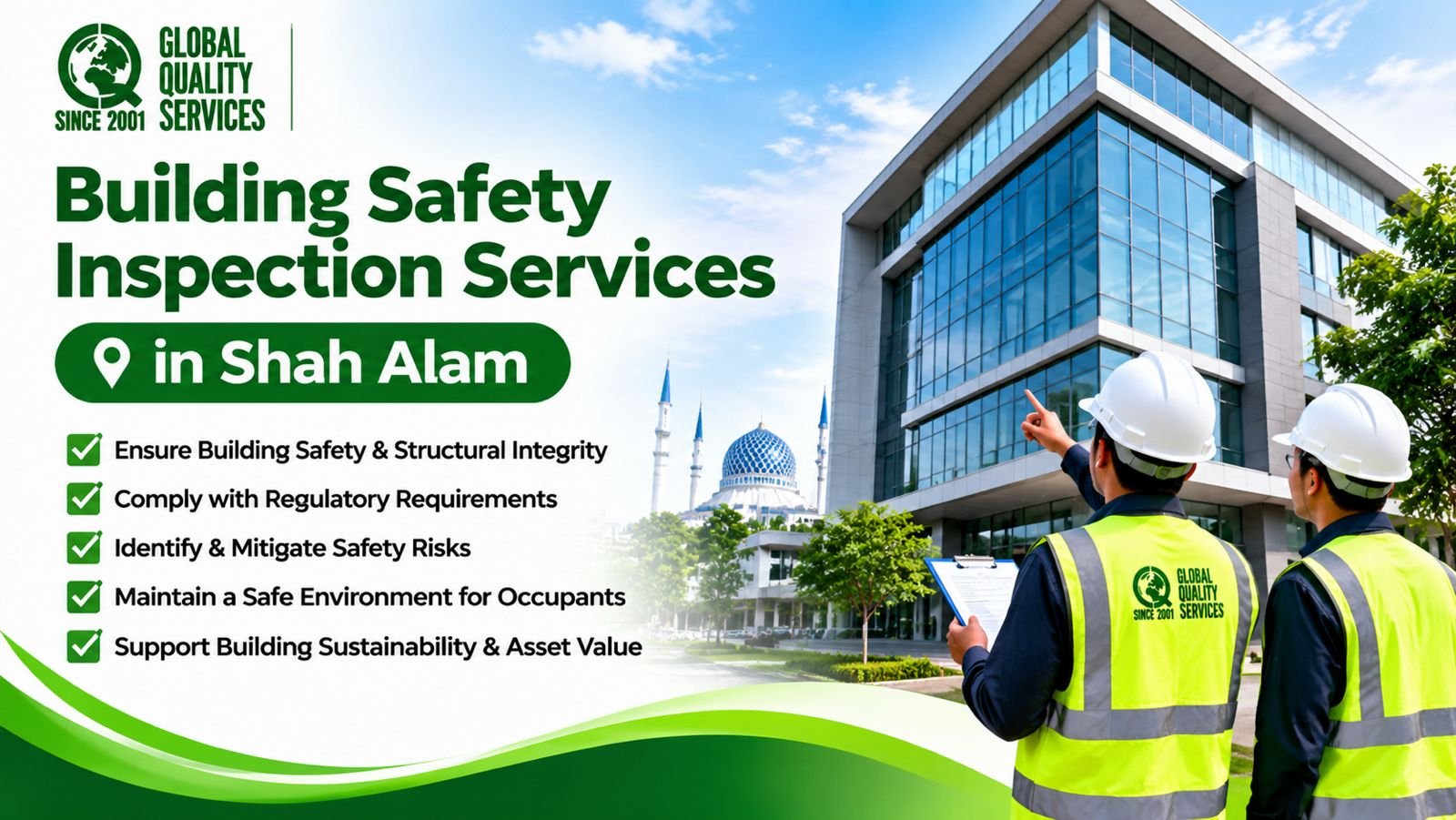
Shah Alam is an important commercial, industrial, and administrative center in Selangor. The city accommodates manufacturing facilities, corporate offices, shopping centers, warehouses, residential developments, educational institutions, and public buildings. With a growing number of occupied and aging properties, regular building inspections are essential for identifying defects and maintaining safe building conditions.
Building Safety Inspection Services in Shah Alam, Malaysia help property owners, facility managers, building management corporations, and businesses evaluate the physical condition of their properties. These inspections identify visible defects, potential safety concerns, and maintenance issues that may affect building performance and occupant safety.
Global Quality Services provides third-party building safety inspection services for commercial, industrial, and residential properties in Shah Alam and surrounding areas.
What Are Building Safety Inspection Services?
Building safety inspections involve examining a property’s physical condition and identifying defects or hazards that may affect its structural integrity, functionality, and safe use. The inspection may cover structural components, building exteriors, roofs, stairways, common areas, access routes, and visible building services, depending on the agreed scope. A structured inspection helps property owners understand the condition of their buildings, prioritize maintenance activities, and determine whether further technical investigations are necessary.
Why Are Building Safety Inspections Important in Shah Alam?
Buildings in Shah Alam experience regular use, weather exposure, and ongoing operational demands. Water penetration, concrete deterioration, corrosion, damaged finishes, and poorly maintained building components can develop over time.
Regular inspections provide several benefits:
- Early defect identification: Detect visible cracks, leaks, corrosion, and deterioration before they become more serious.
- Occupant safety: Identify conditions that may create risks for employees, residents, visitors, and contractors.
- Structural condition monitoring: Examine visible structural components for signs of distress or damage.
- Maintenance planning: Establish priorities for repairs and preventive maintenance.
- Property protection: Reduce the risk of further deterioration caused by unresolved building defects.
- Operational continuity: Identify building conditions that could disrupt business or facility operations.
Benefits of Building Safety Inspection Services in Shah Alam
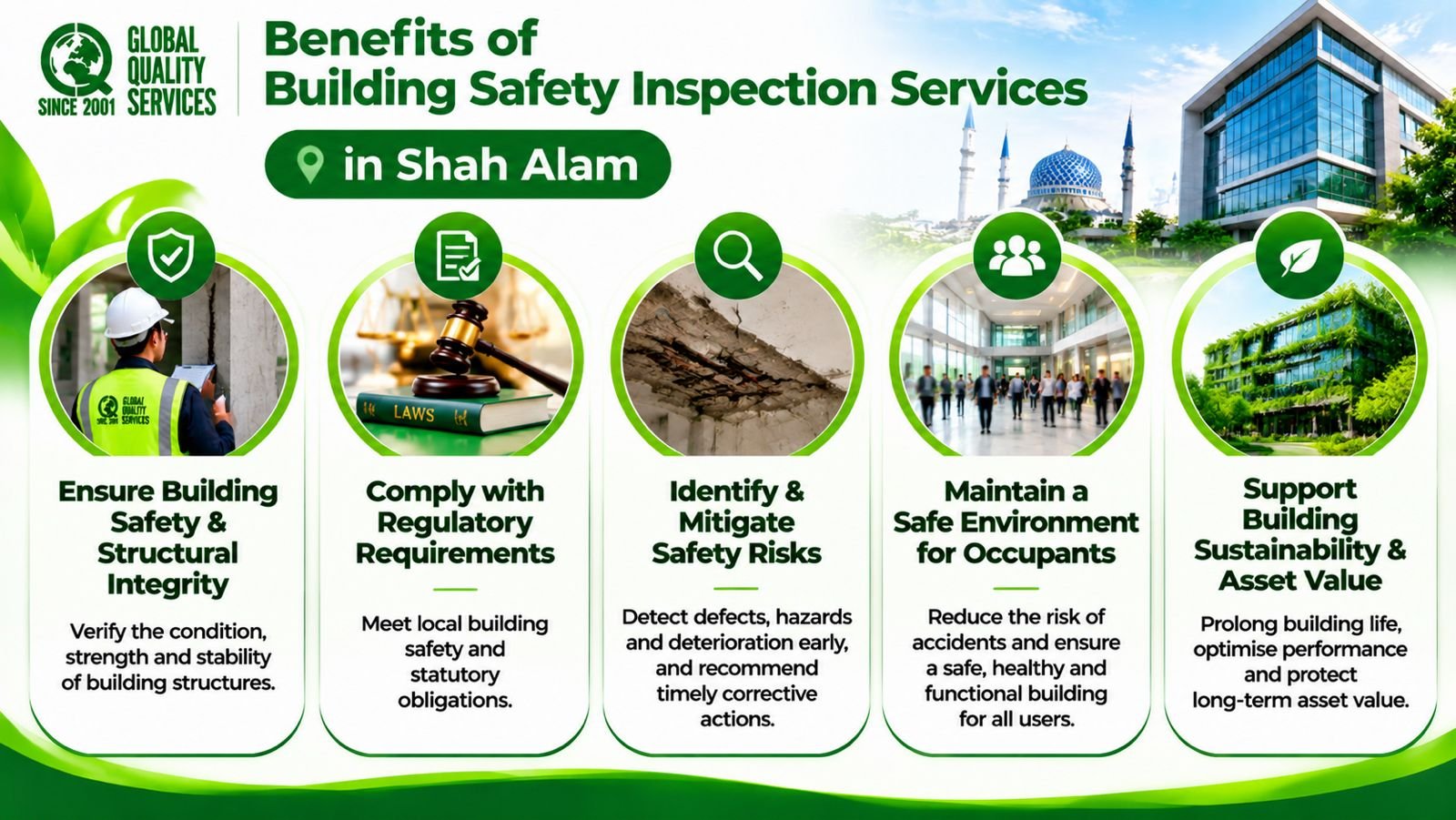
Regular building safety inspections help property owners and facility managers understand the condition of their properties and address potential risks before they become more serious.
Early Identification of Building Defects
Inspections help identify visible cracks, water leakage, concrete deterioration, corrosion, damaged finishes, and other building defects. Early identification allows property owners to investigate problems and plan corrective measures.
Improved Occupant and Visitor Safety
Checking accessible stairways, corridors, balconies, handrails, walkways, and common areas helps identify conditions that could cause accidents or injuries. Addressing these concerns supports safer environments for occupants, employees, and visitors.
Better Maintenance Planning
A detailed inspection report provides information about the location and condition of identified defects. Property managers can use these findings to prioritize repairs, schedule maintenance activities, and allocate resources more effectively.
Protection of Property Value
Unaddressed building defects can lead to further deterioration and expensive repairs. Regular inspections help owners monitor building conditions and make informed decisions about property maintenance and preservation.
Support for Regulatory Responsibilities
Inspection records help property owners maintain documentation of building conditions and maintenance activities. Where statutory inspections apply, owners can also use the findings to identify areas requiring further evaluation by appropriately qualified professionals.
Reduced Operational Disruptions
Identifying maintenance concerns in advance helps businesses plan repair work and manage potential interruptions to daily operations. This is particularly important for offices, manufacturing facilities, warehouses, and commercial properties.
Our Building Safety Inspection Process
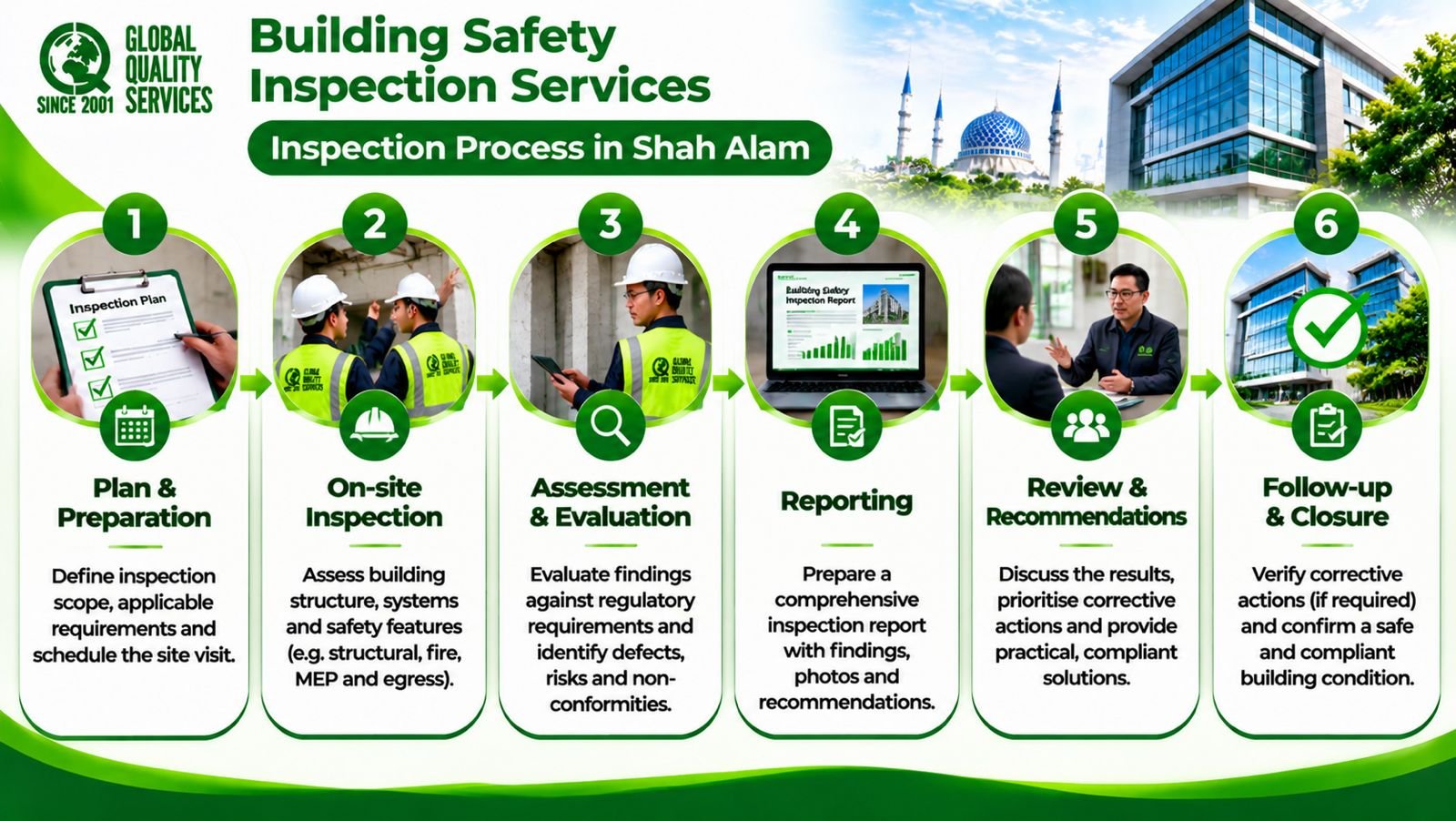
Global Quality Services follows a structured inspection approach to document building conditions, identify visible defects, and prepare clear inspection findings.
1. Initial Consultation and Scope Definition
The process begins with understanding the building type, location, age, occupancy, and inspection objectives. Available drawings, previous inspection reports, and maintenance records may also be reviewed.
2. Inspection Planning
The inspection areas, accessible building components, site arrangements, and reporting requirements are established. This helps ensure that the inspection follows an agreed scope.
3. On-Site Building Inspection
Inspectors examine accessible structural and nonstructural components, including walls, columns, beams, floors, roofs, stairways, facades, and common areas. Visible defects and potential safety concerns are recorded.
4. Defect Recording and Photographic Documentation
Identified defects are documented with descriptions, photographs, and location details. Observations are organized to make it easier for property owners and facility managers to understand the findings.
5. Inspection Report Preparation
A structured inspection report presents the observed conditions, identified defects, supporting photographs, and recommended priorities for further evaluation or maintenance.
6. Review and Follow-Up
The inspection findings are reviewed with the client. Where included in the agreed scope, follow-up inspections can be arranged to examine previously identified defects and review the condition of completed repairs.
Types of Buildings Covered by Our Inspection Services
Global Quality Services conducts building safety inspections for different property types based on their use, construction, and inspection requirements.
Commercial Buildings and Office Complexes
Commercial buildings experience regular occupancy and use of elevators, stairways, parking areas, electrical systems, and shared facilities. Inspections identify visible defects and safety concerns affecting these building components.
Industrial Buildings and Manufacturing Facilities
Industrial properties contain production areas, equipment foundations, loading bays, warehouses, and utility structures. Inspections examine accessible building components for deterioration, damage, and conditions that may affect safe operations.
Warehouses and Distribution Centers
Warehouses require suitable building conditions for storage, material movement, and daily operations. Inspections may cover floors, roofs, walls, loading areas, structural components, and access routes.
Residential and High-Rise Buildings
Apartments, condominiums, and other residential developments require regular attention to common areas and shared building components. Inspections help identify water leakage, damaged concrete, cracks, deteriorating finishes, and other visible defects.
Shopping Centers and Public Buildings
Shopping centers, educational facilities, and public buildings experience high visitor traffic. Inspections focus on accessible common areas, walkways, staircases, building exteriors, and visible safety concerns.
Key Areas Covered During Building Safety Inspections
The inspection scope depends on the property type, building condition, and client requirements.
Structural Components
Accessible columns, beams, slabs, walls, and other structural elements are visually examined for cracks, corrosion, spalling concrete, deformation, and other signs of deterioration.
Roofs and Building Exteriors
Roof surfaces, external walls, facade components, drainage outlets, and accessible exterior areas are examined for water penetration, damaged finishes, loose components, and visible deterioration.
Floors, Stairways, and Common Areas
Floor surfaces, staircases, handrails, corridors, balconies, and shared spaces are checked for visible damage, uneven surfaces, obstructions, and other potential safety hazards.
Fire Safety and Emergency Access
Visible fire safety provisions, emergency exits, escape routes, exit signage, and access arrangements are examined within the agreed inspection scope. Specialist fire protection testing and statutory fire certification are separate activities.
Electrical and Mechanical Installations
Accessible electrical and mechanical installations are visually reviewed for apparent damage, deterioration, exposed components, and unsafe conditions. Detailed electrical testing and equipment performance assessments require the appropriate specialist inspection.
Building Safety Inspection Process in Shah Alam
A systematic inspection process ensures that building conditions are recorded and reported consistently.
1. Inspection Scope and Planning
The property type, building age, occupancy, available drawings, and inspection objectives are reviewed before the site visit.
2. On-Site Visual Inspection
Inspectors examine accessible building areas and components to identify visible defects, deterioration, and potential safety concerns.
3. Defect Documentation
Observations are recorded with relevant descriptions, photographs, and location details. Identified issues are categorized according to their observed condition and potential significance.
4. Inspection Report Preparation
A structured report presents the inspection findings, photographic evidence, and recommended priorities for further evaluation or corrective action.
5. Follow-Up Inspection
Where included in the agreed scope, a subsequent inspection can review the condition of previously identified defects and the status of corrective work.
Building Safety Inspection Requirements in Shah Alam
Building owners and management corporations should understand the local requirements governing periodic building inspections.
Under Section 85A of the Street, Drainage and Building Act 1974, local authorities can require inspections of buildings exceeding five stories after 10 years from the issuance of the Certificate of Completion and Compliance (CCC), with subsequent inspections at intervals of no more than 10 years. Inspections may also be required following a notice from the relevant local authority.
The inspection must be carried out by an engineer appointed by the building owner, in accordance with the applicable legal requirements. Majlis Bandaraya Shah Alam (MBSA) publishes specific guidance and documentation for periodic inspections of buildings exceeding five stories and 10 years of age. General third-party building safety inspections should not be treated as automatic substitutes for statutory Section 85A inspections.
How Global Quality Services Conducts Building Safety Inspections
Global Quality Services provides third-party building inspection services based on the agreed property scope and inspection objectives. Our inspection activities focus on recording the visible condition of building components, identifying defects, and documenting observations in a structured inspection report. The inspection scope can include:
- Visual examination of accessible structural elements.
- Assessment of visible building defects and deterioration.
- Inspection of accessible roofs, walls, floors, and common areas.
- Identification of apparent building safety hazards.
- Photographic documentation of inspection findings.
- Preparation of inspection reports with observations and priorities.
Where specialist testing, engineering calculations, or statutory certification is required, the relevant qualified professional or authorized service provider must undertake that work.
Maintaining safe building conditions requires regular inspections, accurate defect records, and timely attention to maintenance concerns. Contact Global Quality Services to discuss Building Safety Inspection Services for your commercial property, industrial facility, warehouse, or residential building in Shah Alam, Malaysia.
Frequently Asked Questions
1. How often should a building undergo a safety inspection in Shah Alam?
Inspection frequency depends on the building’s age, condition, use, and applicable requirements. Under Section 85A, eligible buildings exceeding five stories may be subject to periodic inspections after 10 years from CCC issuance and at intervals of no more than 10 years thereafter.
2. Are building safety inspections mandatory in Shah Alam?
Certain buildings may be subject to mandatory periodic inspections under Section 85A of the Street, Drainage and Building Act 1974. MBSA may issue inspection notices in accordance with applicable requirements.
3. What defects can be identified during a building safety inspection?
A visual inspection can identify cracks, concrete spalling, corrosion, water leakage, damaged building finishes, deteriorating roof components, and visible safety hazards. Further investigation may be necessary to establish the underlying causes of serious defects.
4. Does a building safety inspection include structural testing?
A standard visual inspection does not automatically include structural testing. Detailed investigations, material testing, load testing, or engineering assessments must be separately scoped and conducted by appropriately qualified professionals when necessary.
5. Who should arrange a building safety inspection?
Building owners, property managers, management corporations, facility managers, and industrial property operators can arrange inspections to evaluate building conditions, document defects, and plan maintenance activities.