Food safety issues can impact customer confidence, business performance, and a catering company’s reputation. Food service businesses in Singapore should ensure they have effective controls around food hygiene, food preparation, temperature control, and safe handling. The economic burden of foodborne illness is significant for Singapore. An estimate of the annual cost of foodborne illness in Singapore was at least S$80.4 million in 2026, according to a national study published in June by the Singapore Food Agency.
By implementing correct procedures and ensuring consistent practices amongst staff, catering companies, restaurants, hotels and commercial kitchens can prevent food safety issues. ISO 22002-2:2025 Consultants can assist your business with putting in place the correct prerequisite programmes to manage the particular risks involved with catering and food service.
Global Quality Services can provide consultancy to help you evaluate current processes and identify areas of improvement. Discover how our consultants can help your business in Singapore get ready for implementation and improve your food safety management.
What is ISO 22002-2:2025 Catering & Food Service
ISO 22002-2:2025 is an international catering standard. It outlines the prerequisite programme requirements for catering businesses and works in conjunction with the ISO 22002-100:2025 standard, which outlines the common requirements for the food, feed and packaging supply chain.
This standard is intended for food service businesses that prepare ready-to-eat or take-away exposed foods. This could include restaurants, hotels, food trucks, vending, school canteens and workplace canteens.
It helps businesses implement appropriate conditions to ensure safe food handling, preparation, storage, and service. This standard helps to manage food safety by ensuring that general conditions are controlled.
The ISO 22002-2:2025 standard does not replace the requirements of ISO 22000. The relevant standards can be used together to create a food safety management system with clearly defined roles.
Why do Food Service Businesses in Singapore Need ISO 22002-2:2025
Having a food safety policy in place is not enough if your staff isn’t following it due to busyness. Having clear processes in place within your food service business will help ensure your processes are suitable for your kitchen. The processes will be based around your menu, equipment, staff, and food handling. By implementing ISO 22002-2:2025, you can:
- Identify any food safety risks within your kitchen.
- Ensure you have standardised cleaning and sanitation processes.
- Control the temperatures of your food.
- Reduce the risk of cross-contamination.
- Clearly define staff roles relating to hygiene and food handling.
- Keep records to show how your food safety controls are being implemented.
- Create consistency across multiple outlets and food preparation staff.
- Support your food safety management system.
These controls are important for restaurants, hotels, catering businesses, institutional kitchens, and other food service businesses in Singapore. We ensure management can identify any issues within their processes.
Key Requirements of ISO 22002-2:2025 for Food Service Businesses
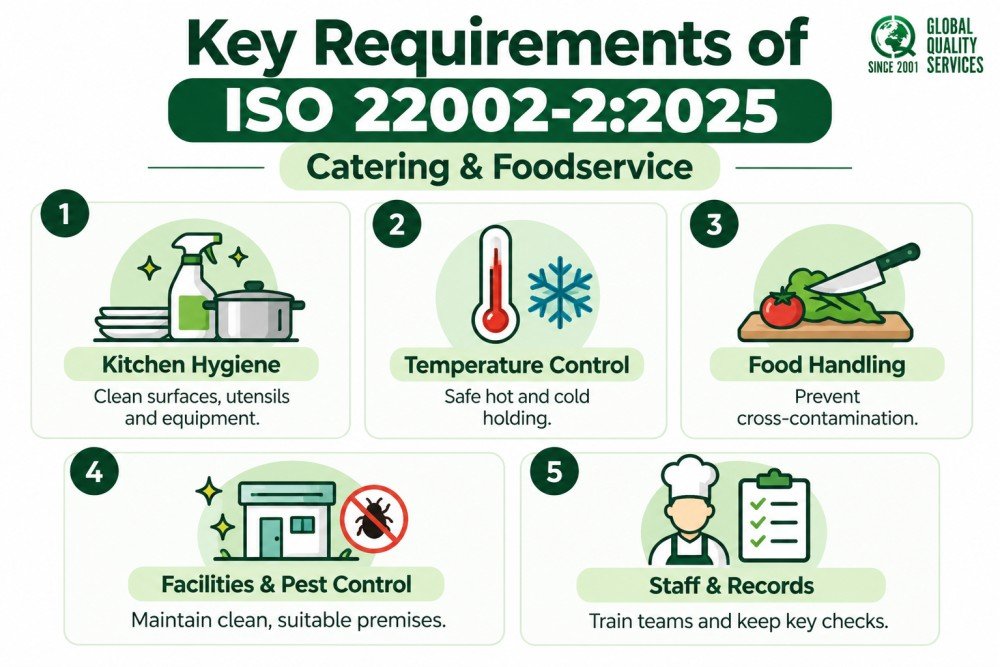
ISO 22002-2:2025 is intended to help catering businesses implement prerequisite programmes. As each business will be different depending on what it does, Global Quality Services can help you identify what requirements apply to your business and implement the correct controls:
Hazards within Commercial Kitchens
Commercial kitchens must identify and control hazards associated with the food, equipment, utensils, premises and general processes. This could include physical contamination, chemical contamination and harmful microorganisms.
Appropriate processes must be in place for the condition of your equipment, cleaning products, waste management, pest control and food flow. These should be based around how your staff carries out their processes.
Hygiene & Sanitation
Having clean preparation areas and good hygiene practices will help keep your food uncontaminated. You should have clear cleaning schedules, appropriate sanitation methods, staff hygiene requirements, and roles for keeping your equipment and food contact surfaces clean.
Staff should understand what needs to be cleaned, how it should be cleaned, what products should be used and how supervisors ensure it is done properly.
Hot & Cold Temperature Controls
Managing the temperatures of your food is vital when receiving, storing, cooking, cooling, reheating, holding and serving. You should have controls in place that are suitable for your food and food safety requirements.
This could include having set temperature requirements, appropriate monitoring equipment, recording checks and corrective actions if the temperature is outside of the set requirements. You should have clear processes for who is checking the temperatures and what to do if there is an issue.
Safe Handling & Preparation of Food
Processes should be in place to reduce cross-contamination and ensure your food is kept safe. This could include separating raw and cooked foods, using clean utensils, having good hand hygiene and controlling the flow of your ingredients.
You should have clear requirements for receiving ingredients, storing, allergen management (if applicable) and keeping your prepared foods safe.
Premises, Equipment & Pest Control
The layout of your kitchen, equipment, ventilation, drainage, water and waste management can impact on your food safety. You should ensure that your premises are in good condition to ensure hygienic processes are carried out.
Pest prevention should also be considered. This should include keeping your building in good condition, waste storage, cleaning and monitoring. Within your programme, you should also identify who is responsible for identifying and correcting any issues.
Staff Training & Food Safety Records
Staff should have training to match their role and the risk involved. Supervisors should ensure staff understand what processes they need to follow and how to report unsafe conditions.
Records should support the controls you have in place. This could include cleaning records, temperature records, training evidence, pest control, and corrective actions depending on your operation.
How ISO 22002-2:2025 Links with Your Current Food Safety Management System
ISO 22002-2:2025 sets out the prerequisite programmes for catering businesses. The ISO 22002-100:2025 sets out the common requirements for the food, feed and packaging supply chain. This standard should be used along with the common requirements and supports your food safety management system.
If you are looking to develop or maintain a food safety management system, we recommend looking into our ISO 22000 Certification in Singapore page.
We can help you identify how the relevant standards link to your current processes, identify any missing controls, and ensure your processes and records are in line with the requirements.
Our Approach to ISO 22002-2:2025 Certification in Singapore
Global Quality Services helps catering and food service businesses implement processes based on the requirements of the standard. We focus on creating clear processes that can be followed by your staff. We can help you with:
- Gap Analysis: Identifying what gaps there are within your current food safety processes.
- Risk-Based Controls: Identifying any issues with your food handling, hygiene, temperature monitoring and kitchen processes.
- Documentation: Creating or improving your processes, checklists, monitoring and corrective actions.
- Awareness: Ensuring your team understands what their role is regarding food safety and following consistent processes.
- Implementation: Helping you implement the required programmes.
- Readiness: Checking your evidence of implementation and identifying any gaps.
Who Should Employ ISO 22002-2:2025 Consultants in Singapore?
This standard is intended for catering businesses that prepare exposed foods on site for direct consumption by consumers. Businesses that would benefit from consultancy could include:
- Restaurants and cafes
- Hotels and resorts
- Food trucks
- Schools and factory canteens
- Dining areas
- Institutional food services
- Catering on board
- Takeaway food services
There are specific limitations to this standard. Kitchens that prepare food for other catering operations to deliver would generally not fall under this standard. We can help you identify what requirements apply to you.
How Global Quality Services Experts Can Help with ISO 22002-2:2025 Certification in Singapore
Choosing the right consultant will help ensure your food safety programmes are suitable for your business. We work with organisations that want to have clear guidance for their management system standards and certification preparation. Our strengths include:
- Reputable Consultant: We can provide you with clear guidance to implement processes based on your activities and the requirements of the standard.
- Industry Experience: We have more than 26 years of experience supporting organisations with certification.
- Multi-Industry Experience: We have experience working with different industries, so we understand the different requirements.
- Regional Support: We can offer consultancy across key Asian business markets.
- Business Focused: We will provide guidance based on your current processes, resources, and requirements.
- Clear Implementation: We can provide guidance on your documentation, staff roles, corrective actions, and readiness.
- Customer Focused: We can provide support based on your business scope, priorities, and implementation.
We aim to provide clear consultancy from the initial assessment to implementation and readiness. We can help your team understand what areas should be focused on, why, and how to improve.
Get ISO 22002-2:2025 Consultancy from Global Quality Services
Ensure your catering or food service business has improved food safety controls by getting guidance from Global Quality Services. Our consultants can review your current processes, identify any gaps, and help your team put in place effective prerequisite programmes for your business. We have a regional presence across Singapore, the Philippines, Indonesia, Malaysia, and China to help you with certification.
Contact Global Quality Services and let us know what scope you have for your business, what consultancy you need, and what your implementation priorities are. Tell us about your current food safety processes so we can give you guidance on what to do next.
Frequently Asked Questions
1. Can I use ISO 22002-2:2025 for my small restaurant in Singapore?
Yes. This standard is suitable for businesses of various sizes and complexity. A small restaurant can use it to implement suitable hygiene, cleaning, food handling, and other prerequisite programmes.
2. Do I need to change my kitchen layout to implement ISO 22002-2:2025?
Not necessarily. However, if you have a layout that causes contamination risks or you are unable to meet the requirements, then changes may need to be made.
3. Does this standard cover allergen management?
Food allergens should be managed using suitable food safety controls and legal requirements. This will depend on the foods you handle, how they are prepared, and the risks.
4. Can I use the same processes across my multiple restaurants?
If your processes and risks are similar, then you can have common processes across your outlets. However, you should still ensure the processes are suitable for your premises, equipment, and menu.
5. What documents are required for ISO 22002-2:2025?
Common records include cleaning schedules, temperature logs, food handling procedures, pest control records, and staff training documents.