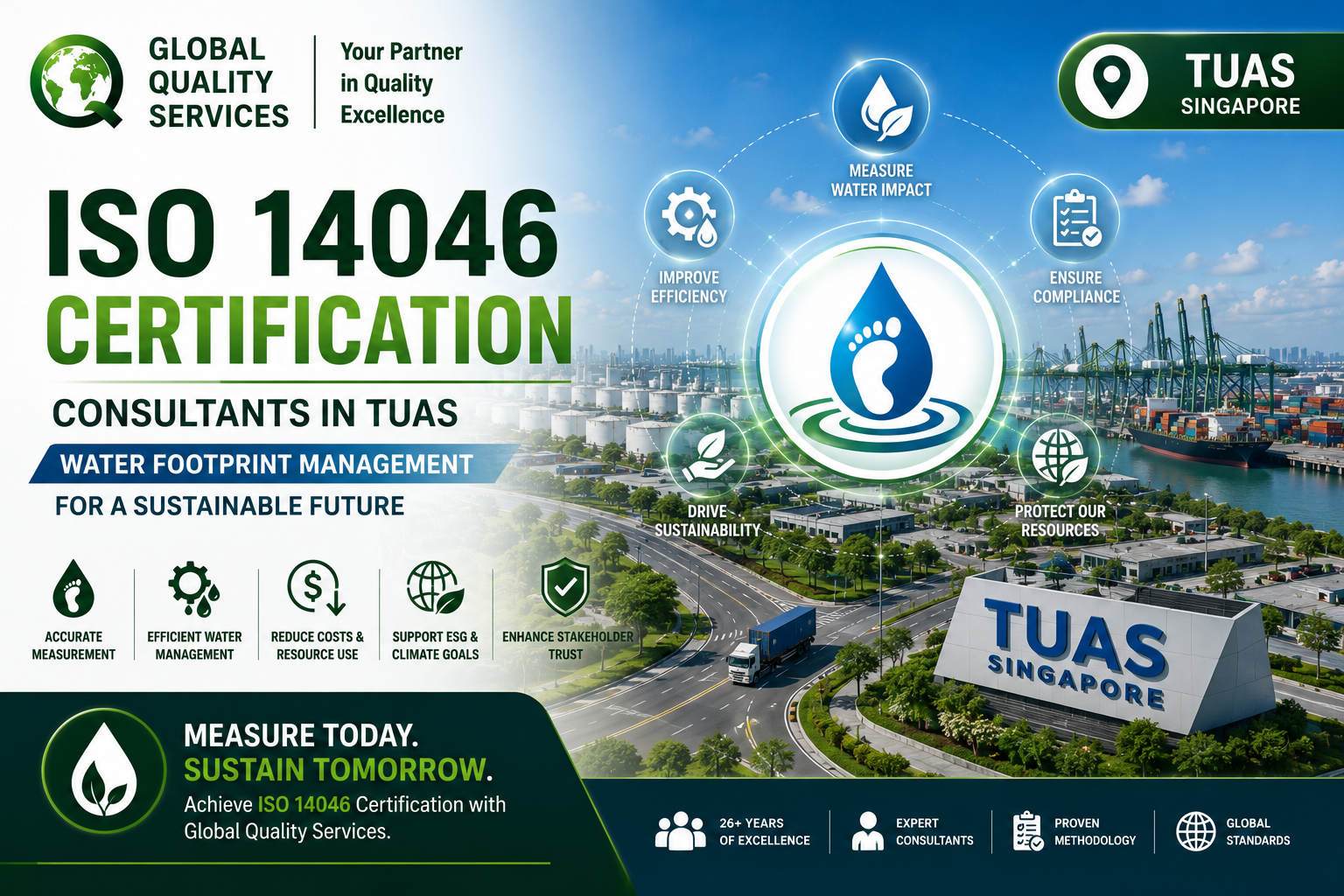
Does your Tuas facility actually know how much water it consumes across its full supply chain, not just at the meter? And can you prove that figure to a customer, an investor or a regulator? GQS Singapore helps manufacturers and industrial operators in Tuas measure, verify and reduce their water footprint to ISO 14046, the international standard for water footprint assessment. With 21 years of experience and a team of SCMC and TUV SUD trained consultants, we turn raw water data into a credible, independently verified result your Tuas operation can stand behind.
What Is ISO 14046 Certification?
ISO 14046 is the international standard that sets out how to measure the water footprint of a product, process or organisation using life cycle assessment (LCA).
Published by the International Organization for Standardization as ISO 14046:2014, it is not a management-system certificate like ISO 9001 or ISO 14001. It is an assessment methodology. In practice, “ISO 14046 certification” means conducting a water footprint study to the standard and having the result independently verified by a third party, so the number is trusted rather than self-declared.
The assessment covers your whole water picture: blue water (the surface and groundwater you draw), green water (rainwater), and grey water (water your activity pollutes that then needs treatment). That data is converted into impact indicators such as water scarcity and water quality degradation, following the same LCA phases defined in ISO 14040 and ISO 14044. The output is a single water footprint value, or a profile of results, that you can report, benchmark and act on.
Why ISO 14046 Matters for Businesses in Tuas
Tuas is Singapore’s most water-intensive industrial cluster, so quantifying and reducing water impact is fast becoming both a commercial and a regulatory expectation for facilities based there.
Tuas concentrates the sectors that use the most water in Singapore: semiconductor and wafer fabrication, chemicals, marine and offshore yards, food and beverage processing, and biomedical manufacturing. National water demand is projected to nearly double by 2060, and the non-domestic sector is the main driver of that growth. That puts industrial water users squarely in the spotlight.
The area is also the centre of Singapore’s water-recycling future. The Tuas Water Reclamation Plant, part of the Tuas Nexus, is being built to treat industrial used water to a high enough standard for industries to reuse. Facilities that can measure their own water footprint are far better placed to plug into this closed-loop system, and to respond to PUB’s mandatory water efficiency requirements as they tighten.
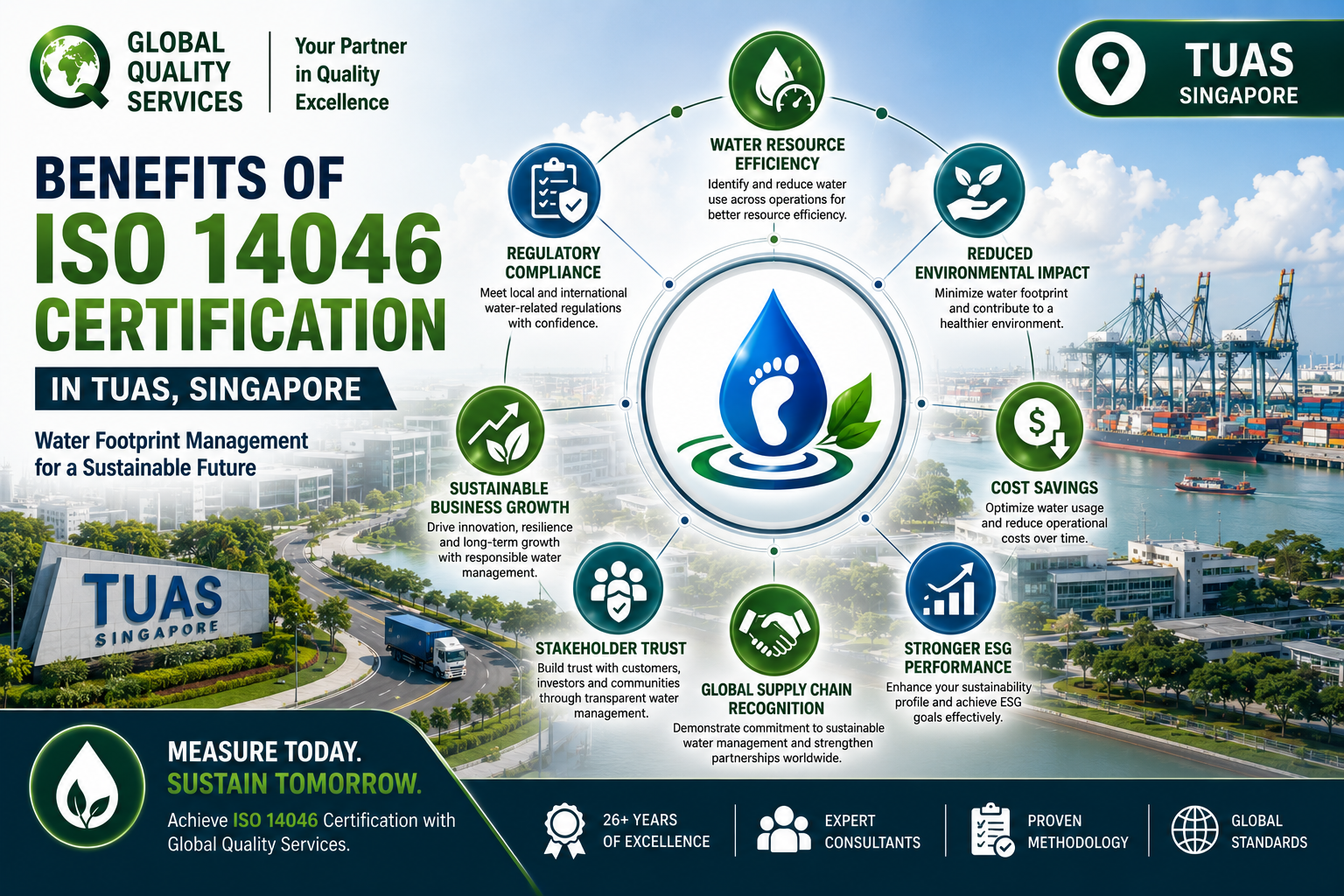
Beyond compliance, global customers and investors now ask for verified water data. A water footprint to ISO 14046 gives your Tuas plant a defensible figure for ESG disclosures, supply-chain questionnaires and tenders, instead of an estimate that gets challenged.
Who Needs ISO 14046 Water Footprint Certification in Tuas
Any water-intensive operation in Tuas that has to report, reduce or prove its water impact is a strong candidate for ISO 14046.
- Semiconductor and electronics manufacturers run water-heavy fabrication and already face PUB recycling thresholds. A water footprint shows where consumption and losses actually sit across the process.
- Chemical and petrochemical plants around Tuas and Jurong Island carry large direct and indirect water impacts that customers increasingly want quantified.
- Food and beverage producers use water as an ingredient, a cleaning agent and a coolant, so water footprint data feeds directly into cost and sustainability decisions. This pairs naturally with our FSSC 22000 food safety certification.
- Marine, offshore and shipyard operators in Tuas have complex water and effluent flows that benefit from a structured, LCA-based assessment.
- Biomedical and pharmaceutical manufacturers face both regulatory scrutiny and client expectations to demonstrate responsible water use.
- Data centres depend on water for cooling, one of the fastest-growing industrial water demands in Singapore.
- Any organisation building an ESG programme needs verified water metrics, which ISO 14046 provides alongside our ESG reporting consultancy.
What ISO 14046 Requires: The Water Footprint Assessment Process
ISO 14046 follows the four-phase life cycle assessment structure, applied specifically to water.
- Goal and scope definition. You set why the assessment is being done, what it covers, the system boundary, and the functional or reporting unit. This decides whether you are footprinting a single product line at your Tuas site or the whole facility.
- Water use inventory analysis. You collect all direct and indirect water inputs, outputs and polluting uses across the life cycle, from supply chain through manufacturing to end of life. This is the data-heavy stage where meter readings, process data and supplier information come together.
- Water footprint impact assessment. Inventory data is converted into impact indicators such as water scarcity, availability and quality degradation, using recognised characterisation models.
- Interpretation. Results are checked for completeness and sensitivity, then turned into clear conclusions and reduction priorities you can act on.
One point worth knowing: reporting is part of the standard, but public claims such as labels or on-pack declarations sit outside ISO 14046 and need additional rules. GQS keeps your reporting accurate and within scope.
How GQS Singapore Delivers ISO 14046 in Tuas: Step by Step
GQS runs your water footprint from first data review through to independent verification, tailored to your Tuas operation.
Step 1: Scoping workshop. We agree the goal, boundary and reporting unit with your team, so the assessment answers the questions your customers, regulators or board are actually asking.
Step 2: Water data inventory. We map every water input, output and effluent stream at your site and across the key supply-chain stages, and identify the data gaps to close.
Step 3: LCA modelling. We build the water footprint model to ISO 14046, applying ISO 14040 and ISO 14044 LCA principles and appropriate impact methods.
Step 4: Impact assessment and analysis. We calculate your water footprint and pinpoint the processes, inputs and supply-chain stages driving the largest impact.
Step 5: Reporting. We produce a clear, standard-compliant water footprint report, written so both technical and management readers can use it.
Step 6: Independent verification support. We prepare your study and evidence for third-party verification, so your water footprint is credible and defensible rather than self-declared.
Step 7: Reduction and integration. We help you turn the findings into a water reduction plan and connect the results to your wider systems, from water efficiency to ESG.
ISO 14046 Works Well With These Certifications
Organisations in Tuas get more value when water footprinting sits alongside related environmental and management-system certifications, and GQS delivers these together.
- ISO 46001 Water Efficiency Management System — ISO 14046 measures your water impact; ISO 46001 gives you the management system to reduce it year after year. The two are a natural pair for Tuas facilities.
- ISO 14001 Environmental Management — Water footprint is a direct input to environmental performance and aspects assessment under ISO 14001.
- ISO 14064 Carbon Footprint Verification — Water and carbon footprints share LCA foundations and independent verification, making them efficient to run in one programme.
- ISO 50001 Energy Management — Pumping, heating and treating water is energy-intensive, so water and energy savings often come from the same projects.
- ISO 59000 Circular Economy — Water reuse and recycling are central to circular operations, and a water footprint shows where reuse pays off most.
- ESG Reporting — A verified water footprint gives your ESG disclosures a defensible water metric.
- ISO 41001 Facility Management — For large Tuas facilities, water performance is a core facility-management concern.
Ready to measure and verify your water footprint in Tuas? Global Quality Services (GQS) Singapore makes ISO 14046 straightforward, from the first data workshop to independent verification. Contact our team for a scoped quote for your facility.
Frequently Asked Questions
1. Is ISO 14046 a certification or an assessment standard?
ISO 14046 is an assessment standard, not a management-system certification. You conduct a water footprint study to the standard and have the result independently verified by a third party. That is why “ISO 14046 certification” in the market really means a verified water footprint, and GQS supports you through both the study and the verification.
2. How is ISO 14046 different from ISO 46001?
ISO 14046 measures your water footprint, meaning the potential water-related environmental impact of your product, process or organisation. ISO 46001 is a water efficiency management system that helps you reduce consumption operationally. Many Tuas facilities use ISO 14046 to quantify impact and ISO 46001 to manage it, and GQS runs both together.
3. How long does an ISO 14046 water footprint assessment take in Tuas?
Most assessments take around 2 to 4 months, depending on the scope, the number of processes, and how readily your water and supplier data is available. Facilities with existing metering and process data move faster. GQS gives you a realistic timeline after the scoping workshop.
4. What water data will my facility need to provide?
You will typically need water intake records, process water use by area, effluent and discharge data, and key supplier or utility information for the stages in scope. GQS identifies exactly what is needed at the start and helps you close any gaps, so data collection does not stall the project.
5. Does ISO 14046 help with PUB requirements and ESG reporting?
Yes. A water footprint gives you the verified data that supports PUB’s water efficiency expectations and makes your ESG water disclosures credible to investors and customers. It also highlights where reduction efforts will have the most impact, which matters increasingly for water-intensive Tuas operations.