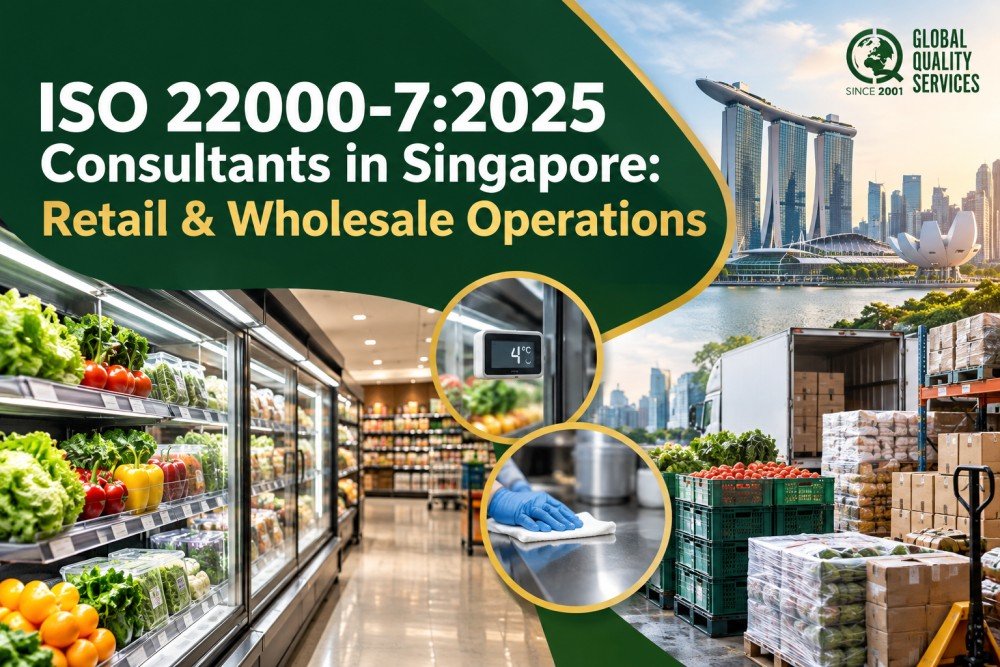
Retail and wholesale play an important role in ensuring food remains safe once it has left manufacture. This can include handling deliveries, storage, display cases, returned goods, and labelling.
Having consistent controls in place will ensure your business looks after your customers, meets buyers’ expectations, and has a reliable process in place. As Singapore imports over 90% of its food supplies from overseas, having good food safety controls in place is very important.
Global Quality Services helps businesses seeking ISO 22000-7:2025 Consultants in Singapore understand the requirements relevant to retail and wholesale operations. Our consulting approach focuses on practical controls, clear documentation, and consistent implementation. Read on to see how this sector-specific framework applies to your business and how our team can support your certification goals.
What is ISO 22000-7:2025 for Retail and Wholesale
ISO 22000-7:2025 is the specific food safety standard for the retail and wholesale industry. However, it is important to confirm which standard you will be working to. The specific standard for retail and wholesale is ISO 22002-7:2025. This provides your business with controls for prerequisite programmes for food retail and wholesale.
This standard will be relevant to your business if you are a supermarket, grocery store, food distributor, wholesale market, or work with chilled, frozen, fresh, or packaged foods. It will enable you to have consistent controls throughout your business.
Global Quality Services can help your business to understand how this will apply to your business.
Why Retail and Wholesale Businesses in Singapore Need This
Having a specific food safety standard will help your business understand what roles are needed, have consistent controls and can give confidence to your suppliers. It can also increase confidence from your customers and give your staff clear guidelines on handling food safety issues.
If you have multiple outlets or distribution centres, it will help you to have consistent requirements. This can help your management to have clear expectations, whilst having controls that relate to the risks of the products, storage and handling.
Key Food Safety Requirements for Retail and Wholesale
The specific standard will provide practical controls. Retail and wholesale businesses should focus on:
1. Clean Display Cases
Ensure your display cases (refrigerators/freezers/shelves) are clean and fit for purpose. Ensure you have a cleaning schedule in place, roles assigned, and that there are no risks of contamination from the display of food.
2. Disinfect Surfaces Touched by Customers
Ensure surfaces such as counters, serving equipment, and weighing areas are being cleaned and disinfected correctly. Your staff should have clear guidance on what products to use, how to use them, and how often to clean.
3. Managing Returned Goods
Ensure you have a process for assessing returned food products. Define how your staff will identify, isolate, log, and dispose of products that cannot be returned. Returned items should not go back into your stock if they do not meet the requirements.
4. Correct Labelling
Ensure your products are labelled correctly. Ensure you have the correct checks in place to confirm the product is correct, allergens (if applicable), storage instructions, and date marking.
5. Chilled/Frozen Products
Ensure chilled and frozen products are stored correctly. Your staff should understand the temperature limits, who is responsible for monitoring, and what to do if the temperature is out of range.
6. Receiving and Stock
Ensure products received are checked for any damage, contamination, or incorrect temperatures. Having a stock rotation system, traceability, and clear separation will help manage your food.
The exact controls you will need will depend on the standard you are working to, the scope of your organisation, Singapore food regulations and what type of products you handle.
Who Should Consider ISO 22002-7:2025 in Singapore
ISO 22002-7:2025 is for organisations that are involved in food retail and wholesale. Depending on your business size, the requirements can be relevant to you if your activities fall under the standard. Here is the list of businesses:
- Supermarkets/Grocery
- Food Wholesale Distributors
- Fresh Food Retailers
- Frozen/Chilled Food Sellers
- Importers/Trading Companies
- Food Banks
- Specialist Food Stores
ISO 22002-7:2025 Implementation and Certification Process in Singapore
Here is a complete process to achieve ISO 22002-7:2025 for businesses:
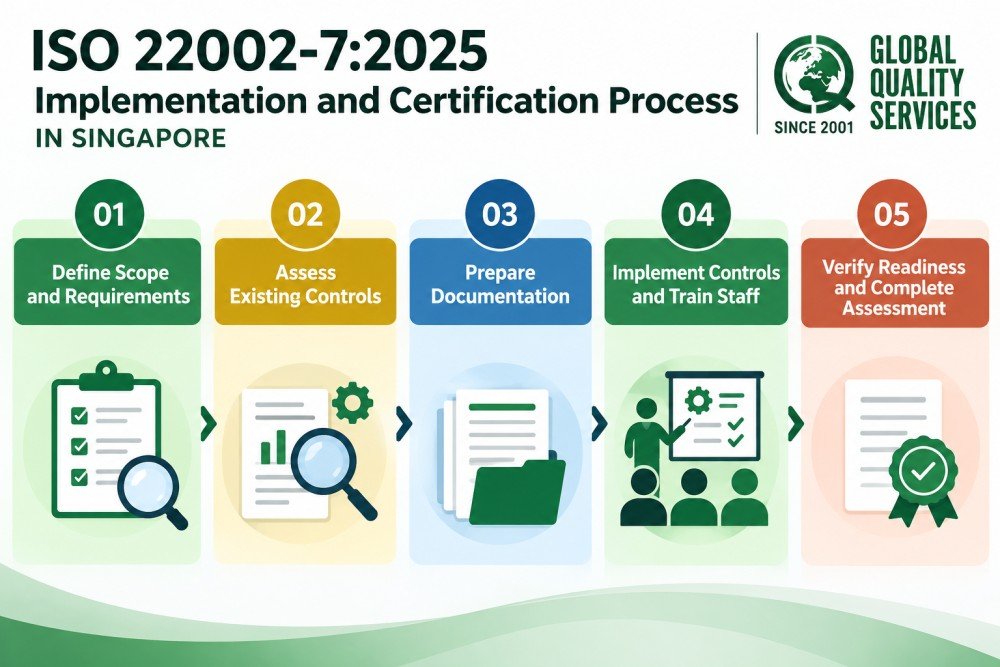
Step 1: Define Scope and Requirements
Identify covered outlets, warehouses, food products, and applicable food safety requirements.
Step 2: Assess Existing Controls
Review hygiene practices, display case cleaning, temperature monitoring, customer returns, and product labeling to identify gaps.
Step 3: Prepare Documentation
Develop or update procedures, cleaning schedules, inspection records, and corrective action reports.
Step 4: Implement Controls and Train Staff
Apply food safety practices and train employees in hygiene, safe handling, labeling, and return management.
Step 5: Verify Readiness and Complete Assessment
Check implementation records, resolve outstanding gaps, and prepare for an independent assessment by the selected certification body.
How ISO 22002-7:2025 Helps Your Food Safety Management System
ISO 22002-7:2025 standard provides prerequisite programmes for food retail and wholesale. It complements the food safety management system. The related standard ISO 22002-100:2025 provides common prerequisite programme requirements for the food, feed and packaging supply chain. Part 7 provides additional requirements for retail and wholesale. This will help your business have correct working conditions and routine controls.
When looking to achieve certification, it is important to understand how these prerequisite programmes will fit into your current food safety management system and certification scheme. Global Quality Services can help your organisation understand this.
Why ISO 22002-7:2025 is Important for the Food Industry in Singapore
Singapore’s food industry relies on having reliable handling processes. The SFA performs regular testing of samples from retail outlets to help identify unsafe products. This will help your business understand the importance of having correct controls. Having a good prerequisite programme can help your organisation:
- Reduce the risk of contamination
- Have consistent hygiene and storage
- Increase staff knowledge
- Help with traceability and managing non-conforming stock
- Have clear records to help with internal checks
- Demonstrate you have a structured approach
The success of this depends on how well you implement and maintain controls. Whilst certification will not guarantee you will not have any food safety incidents, having a well-managed system can help your business identify and control risks.
How Global Quality Services Experts Can Help with ISO 22002-7:2025 in Singapore
Choosing the right consultant will help ensure you have a high-quality food safety system in place. Global Quality Services can help your business with guidance on achieving certification. As a reputable consultant, we focus on helping organisations make informed decisions, identify gaps, and implement food safety systems that are best for their business:
- Sector-specific: Provide guidance that is relevant to your retail/wholesale, distribution, and food handling activities.
- Recommendations: Provide recommendations based on your business, products, facilities, and food safety risks.
- Practical: Provide clear guidance on what requirements you need to meet.
- Documentation: Guide on creating documentation.
- Multi-site: Take into consideration if you have multiple sites.
- Certification: Help you understand what requirements you have and prepare for certification.
- Regional: Provide support for organisations with certification requirements across multiple Asian markets.
Get Started with ISO 22002-7:2025 for Your Retail/Wholesale Business
Talk to Global Quality Services about your retail/wholesale operations. We can help you understand what requirements you need to meet and what support you will require. We can help provide your business with a clear direction and recommendations that are best for your facilities, products, and objectives. Our regional presence can help your business with certification requirements in Singapore, the Philippines, Indonesia, Malaysia, and China.
Frequently Asked Questions
1. Can ISO 22002-7:2025 apply to a small food retailer?
Yes. This standard can be applied to any organisation, regardless of size. The controls should be relevant to your activities, facilities, and food safety risks.
2. Does ISO 22002-7:2025 replace ISO 22000?
No. ISO 22002-7:2025 provides requirements for prerequisite programmes for retail and wholesale. ISO 22000 provides a food safety management system. They are separate.
3. Can ISO 22002-7:2025 apply to multiple sites?
Yes. As long as you have defined the requirements and they apply to the relevant sites. You should have consistent controls and take into consideration the differences between products, facilities, and risks.
4. What records should wholesale and retail businesses keep?
You may need records such as cleaning schedules, temperature monitoring, receiving checks, staff training, stock traceability, and corrective actions. This will depend on the requirements and activities of your organisation.
5. Does ISO 22002-7:2025 cover food labeling?
The standard addresses prerequisite programs for retail and wholesale food safety. Businesses should assess labeling practices alongside applicable food safety requirements and Singapore’s relevant food labeling regulations. Specific legal obligations depend on the product and its intended sale.