Businesses in Jurong East operate in a commercial environment connected to Singapore’s wider manufacturing, technology, research and innovation ecosystem. As organizations develop new products, improve services or introduce more efficient processes, managing innovation requires more than individual ideas. It requires clear objectives, defined responsibilities, measurable outcomes and a consistent approach to evaluating opportunities.
GQS Global Quality Services Pte Ltd offers ISO certification services for organizations seeking a structured approach to innovation management. ISO 56001:2024 specifies requirements for an Innovation Management System (IMS), enabling organizations to manage innovation activities systematically and evaluate their contribution to business objectives.
Whether your organization develops technology solutions, manufactures components, provides professional services, or manages research and development activities, ISO 56001 can align innovation strategy with day-to-day operations.
What Is ISO 56001 Certification?
ISO 56001:2024 is an international standard specifying requirements for an Innovation Management System. Published in September 2024, it gives organizations a systematic framework for establishing, implementing, maintaining, and continually improving their innovation management.
The standard addresses innovation as an organizational capability rather than an isolated activity. It covers how a business identifies opportunities, sets innovation objectives, allocates resources, manages uncertainty, evaluates performance and improves its processes.
ISO 56001 is applicable to organizations of different sizes and sectors. Innovation may involve creating a new product, improving an existing service, changing a production method, developing a business model or introducing a more effective operational process.
Certification involves an independent assessment of the organization’s Innovation Management System against the applicable requirements. It is not a guarantee that every innovation project will succeed or that every new product will achieve commercial success.
Why Consider ISO 56001 Certification in Jurong East?
Jurong East is a key commercial and transport hub in western Singapore. Its connections to surrounding business areas make it relevant to organizations operating across professional services, technology, engineering, manufacturing and regional business operations.
The wider western Singapore ecosystem also includes Jurong Innovation District, which brings together advanced manufacturing, technology providers, research and development, and training activities. These connections make structured innovation management relevant to organizations working with technical teams, production partners, research institutions and customers.
ISO 56001 can be particularly useful when innovation activities have expanded beyond informal brainstorming and require consistent oversight.
Establish Clear Innovation Objectives
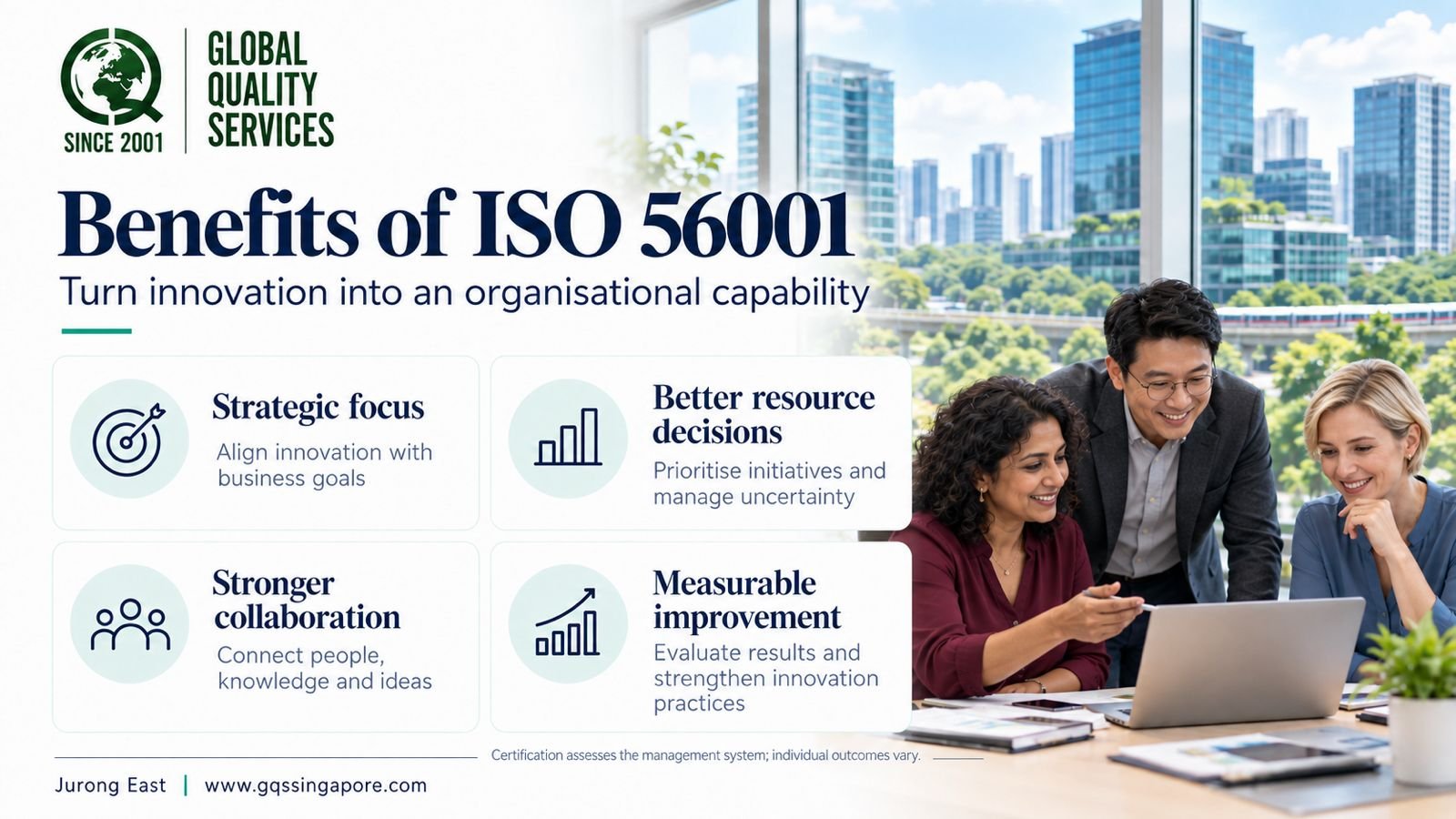
Organizations can define what they want innovation to achieve and connect those objectives to their business strategy. This makes it easier to assess whether innovation projects address customer needs, operational priorities or longer-term business opportunities.
Create a Repeatable Innovation Process
A structured system establishes how ideas are identified, assessed, developed, tested, and reviewed. Teams can use defined criteria to decide which opportunities deserve further investment and which should be reconsidered.
Manage Innovation Risks and Uncertainty
Innovation involves technical, financial, operational and market uncertainties. A formal management approach encourages organizations to evaluate these factors, learn from experiments and make decisions based on available evidence.
Improve Cross-Functional Collaboration
Innovation projects often involve research and development, operations, sales, marketing, finance, and senior management. Defined responsibilities and communication processes can improve coordination between these functions.
Measure Innovation Performance
Organizations can set indicators to track progress against innovation objectives. Depending on their activities, these may include project milestones, development timelines, validated concepts, process improvements or the value realized from new solutions.
Demonstrate a Structured Management Approach
An independently assessed ISO 56001 certificate can demonstrate that an organization’s innovation management system has been evaluated against the standard. This may be relevant when engaging with customers, business partners, investors or other interested parties who value formal management systems.
Who Can Benefit from ISO 56001 Certification in Jurong East?
ISO 56001 is not limited to companies developing new technology. Its requirements can be applied to different types of innovation, provided the management system is appropriate to the organization’s context and scope.
Potential applicants in Jurong East and the surrounding western Singapore business areas include:
- Technology and software companies: Organizations developing digital platforms, software products, automation solutions or new technology-enabled services.
- Engineering and manufacturing businesses: Companies introducing product improvements, production methods, process automation or new engineering solutions.
- Research and development teams: Organizations managing experiments, prototypes, technical development and the transition from research outcomes to practical applications.
- Professional service providers: Businesses developing new service models, digital workflows, or improved ways to deliver customer value.
- Start-ups and growing enterprises: Organizations seeking to formalize innovation responsibilities, prioritize opportunities, and establish processes that scale with business growth.
- Established companies undertaking transformation: Businesses modernizing operations, redesigning services or introducing new offerings alongside existing products and processes.
Certification suitability depends on the organization’s activities, defined scope, and ability to meet the standard’s requirements. A preliminary review can establish whether ISO 56001 aligns with the organization’s needs and certification objectives.
Key Areas Covered by an ISO 56001 Innovation Management System
An effective Innovation Management System connects leadership decisions with practical innovation activities. ISO 56001:2024 requirements cover several related areas.
1. Organizational Context and Innovation Strategy
The organization determines the internal and external factors that influence its innovation objectives. It considers relevant interested parties, defines the scope of its Innovation Management System and establishes the direction for innovation.
For a Jurong East business, this could involve understanding changing customer expectations, technology developments, production constraints, competitive conditions, or opportunities to enter new markets.
2. Leadership and Responsibilities
Top management establishes the organization’s innovation direction, policy and objectives. Define responsibilities, decision-making authority, and resource commitments so innovation activities align with the wider business strategy.
3. Planning and Opportunity Management
Innovation planning addresses objectives, opportunities, uncertainty and the resources required to pursue selected initiatives. Organizations establish a suitable approach to evaluate ideas and decide how to allocate time, skills, and investment.
4. Resources and Organizational Capabilities
Innovation depends on people, knowledge, information, infrastructure and collaboration. The management system considers the resources and competencies needed to carry out innovation activities effectively.
5. Operational Innovation Processes
The organization establishes and manages processes to pursue innovation initiatives. These processes should suit the type and level of uncertainty involved, allowing teams to test concepts, evaluate results, and adapt their approach as they learn.
6. Performance Evaluation and Continual Improvement
Organizations monitor and evaluate the performance of their Innovation Management System. Reviews, measurements, internal audits where applicable, and corrective actions provide a basis for identifying weaknesses and improving the system over time.
ISO 56001 Certification Process with GQS
The certification process depends on the organization’s size, operational complexity, innovation activities, and readiness. The following stages outline a typical approach to external management system certification.
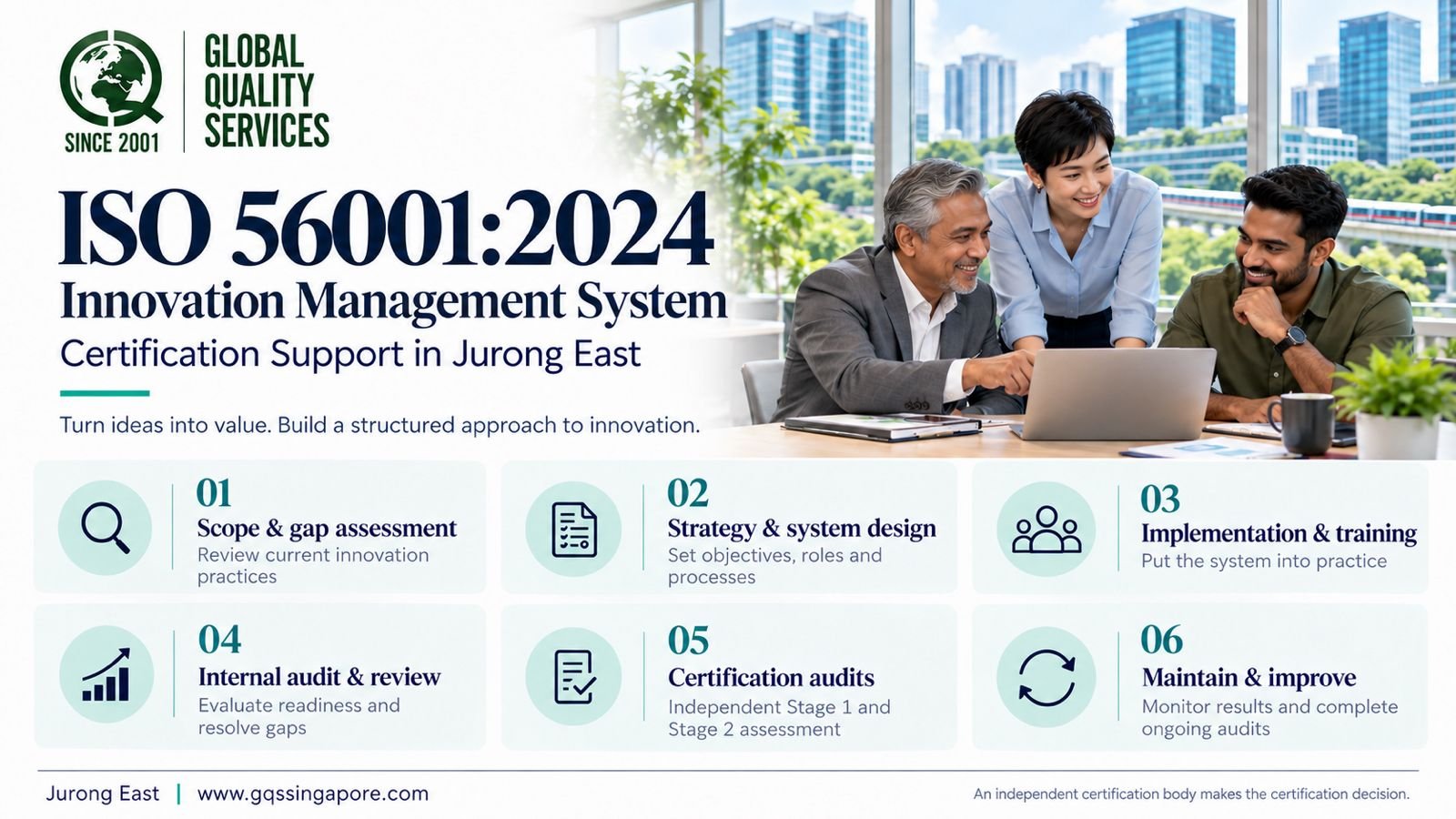
Step 1: Define the Certification Scope
Identify the legal entity, locations, functions, and innovation activities intended to fall within the Innovation Management System. The scope should accurately reflect the organization’s operations and responsibilities.
Step 2: Review Readiness
Assess the existing innovation strategy, management responsibilities, documented processes, performance measures and operational practices against the requirements of ISO 56001:2024.
This review helps identify areas that may need attention before the external assessment.
Step 3: Establish and Operate the Management System
The organization establishes the processes, responsibilities, controls, and records needed to meet applicable requirements. It then operates the system so that its effectiveness can be evaluated using appropriate evidence.
Step 4: Conduct Internal Evaluation
Before seeking certification, the organization should evaluate whether it has implemented and is operating the management system as intended. Internal audits and management reviews, where applicable, can identify nonconformities and opportunities for improvement.
Step 5: Complete the Certification Assessment
An independent certification assessment evaluates the defined scope against ISO 56001 requirements. The assessment considers documented information, relevant records, implementation and objective evidence.
Step 6: Address Findings and Certification Decision
Where nonconformities are raised, the organization must address them in accordance with the applicable certification process. Certification is granted only when the requirements for a positive certification decision have been satisfied.
Step 7: Maintain Certification
After certification, the organization continues to operate and improve its Innovation Management System. Surveillance assessments and recertification take place according to the applicable certification arrangements.
ISO 56001 Certification Services for Jurong East and Nearby Business Areas
GQS can discuss certification requirements with organizations in Jurong East and other business locations in western Singapore, subject to service availability and the proposed assessment scope.
Relevant locations for businesses exploring ISO 56001 certification include:
- Jurong East: Commercial offices, service providers and businesses coordinating regional operations.
- International Business Park: Organizations involved in technology, engineering, corporate services and business operations.
- Jurong Innovation District: Businesses connected to advanced manufacturing, technology development and research activities.
- Jurong West: Organizations undertaking manufacturing, engineering and operational improvement initiatives.
- Clementi: Technology-related businesses, professional service providers and growing enterprises.
- Tuas: Industrial and manufacturing businesses pursuing product, process or operational innovation.
The appropriate certification scope is determined by the organization’s actual activities and locations, not simply its registered address.
Why Choose Global Quality Services for ISO 56001 Certification Services?
Choosing a certification provider requires clarity on the applicable standard, assessment scope, certification process, and decision criteria.
GQS Global Quality Services Pte Ltd provides certification services for organizations seeking formal management system assessments. For ISO 56001, the certification process should be aligned with the organization’s innovation activities and the requirements of the 2024 edition.
When discussing your certification requirements, key considerations include:
- Defined assessment scope: Establish which business functions, locations, and innovation activities are included.
- Standard-specific evaluation: Assess conformity against ISO 56001:2024 rather than relying on a generic innovation checklist.
- Evidence-based assessment: Base findings on objective evidence of the management system’s conformity and implementation.
- Clear certification stages: Understand the assessment sequence, treatment of nonconformities and conditions for a certification decision.
- Ongoing system maintenance: Recognize that certification requires continued conformity and participation in applicable surveillance and recertification activities.
Confirm certification availability, assessment arrangements, and applicable accreditation status directly with GQS before an engagement begins.
Frequently Asked Questions
1. Can ISO 56001 certification cover innovation in both products and internal business processes?
Yes. An Innovation Management System can cover different forms of innovation, including new products, service development, process improvements,, andbusiness model changess. The certification scope should clearly define the innovation activities and organizational functions included in the assessment.
2. What evidence may be reviewed during an ISO 56001 certification audit?
The assessment may examine innovation policies and objectives, assigned responsibilities, opportunity evaluation methods, project records, resource planning, performance measures, management reviews, and improvement actions. The required evidence ependdependsthe the organization’s scopehow its Innovation Management System operates.
3. Does our Jurong East office need to carry out innovation activities to be included in the certification scope?
Not necessarily. An office may perform strategic, management, or coordination functions within a wider Innovation Management System. However, its role must be clearly defined, and the proposed scope must accurately represent the organization’s activities and responsibilities.
4. Can a company apply for ISO 56001 certification while its innovation processes are still developing?
An organization can begin assessing its readiness while developing its system. However, certification requires sufficient objective evidence that the Innovation Management System meets the applicable requirements and is implemented within the proposed scope. Any identified nonconformities must be addressed according to the certification process.
5. How is ISO 56001 certification maintained after the initial assessment?
Maintaining certification involves continuing to operate and improve the Innovation Management System, monitoring performance against objectives, addressing nonconformities, and participating in applicable surveillance and recertification assessments. The organization should retain relevant records and ensure that changes to its activities or scope are managed appropriately.