ISO 26262 Certification in Singapore helps automotive manufacturers address functional safety risks in electrical and electronic vehicle systems. According to The Business Times, electric vehicles accounted for 45% of Singapore’s new car registrations in 2025, highlighting the growing role of advanced automotive technology.
The standard guides businesses in managing safety risks throughout vehicle development and production. Hiring an experienced consultant helps your team identify compliance gaps, strengthen safety processes, and prepare the required documentation for assessment.
What is ISO 26262?
ISO 26262 is an international functional safety standard for electrical and electronic systems in road vehicles. It addresses potential hazards caused by malfunctioning electronic systems and guides organisations in managing safety risks throughout a product’s lifecycle.
The standard follows a lifecycle approach, covering concept development, system design, hardware and software development, production, operation, service, and decommissioning.
ISO 26262 also introduces Automotive Safety Integrity Levels, commonly known as ASILs. These levels help organisations determine the safety requirements for different hazards based on risk assessment.
For automotive companies in Singapore, ISO 26262 offers a structured approach to functional safety. It helps engineering teams build safety considerations into product development rather than treating them as a final testing requirement.
Who Needs ISO 26262 Certification in Singapore?
ISO 26262 is relevant to organisations that develop, manufacture, integrate, or supply electrical and electronic systems for road vehicles. Companies across Singapore’s automotive supply chain may benefit from adopting its requirements.
Key industries and businesses include:
- Automotive component manufacturers: Companies producing sensors, electronic control units, braking components, steering systems, and other safety-related parts.
- Automotive software developers: Teams creating embedded software, vehicle control applications, and safety-critical software functions.
- Electric vehicle technology companies: Businesses developing battery management systems, power electronics, charging-related vehicle controls, and motor control systems.
- Automotive electronics suppliers: Organisations supplying circuit boards, microcontrollers, electronic modules, and integrated vehicle systems.
- Automotive engineering and design firms: Companies supporting vehicle architecture, system integration, verification, and validation.
- Automotive testing laboratories: Facilities involved in testing and evaluating vehicle electronics and functional safety requirements.
Singapore-based businesses supplying components to international vehicle manufacturers may also encounter ISO 26262 requirements during supplier qualification and contract reviews.
Why is ISO 26262 Important for Automotive Businesses?
Automotive companies must consider functional safety from the earliest design stages. A small defect in a braking controller, steering system, or battery management unit can create serious safety risks.
ISO 26262 helps businesses address these risks through defined safety activities, technical assessments, and documented development procedures. Here are the main benefits for automotive organisations in Singapore.
1. Identify Safety Risks Early
ISO 26262 encourages engineering teams to identify potential hazards before they become expensive design problems. Teams can assess how system failures might affect drivers, passengers, and other road users.
Early risk analysis helps developers make informed design decisions and establish suitable safety requirements.
2. Strengthen Product Development
The standard guides teams through system design, hardware development, software development, integration, and validation. This approach helps businesses maintain consistent safety practices throughout product development.
It also encourages teams to document design decisions, verify requirements, and investigate potential failures before releasing products.
3. Build Customer Confidence
Automotive manufacturers often evaluate suppliers based on their technical capabilities and safety processes. Demonstrating ISO 26262 compliance can help suppliers build confidence among original equipment manufacturers and other business partners.
Independent assessment can also support supplier qualification when customers require evidence of functional safety practices.
4. Support International Business Opportunities
Singapore-based automotive suppliers may work with customers across different countries. Recognised functional safety practices can help these businesses demonstrate their commitment to safety during international procurement and technical reviews.
However, certification alone does not guarantee contracts or regulatory approval. Buyers may also require specific technical evidence, customer approvals, and additional compliance assessments.
5. Improve Safety Documentation and Traceability
ISO 26262 encourages teams to maintain records of safety requirements, design decisions, verification results, and validation activities. These records help engineers trace requirements from initial hazard analysis to final product testing.
Clear documentation also makes it easier to investigate defects, manage design changes, and explain safety decisions during customer assessments.
Key Requirements of ISO 26262
ISO 26262 covers several functional safety activities. Organisations must determine which requirements apply to their products, responsibilities, and development lifecycle.
The standard’s main areas include the following.
| Requirement | What it involves |
|---|---|
| Functional safety management | Assigning responsibilities, managing safety activities, and establishing appropriate organisational processes. |
| Hazard analysis and risk assessment | Identifying hazardous situations and determining the required safety measures. |
| System development | Defining safety requirements, designing system architecture, and validating system behaviour. |
| Hardware development | Assessing hardware failures and demonstrating that safety targets are met. |
| Software development | Establishing safety requirements, developing software, and performing verification and testing. |
| Supporting processes | Managing configuration, changes, documentation, verification tools, and other supporting activities. |
| Production and operation | Addressing safety considerations during manufacturing, servicing, operation, and decommissioning. |
The relevant requirements depend on the product and its role in the vehicle. ISO 26262 also includes guidance on semiconductor applications, motorcycle adaptations, and safety-oriented analyses.
Understanding Automotive Safety Integrity Levels
Automotive Safety Integrity Levels, or ASILs, help engineers determine the rigour of safety requirements for identified hazards.
ISO 26262 defines four ASIL classifications: ASIL A, ASIL B, ASIL C, and ASIL D. ASIL A represents the lowest level of safety risk reduction requirements within the classification, while ASIL D represents the highest.
The assessment considers three main factors:
- Severity: The potential consequences of a hazardous event.
- Exposure: How frequently people may encounter the operational situation associated with that hazard.
- Controllability: How difficult it may be for drivers or other people to control the situation and avoid harm.
Engineers use hazard analysis and risk assessment to determine the appropriate ASIL for each relevant hazardous situation. They then establish safety requirements that match the identified risk.
For example, a safety-critical braking function may require more rigorous measures than a non-safety-critical convenience feature. The actual ASIL depends on the hazard assessment, not simply on the type of component.
What is the ISO 26262 Certification Process in Singapore
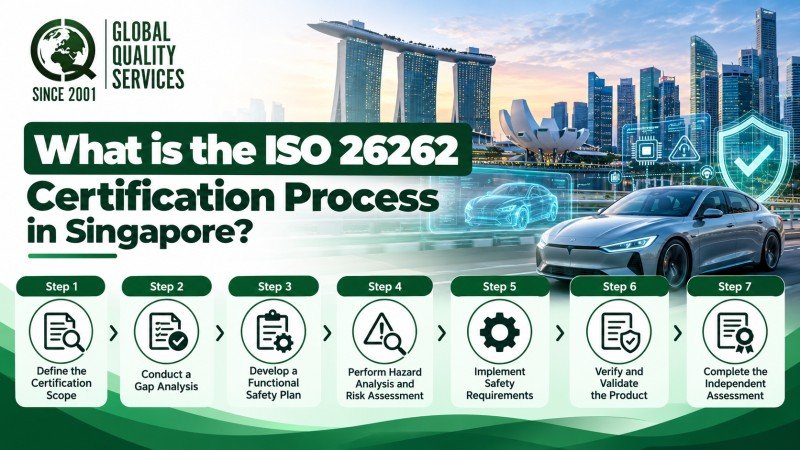
The certification process depends on whether your organisation needs an assessment of its development processes, a product evaluation, or another form of functional safety assessment. A consultant can help you define the scope before you begin.
Step 1: Define the Certification Scope
Identify the product, component, system, software, or development process you want to assess. Review customer requirements and determine which parts of ISO 26262 apply to your responsibilities.
A clear scope helps you avoid unnecessary work and directs the assessment towards relevant safety activities.
Step 2: Conduct a Gap Analysis
Compare your existing processes and technical documentation with the applicable ISO 26262 requirements. Review safety management, hazard analysis, engineering practices, testing records, and supporting procedures.
The gap analysis identifies missing evidence and areas that need improvement before an independent assessment.
Step 3: Develop a Functional Safety Plan
Establish responsibilities, deliverables, review activities, and project milestones. Your team should define how it will manage safety requirements, technical decisions, verification, validation, and changes.
A practical plan helps engineers understand their responsibilities and coordinate safety activities across departments.
Step 4: Perform Hazard Analysis and Risk Assessment
Identify potential hazards associated with the product’s intended functions and possible malfunctions. Assess severity, exposure, and controllability to determine the applicable ASIL classifications.
Use the results to define safety goals and establish suitable technical requirements.
Step 5: Implement Safety Requirements
Update your development processes and technical documentation to address the identified gaps. This may involve improving software development procedures, hardware analysis, configuration management, testing, and change control.
Keep evidence of completed activities so assessors can review how your team applies the requirements.
Step 6: Verify and Validate the Product
Test the relevant hardware, software, and integrated systems against their safety requirements. Record test results, investigate failures, and resolve identified issues.
Verification checks whether the team has developed the product correctly. Validation evaluates whether the product meets its intended safety needs.
Step 7: Complete the Independent Assessment
Engage a qualified assessment or certification body to evaluate the agreed scope. The assessor may review documentation, interview engineers, examine technical evidence, and evaluate relevant development activities.
Address any findings and submit additional evidence where required. The assessment outcome determines whether the applicable certification or assessment requirements have been met.
What Documents Do You Need for ISO 26262 Certification?
Your documentation should demonstrate how your organisation identifies hazards, manages safety requirements, and verifies product safety. The exact documents depend on your assessment scope and the products you develop.
Common documents include:
- Functional safety management plans and assigned responsibilities
- Item definition and system architecture documents
- Hazard analysis and risk assessment reports
- Functional safety concept and technical safety requirements
- Hardware and software development records
- Failure analysis and safety verification reports
- Test plans, test results, and validation records
- Configuration management and change control records
- Competence records and relevant training evidence
- Safety assessment reports and corrective action records
Your team should keep these documents current throughout product development. Assessors need clear evidence that your organisation follows the applicable safety requirements rather than simply maintaining written procedures.
How Long Does ISO 26262 Certification Take?
The timeline varies according to your organisation’s readiness, product complexity, and the scope of the assessment. Projects that require extensive engineering changes may take longer than those with established functional safety processes.
Your project may involve an initial gap analysis, documentation updates, engineering improvements, verification activities, and an independent assessment. The availability of technical specialists and the time needed to resolve findings can also affect the schedule.
Before starting, ask your consultant to prepare a project plan with realistic milestones. Confirm the expected assessment duration separately with the certification or assessment body.
Why Choose Global Quality Services for ISO 26262 Consulting in Singapore
Global Quality Services can support your organisation in preparing for ISO 26262 assessment by helping you understand the applicable requirements and organise your compliance activities.
With the right consulting support, your team can identify process gaps, improve safety documentation, and prepare evidence for independent review.
GQS can help your business focus on the following areas:
- Gap analysis: Identify areas that need attention before an independent assessment.
- Documentation support: Organise safety plans, procedures, technical records, and supporting evidence.
- Implementation guidance: Help your team address applicable functional safety requirements.
- Assessment preparation: Review documentation and readiness before the formal assessment.
- Practical recommendations: Prioritise improvements according to your product scope and development needs.
When selecting a consultant, check their experience with automotive functional safety and confirm whether they can support your specific technical requirements. Also clarify which activities the consultant handles and which an independent assessment body must perform.
Frequently Asked Questions
1. Can a small automotive startup in Singapore pursue ISO 26262 certification?
Yes. A startup can pursue an appropriate assessment based on its product and responsibilities. It should establish suitable safety processes, demonstrate technical competence, and prepare the required evidence.
2. Does ISO 26262 cover autonomous driving systems?
ISO 26262 addresses hazards caused by malfunctioning electrical and electronic systems. Autonomous driving projects may also need ISO 21448 to address risks arising from functional limitations.
3. Can suppliers reuse safety documentation across different automotive projects?
Teams can reuse suitable templates, procedures, and verified components. However, they must review project specific hazards, assumptions, interfaces, and safety requirements before applying existing evidence.
4. What happens when an automotive product changes after assessment?
Your team should evaluate the change’s impact on existing safety requirements, risk assessments, and verification results. Significant changes may require additional testing, documentation updates, or reassessment.
5. Does ISO 26262 certification replace automotive cybersecurity requirements?
No. ISO 26262 focuses on functional safety, while ISO/SAE 21434 addresses automotive cybersecurity risks. Organisations may need both standards depending on their products and customer requirements.