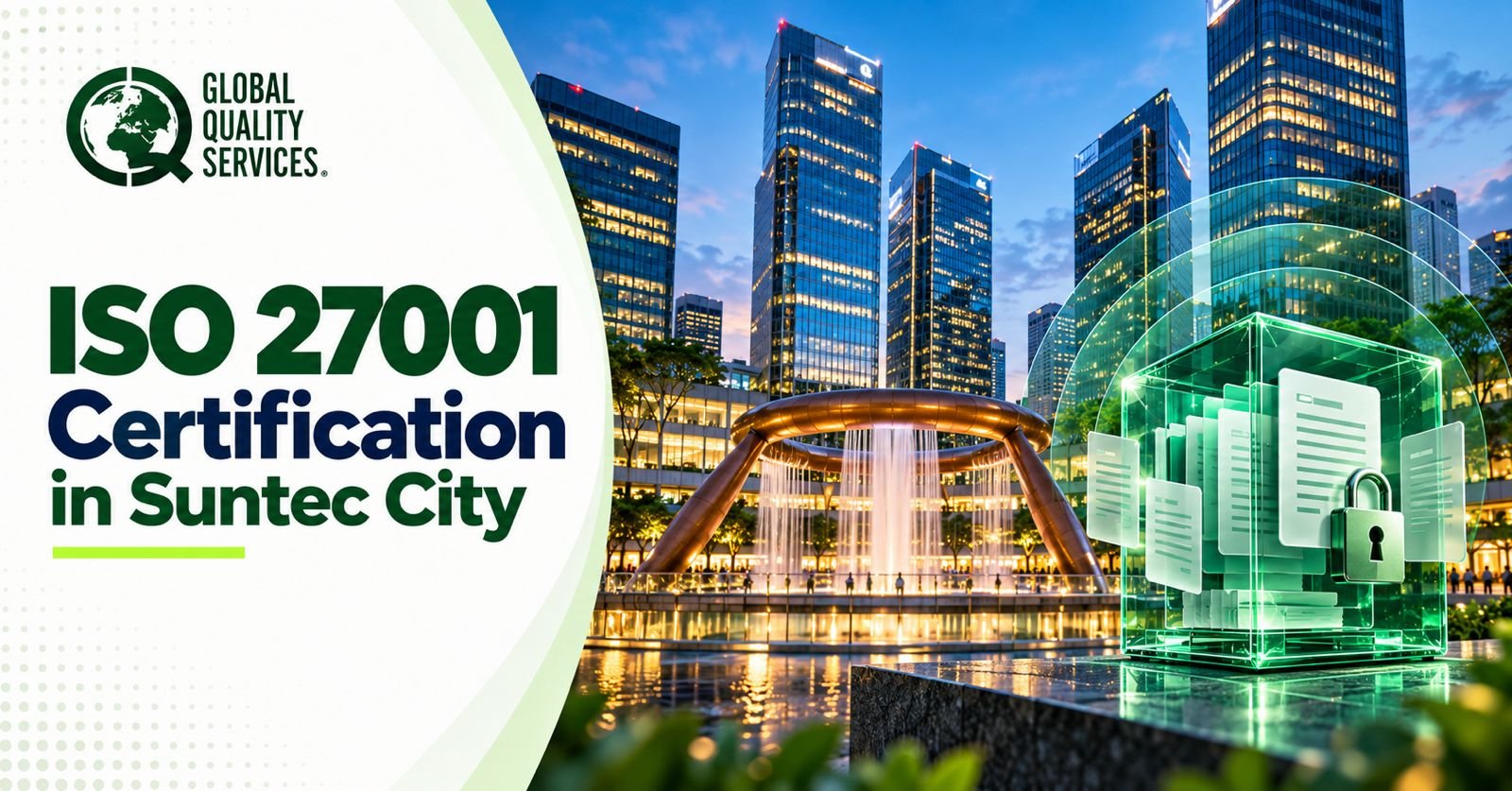
Suntec City is a prominent commercial destination in Singapore, bringing together corporate offices, professional services, technology businesses, retail outlets, and event-related organizations. These businesses handle sensitive information, including customer records, financial data, employee details, contracts, and confidential business documents. Protecting this information is essential for maintaining customer trust and business continuity.
ISO 27001 Certification in Suntec City helps organizations establish a structured Information Security Management System (ISMS) to identify risks, strengthen security controls, and protect information across their operations. GQS Singapore provides ISO 27001 consultancy and certification readiness support to help businesses prepare for independent certification.
Whether your company operates from a Suntec City office, delivers digital services, or manages information for clients and business partners, ISO 27001 can help establish a consistent and risk-based approach to information security.
What Is ISO 27001 Certification?
ISO 27001 is an internationally recognized standard for information security management. It helps organizations manage risks affecting the confidentiality, integrity, and availability of information through defined policies, risk assessments, security controls, and continual improvement.
Certification demonstrates that an organization’s ISMS has been independently assessed against the applicable standard. It does not guarantee that cyberattacks or data breaches will never occur. Instead, it provides a structured framework for identifying risks, implementing safeguards, and reviewing whether controls remain effective.
For Suntec City businesses, ISO 27001 can help align information security practices across employees, IT systems, business processes, and external service providers.
Latest ISO 27001 Standard Updates
The current international standard is ISO/IEC 27001:2022, which specifies requirements for establishing, implementing, maintaining, and continually improving an ISMS. The previous ISO/IEC 27001:2013 edition has been withdrawn.
In February 2024, ISO published Amendment 1:2024, Climate Action Changes. It requires organizations to consider whether climate change is relevant to their organizational context and to recognize that interested parties may have climate-related requirements. This is an amendment to the existing standard, not a separate certification.
Businesses preparing for certification should use the 2022 edition and consider the applicable amendment within their ISMS. The official ISO/IEC 27001 standard provides the authoritative reference.
Which Businesses in Suntec City Need ISO 27001 Certification?
ISO 27001 can benefit organizations of different sizes and sectors. Its relevance depends on the information a business handles, its contractual obligations, and the risks associated with its operations.
Technology and IT Service Providers
Software companies, managed service providers, cloud-based businesses, and IT support firms may handle customer data, system credentials, application information, and confidential technical documentation. An ISMS helps establish controls for access management, system security, incident response, and supplier relationships.
Financial and Professional Services
Consultancies, corporate service providers, financial businesses, and professional firms often manage confidential client information and commercially sensitive records. ISO 27001 can help formalize information-handling procedures and demonstrate a structured approach to security during client and supplier evaluations.
Event and Exhibition Businesses
Organizations involved in conferences, exhibitions, and corporate events may process attendee registrations, exhibitor details, payment-related information, and event access records. Their security arrangements must account for the systems, employees, contractors, and external platforms used to manage this information.
Retail, Hospitality, and Commercial Businesses
Retailers and hospitality operators may handle customer profiles, employee records, booking information, and transaction-related data. ISO 27001 helps them assess information security risks across business applications, networks, and third-party services.
Regional Offices and Multinational Companies
Companies using Suntec City as a regional business location may need consistent information security practices across departments and international teams. ISO 27001 provides a framework for defining responsibilities, managing risks, and maintaining controls across the agreed certification scope.
Why Is ISO 27001 Important for Businesses in Suntec City?
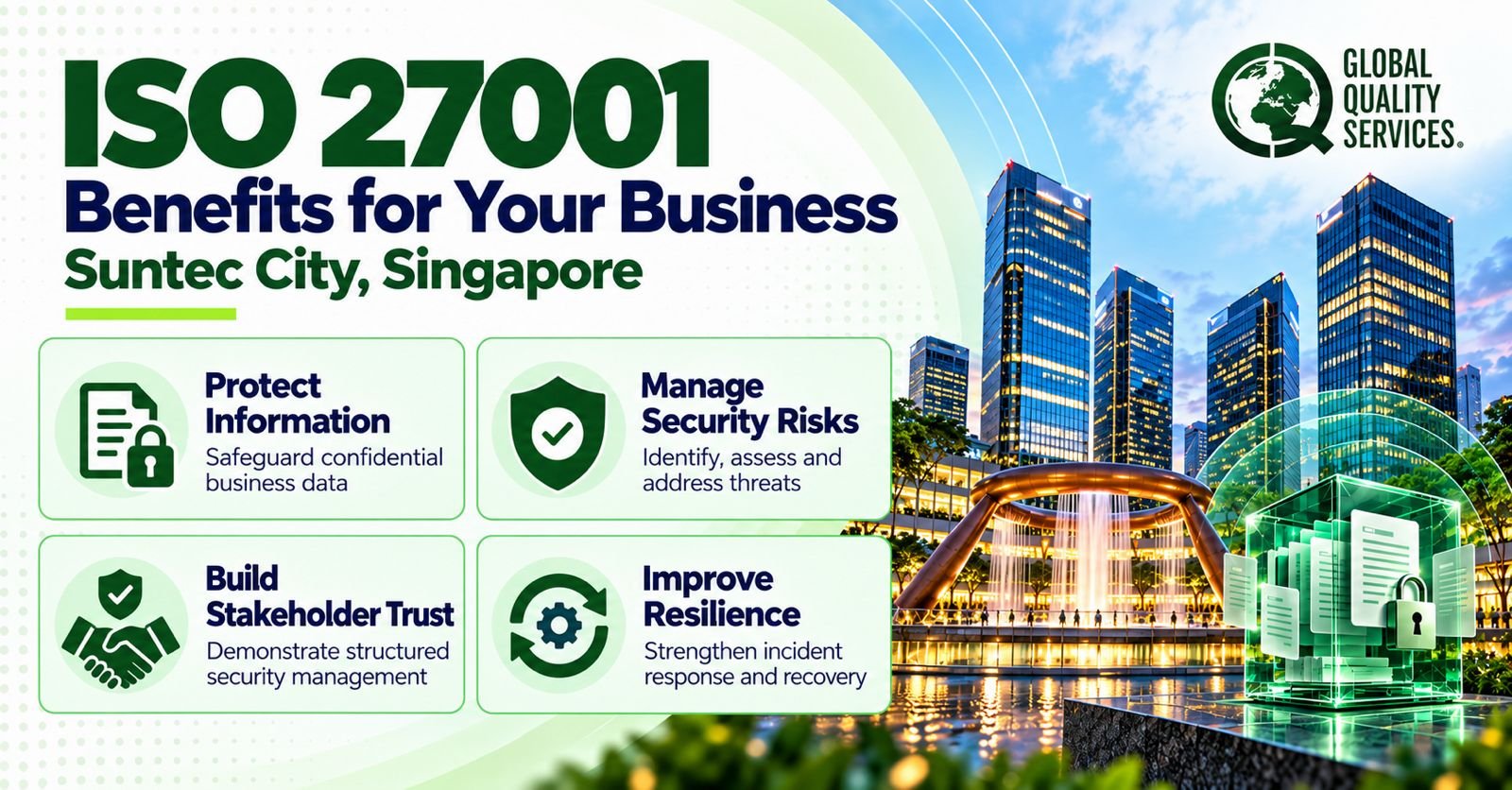
Businesses operating in a commercial hub often depend on connected applications, outsourced IT services, shared information systems, and external business partners. A weakness in one area can compromise confidential information or disrupt operations.
ISO 27001 brings risk assessment, security policies, employee responsibilities, technical controls, and management oversight into a coordinated system.
Protects Confidential Business Information
A structured ISMS helps identify where sensitive information is stored, accessed, transferred, and processed. Appropriate controls can reduce the risk of unauthorized access, accidental disclosure, and loss of important business records.
Builds Customer and Partner Confidence
Clients may want evidence that their information is handled under a recognized security framework. ISO 27001 certification can support supplier evaluations, procurement requirements, business proposals, and contractual discussions involving information security.
Improves Risk Management
Risk assessments help organizations prioritize threats based on likelihood and potential impact. Defined responsibilities and documented procedures make it easier to track security issues and evaluate corrective actions.
Supports Business Continuity
Security incidents, system failures, and unavailable information can interrupt operations. An ISMS helps organizations consider these risks, establish appropriate controls, and coordinate information security with relevant recovery arrangements.
Strengthens Supplier Oversight
Businesses often rely on cloud platforms, software vendors, payroll providers, and outsourced IT teams. ISO 27001 encourages organizations to assess relevant supplier risks and set appropriate requirements to protect shared information.
What Are the Main ISO 27001 Requirements?
ISO/IEC 27001:2022 requires an organization to establish an ISMS suited to its context, risks, and business objectives. The system must be maintained and improved, not treated as a one-time documentation exercise.
Context and Scope of the ISMS
The organization must understand relevant internal and external issues, identify interested parties and their requirements, and define the boundaries of its ISMS. The scope may cover a specific office, business unit, service, or wider operation, depending on how information is managed.
Information Security Risk Assessment
The organization must establish a process to identify, analyze, and evaluate information security risks. It should determine which risks require treatment and retain appropriate assessment records.
Risk Treatment and Statement of Applicability
The organization must select suitable risk treatment measures and document its decisions in a risk treatment plan. The Statement of Applicability identifies the controls considered necessary, explains why they were included or excluded, and records their implementation status.
Leadership and Employee Responsibilities
Top management must demonstrate commitment to the ISMS, assign responsibilities, provide necessary resources, and support information security objectives. Employees should understand their responsibilities and follow relevant security policies.
Operational Controls and Monitoring
Depending on its risks and scope, the organization may need controls for access management, asset handling, cryptography, supplier security, incident management, vulnerability management, backups, and security logging.
Internal Audit and Continual Improvement
The organization must conduct internal audits at planned intervals and carry out management reviews. Nonconformities must be addressed, and corrective actions should improve the effectiveness of the ISMS over time.
How Does the ISO 27001 Certification Process Work in Suntec City?
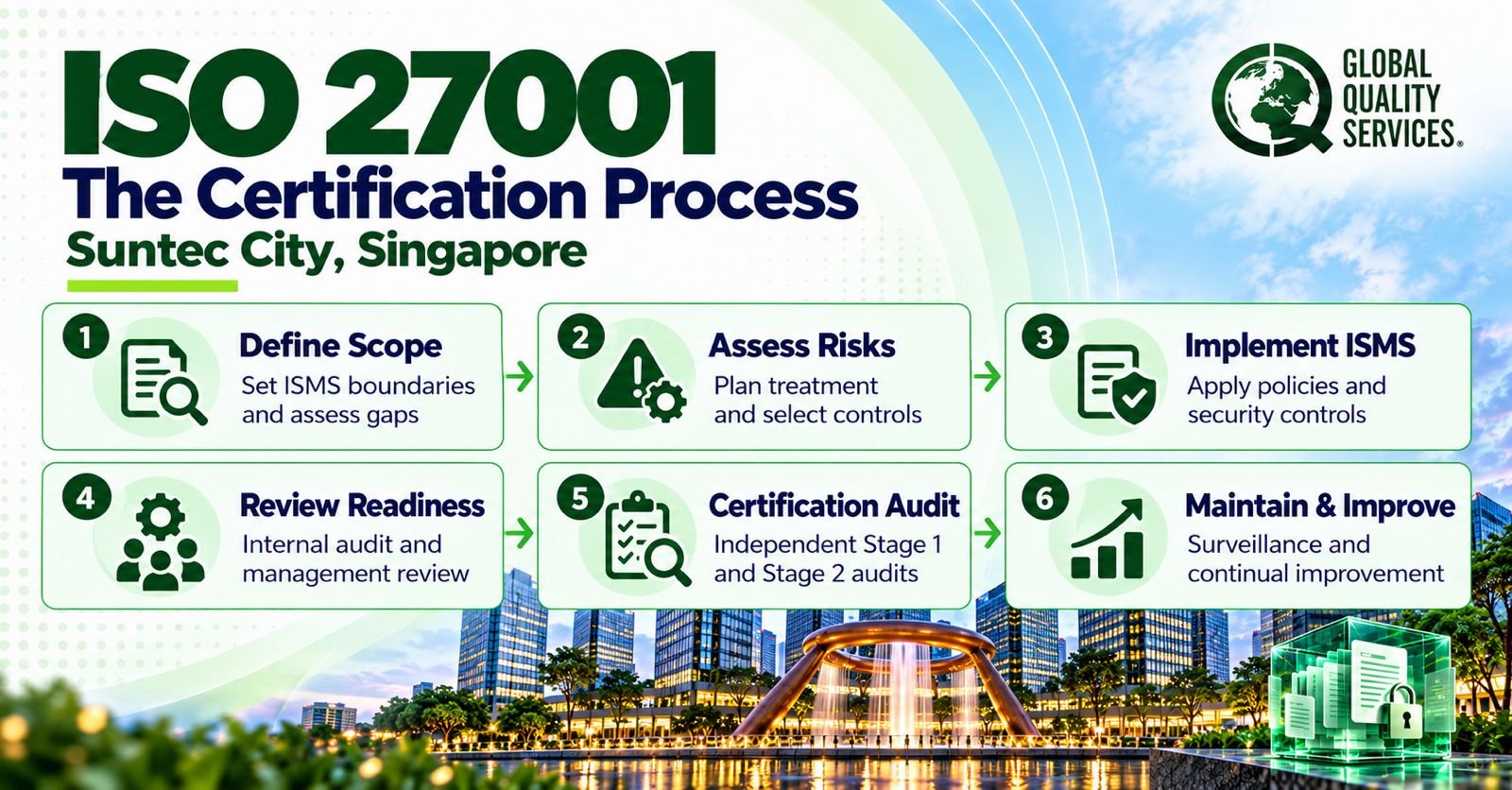
The process depends on the organization’s size, existing security arrangements, ISMS scope, and the complexity of its information systems. GQS Singapore can support preparation through the following stages.
1. Define the Certification Scope
Identify the business functions, locations, services, information assets, systems, and relevant external parties covered by the proposed ISMS. The scope should reflect how the organization operates and manages information security risks.
2. Conduct an ISO 27001 Gap Assessment
Review existing policies, risk assessment practices, access controls, supplier arrangements, incident procedures, and records against the standard’s requirements. The findings help identify the work needed before the certification audit.
3. Perform Risk Assessment and Treatment
Identify information security risks and evaluate their significance. Select suitable treatment measures, assign responsibilities, and document the rationale for the chosen controls.
4. Develop and Implement the ISMS
Establish the required policies, procedures, records, and operational controls. Employees and relevant stakeholders should understand their responsibilities, while the organization generates evidence that its processes are being followed.
5. Conduct Internal Audit and Management Review
Evaluate whether the ISMS meets applicable requirements and operates effectively. Address identified nonconformities and review outstanding risks before proceeding to the external certification assessment.
6. Complete the External Certification Audit
An independent certification body assesses the organization’s ISMS. Certification generally involves a Stage 1 audit to review readiness and documented arrangements, followed by a Stage 2 audit to evaluate implementation and effectiveness. Any nonconformities must be addressed through the certification body’s process.
GQS Singapore supports consultancy and readiness activities. The independent certification body conducts the certification audit and makes the certification decision.
How Long Does ISO 27001 Certification Take?
The timeline depends on the organization’s existing security controls, the number of in-scope systems and business functions, the availability of documented evidence, and the time needed to address gaps.
A business with established security practices may need less preparation than an organization building its ISMS from the beginning. Delays can arise when risk assessments, employee awareness, internal audits, or corrective actions remain incomplete.
A gap assessment can help establish a practical implementation plan and identify the activities most likely to affect the schedule.
What Factors Affect ISO 27001 Certification Cost in Suntec City?
No single certification cost applies to every organization. The overall budget depends on the ISMS’s scope and complexity, the number of employees and locations covered, the maturity of existing controls, and the work required to close identified gaps.
Costs may include consultancy, internal resources, technology or security improvements, employee awareness activities, and external certification audit fees. Certification audit fees are separate from consultancy charges.
Defining an appropriate scope early can help the organization plan its resources while ensuring that relevant activities, systems, and information security risks are addressed.
ISO 27001 and Singapore’s Personal Data Protection Act
Businesses in Suntec City that collect, use, or disclose personal data must consider their obligations under Singapore’s Personal Data Protection Act (PDPA) where applicable. The Personal Data Protection Commission Singapore provides official guidance on personal data protection requirements.
ISO 27001 and the PDPA serve different purposes. ISO 27001 establishes a management system for information security risks, while the PDPA sets legal requirements for the handling of personal data. An effective ISMS can support managing relevant security risks, but certification does not automatically ensure compliance with every PDPA obligation.
Organizations should assess their legal responsibilities separately and ensure their information security controls support applicable privacy requirements.
How Global Quality Services Can Help
With 26 years of experience, Global Quality Services supports organizations seeking to establish and improve management systems. Our ISO 27001 consultancy approach focuses on understanding your business operations, identifying gaps, planning practical controls, and preparing your team for an independent certification audit. Whether you operate a technology business, professional services firm, retail operation, or regional office in Suntec City, we can tailor our support to your information security risks and certification objectives.
Contact GQS Singapore to discuss your ISO 27001 requirements and develop a suitable certification readiness plan.
Frequently Asked Questions
1. Can ISO 27001 certification help a business qualify for an overseas client’s vendor requirements?
Yes. Certification provides evidence that an organization’s information security management system has been independently assessed. However, overseas clients may have additional requirements relating to data handling, security controls, incident notification, or service delivery. Acceptance depends on the client’s vendor assessment criteria.
2. What should a company do if its cloud provider experiences a security incident?
The company should follow its incident response procedures, assess whether its own information or services are affected, preserve relevant evidence, and coordinate with the provider. It should also determine whether contractual notifications or legal reporting obligations apply. Responsibilities for managing such incidents should be defined in advance.
3. Can a company keep its certification if it changes its cloud platform or IT service provider?
Potentially, yes. The organization should review how the change affects its information security risks and controls. It may need to update risk assessments, supplier records, access permissions, and recovery arrangements. Significant changes affecting the certified scope or ISMS should be handled in line with the certification body’s requirements.
4. How should a company manage information security when an employee leaves?
The organization should promptly revoke or modify access rights, recover company devices where applicable, and review the employee’s accounts, credentials, and permissions. Its offboarding process should also cover temporary workers and third-party personnel where relevant.
5. What happens if a customer asks for confidential security documents after certification?
The organization should first determine what evidence the customer needs and whether it is contractually required to provide it. A certificate or approved summary may suffice for some requests, while others may require additional evidence. Review and share sensitive internal records only through an authorized process, with appropriate confidentiality protections.