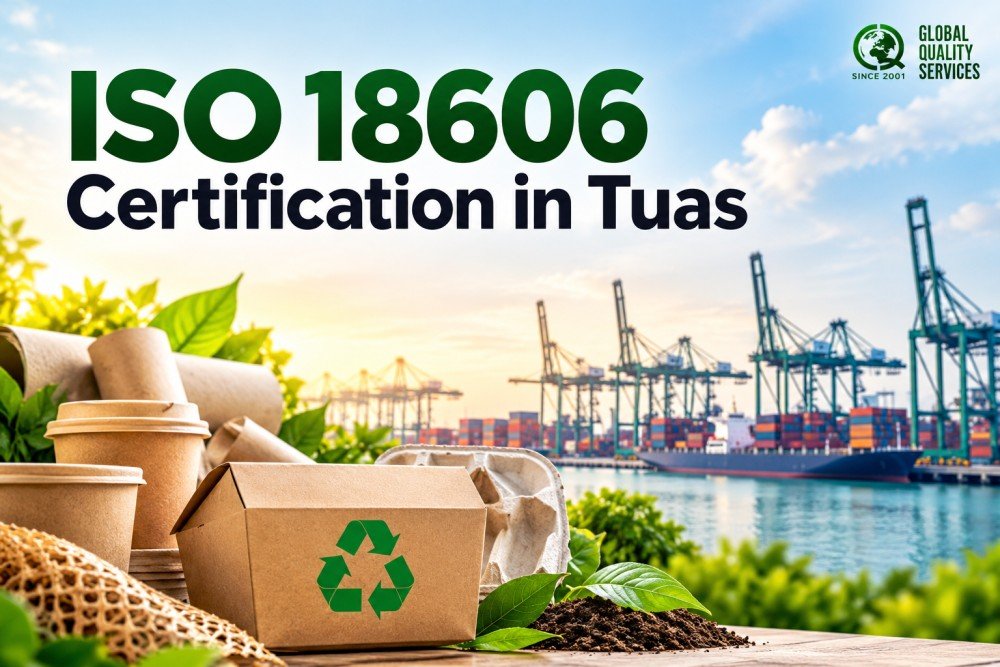
If your business in Tuas makes, supplies, or uses packaging intended for organic recycling, ISO 18606 deserves a closer look. Buyers may ask what happens to packaging after use, what materials it contains, and whether its environmental claims have supporting evidence. If your team cannot answer these questions with reliable records, winning or retaining certain contracts may become harder.
Singapore generated 918,000 tonnes of plastic waste in 2024, according to the Ministry of Sustainability and the Environment. The figure shows why packaging choices and waste management deserve serious attention. You can check the official government figures here.
ISO 18606 addresses packaging intended for organic recycling, including composting and biodegradation under defined conditions. However, not every material described as biodegradable meets the standard’s requirements. Your business needs the right technical evidence for its actual packaging.
Global Quality Services helps businesses understand these requirements before they commit time and money to certification. Read on to see whether ISO 18606 fits your packaging and how our consultants can help you prepare for assessment.
What Does ISO 18606 Mean for Your Business
ISO 18606:2013 sets requirements for packaging recoverable through organic recycling. In practical terms, it helps businesses assess whether packaging meets the applicable criteria for this recovery route.
Consider a packaging supplier in Tuas developing a product for a customer who wants compostable packaging. A description on the product label may not be enough. The supplier needs evidence that supports its claims about the packaging and its components.
The same issue can affect manufacturers, food businesses, importers, and brands that purchase packaging from third parties. Your company may not manufacture the material itself, but you may still need reliable information from suppliers to answer customer questions.
Is ISO 18606 Certification Relevant to Your Company in Tuas
Not every business needs ISO 18606. The standard makes sense when your packaging and commercial requirements call for organic recycling. You may want to explore certification if your company:
- Manufactures packaging intended for composting or biodegradation.
- Supplies packaging materials to food, retail, or consumer goods companies.
- Buys packaging from multiple suppliers and needs better technical records.
- Develops products for customers with specific organic recycling requirements.
- Sells packaged goods and needs evidence to support packaging claims.
- Wants to assess whether existing packaging specifications meet a recognized standard.
What Should You Check Before Applying for ISO 18606 Certification
The biggest challenge is often the evidence behind the packaging, rather than the application itself. A company may already have material specifications and laboratory reports, yet still lack information about individual components or the conditions covered by those reports. Before you proceed, pay attention to these areas.
1. Material Composition
Do you know exactly what goes into your packaging? Gather the specifications for the main material, coatings, inks, adhesives, additives, and other relevant components. Ask suppliers for missing information instead of making assumptions.
2. Existing Laboratory Reports
Review the test reports you already hold. Check which material the laboratory tested, which methods it used, and whether the results address the applicable ISO 18606 requirements. A report for one material may not establish conformity for the complete packaging.
3. Packaging Components
A package may contain several materials that behave differently during organic recycling. Your team needs to assess the relevant components against the applicable criteria. Do not assume that a suitable main material makes every part of the package compliant.
4. Supplier Cooperation
Your assessment may depend on information held by material manufacturers and other suppliers. Establish who can supply the necessary specifications, declarations, and test evidence. Missing supplier information can delay your preparation.
5. Environmental Claims
Check the wording your company uses in product descriptions, packaging labels, and marketing materials. Claims about compostability or biodegradation should match the available evidence and the conditions supported by the applicable requirements.
Global Quality Services can review these areas with your team and help you decide what to address first.
What Happens During ISO 18606 Certification Preparation
Preparing for ISO 18606 certification starts with understanding your packaging, not filling out paperwork. Global Quality Services helps businesses in Tuas identify what they already have, what needs attention, and how to prepare for assessment:
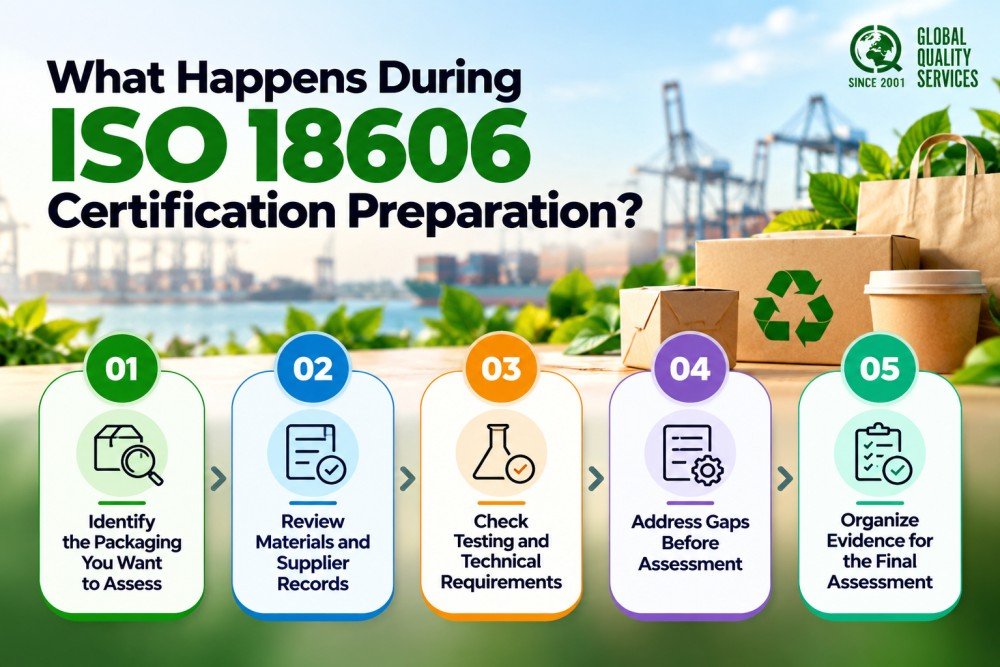
Step 1: Identify the Packaging You Want to Assess
Start by listing the packaging products you want to assess. Record their materials, components, intended use, and organic recycling route. This gives your consultant a clear picture of the scope.
Step 2: Review Materials and Supplier Records
Gather material specifications, supplier declarations, and existing laboratory reports. Your consultant reviews these records to identify missing details, unclear claims, or information that needs further verification.
Step 3: Check Testing and Technical Requirements
Not every packaging product needs the same evidence. Review the applicable ISO 18606 requirements and determine whether existing test results are suitable or additional laboratory testing may be necessary.
Step 4: Address Gaps Before Assessment
Resolve missing documentation, request outstanding supplier information, and arrange any necessary testing. Addressing these issues early can help prevent avoidable delays during the assessment.
Step 5: Organize Evidence for the Final Assessment
Bring the relevant specifications, test reports, and supporting records together. Global Quality Services can help your team review the documentation and prepare for assessment by the appropriate certification or conformity assessment body.
ISO 18606 and ISO 14001: Which Should You Consider
These standards address different business needs.
ISO 18606 focuses on packaging recoverable through organic recycling. It concerns the suitability of packaging for this specific recovery route.
ISO 14001 addresses an organization’s environmental management system. It helps businesses manage environmental responsibilities, operational impacts, objectives, and related controls.
A packaging manufacturer may consider both standards if it needs to demonstrate packaging conformity and improve its wider environmental management practices. However, one standard does not replace the other.
Global Quality Services can help you assess which requirements apply to your business and whether pursuing both standards makes sense for your objectives.
How Global Quality Services Helps You Prepare for ISO 18606 Certification in Tuas
Global Quality Services approaches ISO consulting with that practical objective. Our company website lists 21 years of experience and services across several certification areas. We also publish client testimonials describing our responsiveness, practical advice, and support with certification projects. Businesses considering our consulting services can discuss the following with our team:
- Reputed consultant: Access to a consulting team with experience across international certification requirements.
- Relevant technical guidance: Help understanding packaging components, test evidence, and applicable requirements.
- Individual attention: Recommendations based on your products, available records, and business objectives.
- Clear gap identification: A practical view of missing information and areas requiring further evaluation.
- Documentation support: Guidance on organizing technical specifications, supplier records, and assessment evidence.
- Team knowledge transfer: Help your employees understand the requirements and their responsibilities.
- Broader certification experience: Access to consulting support for related standards where your business has additional requirements.
Talk to Global Quality Services About ISO 18606 Certification in Tuas
Not sure whether your current packaging meets ISO 18606 requirements? Speak with Global Quality Services before investing in additional tests or making changes to your products.
Tell us what you manufacture or supply, which materials your packaging contains, and whether you already have laboratory reports. Our team can discuss your requirements, identify the questions that need attention, and explain the consulting support your business may need.
You can also contact Global Quality Services Singapore to arrange a discussion about your packaging and certification goals. Global Quality Services offers services in China, Singapore, Malaysia, and the Philippines.
Frequently Asked Questions
1. Can we use our supplier’s laboratory reports for ISO 18606 assessment?
Possibly. The assessor will need to determine whether the reports cover your actual packaging, relevant components, applicable test methods, and required conditions. Incomplete evidence may require further testing.
2. What if our packaging contains inks, coatings, and adhesives?
You should include these components in the technical review. Their composition and role may affect the applicable requirements, so gather supplier information and relevant test evidence before assessment.
3. Should we change our packaging before hiring an ISO 18606 consultant?
Not necessarily. Start by reviewing the materials and evidence you already have. A gap assessment can help identify whether changes or additional testing are actually needed.
4. Can ISO 18606 help us respond to customer sustainability requirements?
Yes, where customers specifically require evidence relating to organic recycling. Your business can use relevant conformity evidence to support discussions, but it should not claim broader environmental benefits without appropriate proof.
5. How can we estimate the cost of ISO 18606 certification in Tuas?
The cost depends on product scope, packaging complexity, existing test reports, additional laboratory work, and assessment fees. Share these details with your consultant to discuss a realistic estimate.