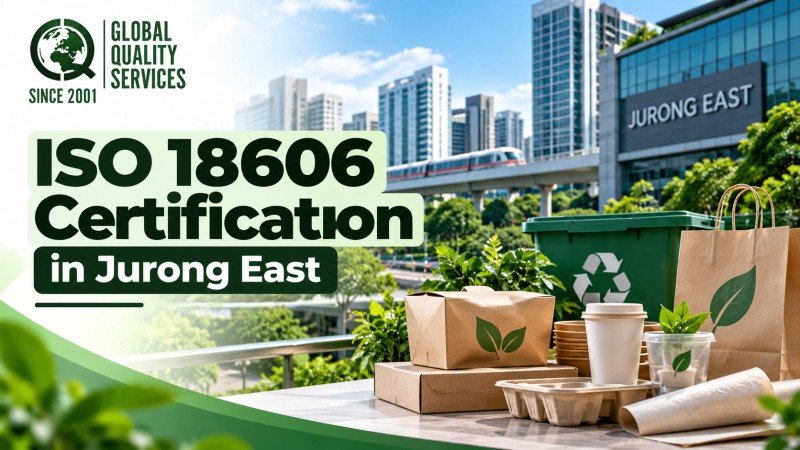
ISO 18606 Certification in Jurong East helps businesses assess whether their packaging meets organic recycling requirements. The ISO 18606:2013 standard evaluates biodegradation, disintegration, effects on biological treatment processes, and compost quality.
According to Singapore’s National Environment Agency, packaging waste accounted for about one-third of domestic waste disposed of in 2017, highlighting the need for better packaging design. Businesses in Jurong East can assess suitable materials and support responsible packaging choices. Hiring an experienced consultant helps identify gaps, coordinate testing, organise documentation, and prepare for the relevant assessment or certification process.
What is ISO 18606 Certification
ISO 18606:2013 is an international standard titled Packaging and the environment: Organic recycling. It explains how businesses can assess used packaging for suitability in organic recycling processes.
The standard considers the entire packaging component, not just its main material. For example, a package may contain paper, a coating, adhesive, ink, and other components. Each component must meet the relevant requirements for the packaging to qualify as recoverable through organic recycling.
If workers can easily separate certain components before disposal, businesses may assess those components individually. However, a package does not qualify simply because its main material appears biodegradable.
ISO 18606 also distinguishes organic recycling from littering. It does not establish requirements for packaging that ends up in the natural soil environment as litter.
Why Does ISO 18606 Matter for Businesses in Jurong East?
Jurong East supports commercial, retail, distribution, and industrial activities that rely on packaging. Businesses serving customers in Singapore may need to review their packaging choices, sustainability goals, and environmental claims.
ISO 18606 gives organisations a structured way to assess packaging intended for organic recycling. It helps them look beyond labels such as “compostable” or “biodegradable” and examine whether the material meets the relevant technical requirements.
Singapore’s National Environment Agency reports that packaging waste accounts for about one-third of domestic waste disposed of in the country. This makes packaging design and waste reduction important considerations for businesses.
Companies in Jurong East can use ISO 18606 assessments to make better-informed material choices, work with packaging suppliers, and support credible sustainability communication. However, meeting the standard does not automatically guarantee that local waste facilities accept a particular package for composting.
Key Requirements of ISO 18606
Businesses assessing packaging against ISO 18606 should consider several technical requirements.
1. Material characterisation
Identify the packaging materials and their constituents before testing. Review relevant information about their composition and check for substances that could harm the biological treatment process or resulting compost.
2. Biodegradation
Assess whether the packaging material breaks down biologically under the applicable test conditions. The material must meet the standard’s criteria rather than rely solely on a supplier’s general biodegradability claim.
3. Disintegration
Evaluate how the packaging breaks down during biological waste treatment, including composting. The assessment must also consider whether the material causes observable negative effects on the treatment process.
4. Compost quality
Check whether the treated packaging negatively affects the quality of the resulting compost. Assessments consider relevant hazardous substances and regulated metals against the applicable requirements.
5. Recognition of organic recyclability
Businesses must consider how users can recognise packaging intended for organic recycling. Appropriate identification helps distinguish the intended disposal route and supports correct handling.
The standard sets requirements for these areas, but the applicable testing programme depends on the packaging material and assessment circumstances.
Which Businesses Can Benefit from ISO 18606 in Jurong East?
ISO 18606 may be relevant to businesses that design, manufacture, supply, or use packaging intended for organic recycling.
- Packaging manufacturers: They can assess material formulations and determine whether packaging components meet the standard’s requirements.
- Food and consumer goods brands: Businesses can review suitable packaging options for products they sell, while separately checking food-contact and product-safety requirements where applicable.
- Retailers and distributors: They can work with suppliers to understand packaging claims and select materials that match their sustainability objectives.
- E-commerce businesses: Companies can assess suitable shipping packaging and explore options that support their waste-reduction plans.
- Packaging material suppliers: Suppliers can use appropriate test evidence to support customer evaluations and communicate material performance more accurately.
Businesses should confirm the standard’s suitability for their packaging and intended treatment route before making compliance or environmental claims.
How to Prepare for ISO 18606 Assessment
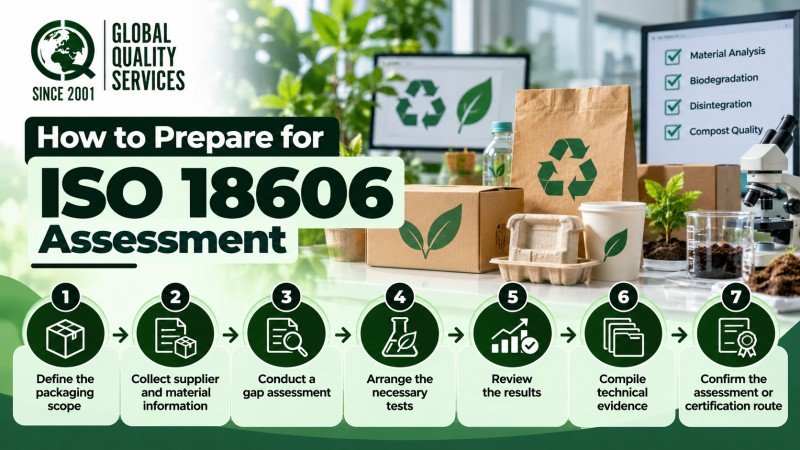
Businesses in Jurong East can follow a structured preparation process before arranging testing or conformity assessment.
Step 1: Define the packaging scope
Identify the packaging products, materials, components, and intended applications for assessment. Include coatings, adhesives, inks, labels, and other relevant elements, not just the main packaging material.
Step 2: Collect supplier and material information
Gather specifications, material composition details, technical data sheets, and available test reports. Ask suppliers for evidence supporting any existing biodegradability or compostability claims.
Step 3: Conduct a gap assessment
Compare available information with the applicable ISO 18606 requirements. Identify missing evidence, materials that need further testing, and components that may affect organic recycling performance.
Step 4: Arrange the necessary tests
Work with a competent testing laboratory to determine the appropriate assessment programme. Testing may cover material characterisation, biodegradation, disintegration, compost quality, and other applicable requirements.
Step 5: Review the results
Examine laboratory findings and address any areas that do not meet the relevant criteria. You may need to revise the material composition, change a component, or repeat specific tests.
Step 6: Compile technical evidence
Keep the applicable test reports, material specifications, supplier information, packaging descriptions, and assessment records together. Clear documentation helps your team explain the basis for its conclusions.
Step 7: Confirm the assessment or certification route
Determine whether your customer, market, or chosen conformity assessment provider requires testing, independent verification, or a particular certification arrangement. ISO itself does not certify products or issue certificates.
Documents Required for ISO 18606 Assessment
Your documentation will depend on the packaging type, its components, and the assessment route. Businesses should prepare the following records where applicable:
- • Packaging specifications and technical drawings.
- • Material composition and constituent information.
- • Supplier declarations and technical data sheets.
- • Information about inks, adhesives, coatings, and labels.
- • Laboratory test reports for relevant requirements.
- • Records of regulated metals or other potentially hazardous substances.
- • Packaging samples and product identification details.
- • Records of material changes and corrective actions.
- • Evidence supporting environmental claims and disposal instructions.
Organised documentation helps businesses trace test results to the correct packaging design. It also makes it easier to review changes when suppliers modify materials or manufacturing processes.
Common Challenges During ISO 18606 Assessment
Businesses may face practical challenges when evaluating packaging for organic recycling.
- Incomplete material information: Suppliers may not disclose enough detail about coatings, additives, adhesives, or inks. Request clear technical information before selecting a test programme.
- Mixed packaging materials: A package may combine materials that behave differently during biological treatment. Assess each relevant component and consider whether users can separate components before disposal.
- Unsupported environmental claims: Words such as “eco-friendly,” “biodegradable,” and “compostable” do not automatically demonstrate conformity. Use claims that match available evidence and the intended treatment conditions.
- Unsuitable disposal assumptions: Packaging that meets technical requirements may still lack access to an appropriate local treatment facility. Check local collection and processing arrangements before communicating disposal instructions.
- Changes to packaging design: A new coating, adhesive, colourant, or material supplier may affect earlier test results. Review whether changes require additional assessment
Working with an experienced consultant can help businesses organise technical evidence, identify testing needs, and address documentation gaps before an external review.
How Global Quality Services Can Help with ISO 18606 in Jurong East
Global Quality Services can help businesses understand ISO 18606 requirements and prepare for the relevant assessment process. Our team can review your packaging scope, identify documentation gaps, coordinate preparation activities, and help you understand what evidence your selected assessment route requires.
We can also help your team organise supplier information and test reports, review the basis for environmental claims, and plan corrective actions where needed. Global Quality Services offers services for China, Indonesia, Malaysia, the Philippines, and Singapore.
If your business operates in Jurong East, contact Global Quality Services to discuss your packaging requirements and determine a suitable path towards ISO 18606 conformity assessment.
Frequently Asked Questions
1. Can ISO 18606 assessment results apply to packaging sold under different brand names?
Possibly, if the packaging materials, composition, design, and relevant specifications remain equivalent. Confirm the assessment scope with the testing laboratory or conformity assessment provider before reusing results.
2. Does ISO 18606 require businesses to change all existing packaging immediately?
No. The standard does not automatically require every business to replace existing packaging. Companies should assess applicable customer, market, regulatory, and contractual requirements before planning changes.
3. Can packaging pass ISO 18606 if it contains recycled material?
Recycled content alone does not determine conformity. The packaging must meet applicable organic recycling requirements, including relevant biodegradation, disintegration, treatment-process, and compost-quality criteria.
4. Should businesses repeat ISO 18606 testing after changing a supplier?
A supplier change may affect material composition or performance. Review the new specifications and existing test evidence with the laboratory to determine whether additional testing is necessary.
5. Does ISO 18606 approval mean packaging will decompose in a home compost bin?
Not necessarily. ISO 18606 does not cover biological treatment in small household installations, so businesses should not assume industrial composting results apply to home composting.