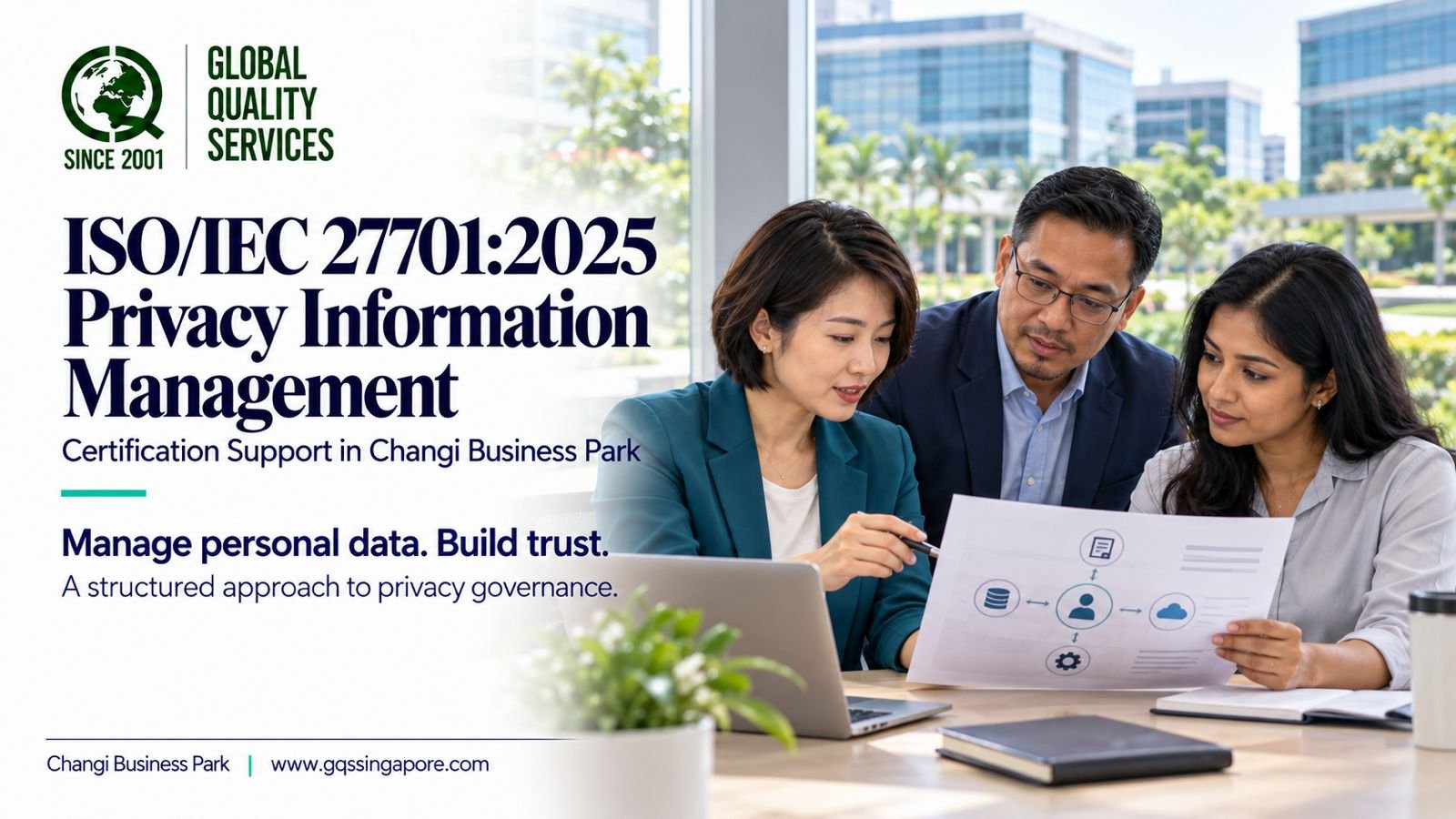
Technology businesses manage personal information across product development, customer support, recruitment, software platforms, and external service provider relationships. For organizations in Changi Business Park, these activities can involve multiple teams and systems, making consistent privacy controls a key part of business governance.
ISO/IEC 27701:2025 Certification in Changi Business Park provides a way for organizations to demonstrate that their Privacy Information Management System (PIMS) has been assessed against an internationally recognized standard. The standard establishes requirements for managing personally identifiable information (PII), defining responsibilities, evaluating privacy risks, and continually improving privacy management practices.
Global Quality Services provides certification services for organizations seeking an independent assessment of their privacy management systems.
Privacy Management for Changi Business Park Organizations
Changi Business Park accommodates businesses engaged in high-technology, research and development, and knowledge-intensive activities. For organizations operating in these fields, privacy considerations may arise throughout product and service development and delivery.
Personal information may enter an organization through customer registrations, employee records, product testing, technical support, recruitment platforms, or business partner systems. The challenge is to keep privacy responsibilities clear as information moves between teams and service providers.
ISO/IEC 27701:2025 is relevant to organizations that determine the purposes and means of processing personal information, as well as those that process information on behalf of other organizations.
Businesses that may consider certification include:
- Software and technology companies handling customer accounts, user profiles, support tickets, or platform data.
- Research and development organizations processing identifiable information as part of defined projects or business activities.
- Regional offices and headquarters coordinating employee, customer, and supplier information across different locations.
- IT service providers managing systems or personal information for business clients.
- Corporate service teams handling recruitment, payroll, finance, and other employee-related records.
- Business process service providers processing customer or employee information under contractual arrangements.
The appropriate certification scope depends on the organization’s actual activities, responsibilities, and boundaries. A company should not assume that every group entity, system, or overseas operation is automatically included.
Where Privacy Risks Can Arise in Technology-Led Operations
Privacy risks are not limited to cyberattacks or unauthorized access. They can also arise when personal information is collected without a clear purpose, retained longer than necessary, shared with the wrong party, or accessed by employees who don’t need it for their work.
For Changi Business Park organizations, several operational areas deserve attention.
Product Development and Testing
Product teams may use customer feedback, account information, support records, or test data while developing and improving digital services. Organizations should establish procedures for using personal information, controlling access, and deciding when to retain or delete information.
Employee and Contractor Access
Employees, temporary staff, contractors, and external specialists may require access to different systems. Documented access responsibilities and processes for changing or removing permissions help organizations manage personal information throughout the employment and service lifecycle.
Cloud Platforms and External Vendors
Software platforms, hosting providers, recruitment systems, and outsourced service companies may handle information on an organization’s behalf. The organization should define relevant responsibilities, assess third-party arrangements, and maintain appropriate oversight of processing activities.
Regional Data Sharing
A business may share information with overseas offices, group entities, or service providers. These arrangements require clear accountability and consideration of applicable legal and contractual obligations. The organization should understand what information is transferred, why it is shared, and which parties are responsible for handling it.
What ISO/IEC 27701:2025 Certification Assesses
ISO/IEC 27701:2025 specifies requirements for establishing, implementing, maintaining, and continually improving a Privacy Information Management System. Published on October 14, 2025, the 2025 edition is a standalone management system standard.
The assessment considers the organization’s defined PIMS scope and its conformity with the applicable requirements. Depending on the nature of its processing activities, relevant areas may include:
- Privacy policies and accountability: Defined responsibilities, management oversight, and documented privacy objectives.
- PII processing activities: The purposes, methods, and conditions under which personal information is handled.
- Risk assessment and treatment: Processes for identifying privacy risks and addressing them appropriately.
- Information handling procedures: Controls covering access, retention, disclosure, and disposal of personal information.
- Third-party relationships: Relevant responsibilities and requirements for external organizations involved in processing.
- Privacy requests and incidents: Procedures for managing applicable individual requests, complaints, and privacy-related incidents.
- Performance evaluation: Monitoring, internal audits, management reviews, corrective action, and continual improvement.
Certification applies to the assessed scope, not automatically to every activity performed by a corporate group or every provider connected to its systems.
Benefits of ISO/IEC 27701:2025 Certification in Changi Business Park
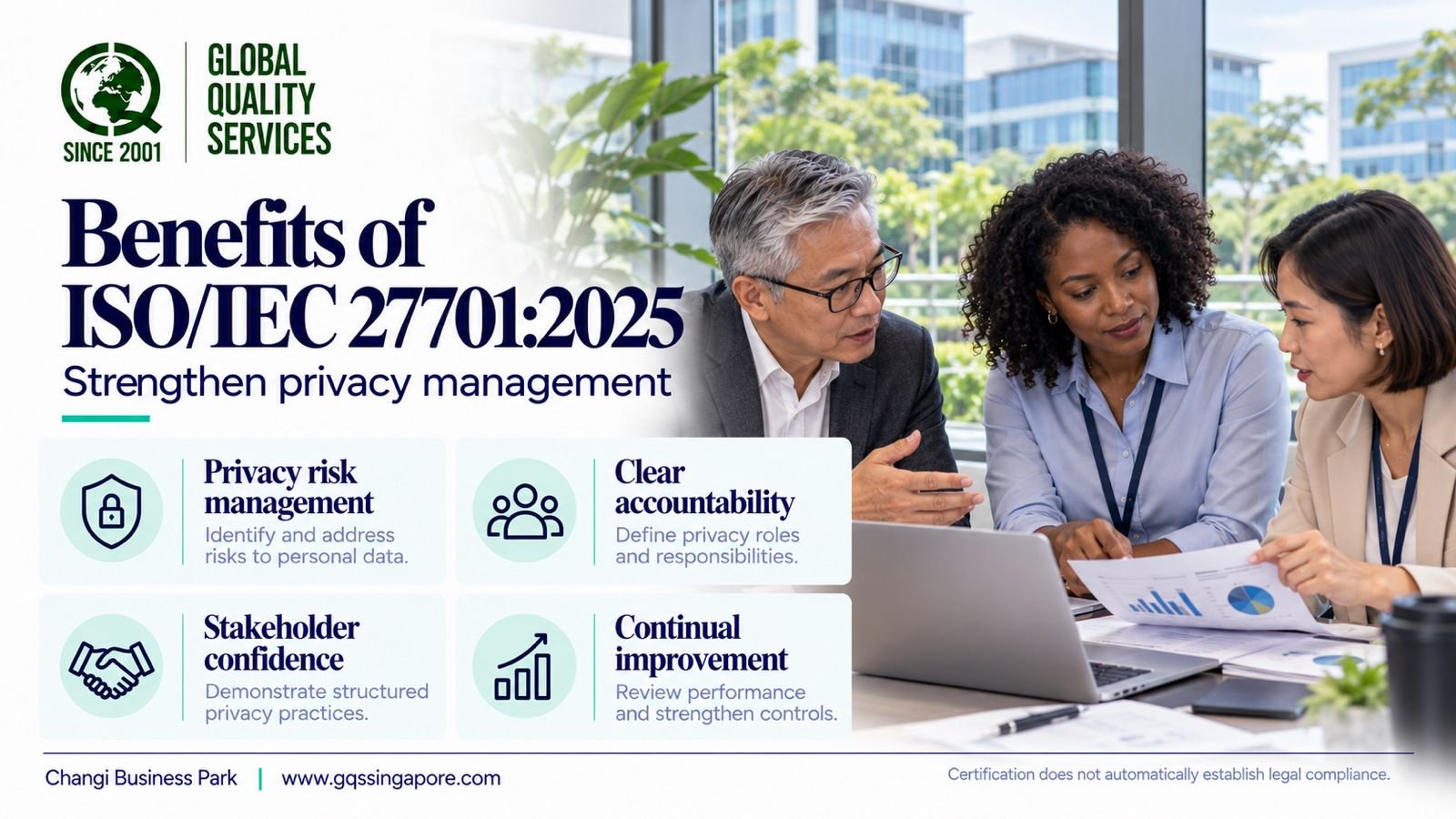
For technology-focused and service-based organizations, certification provides a structured way to show that privacy management is handled through defined processes rather than informal practices. Key benefits may include:
- Clearer accountability: Defined roles establish who is responsible for privacy decisions and processing activities.
- More consistent data handling: Documented procedures help teams manage personal information across business functions.
- Improved supplier oversight: Privacy responsibilities can be considered when selecting and monitoring external service providers.
- Better risk visibility: A structured assessment process helps management identify privacy-related weaknesses and prioritize corrective action.
- Stronger customer assurance: A valid certificate provides evidence that an independent assessor has reviewed the stated PIMS scope.
- Support for business relationships: Certification may be relevant when customers or partners evaluate a supplier’s privacy management arrangements.
- Ongoing system improvement: Monitoring and corrective action help organizations respond to changes in technology, services, and processing activities.
Certification does not guarantee that privacy incidents will not occur. Its value depends on the suitability of the management system, the scope assessed, and the organization’s continued conformity with the standard.
ISO/IEC 27701:2025 and Singapore’s PDPA
Organizations handling personal information in Singapore should consider the requirements of the Personal Data Protection Act (PDPA), where applicable. These include obligations for collecting, using, disclosing, protecting, retaining, and managing personal data.
ISO/IEC 27701:2025 provides a management system framework for privacy information management. The PDPA establishes legal obligations. Although a PIMS can help an organization document responsibilities, assess risks, and manage relevant procedures, certification does not automatically establish compliance with every applicable legal requirement.
Organizations should identify the legal and contractual obligations relevant to their activities and assess whether their existing controls meet those obligations. Official guidance from Singapore’s Personal Data Protection Commission can be used as a reference when reviewing the PDPA requirements applicable to an organization.
Steps to Prepare for ISO/IEC 27701:2025 Certification
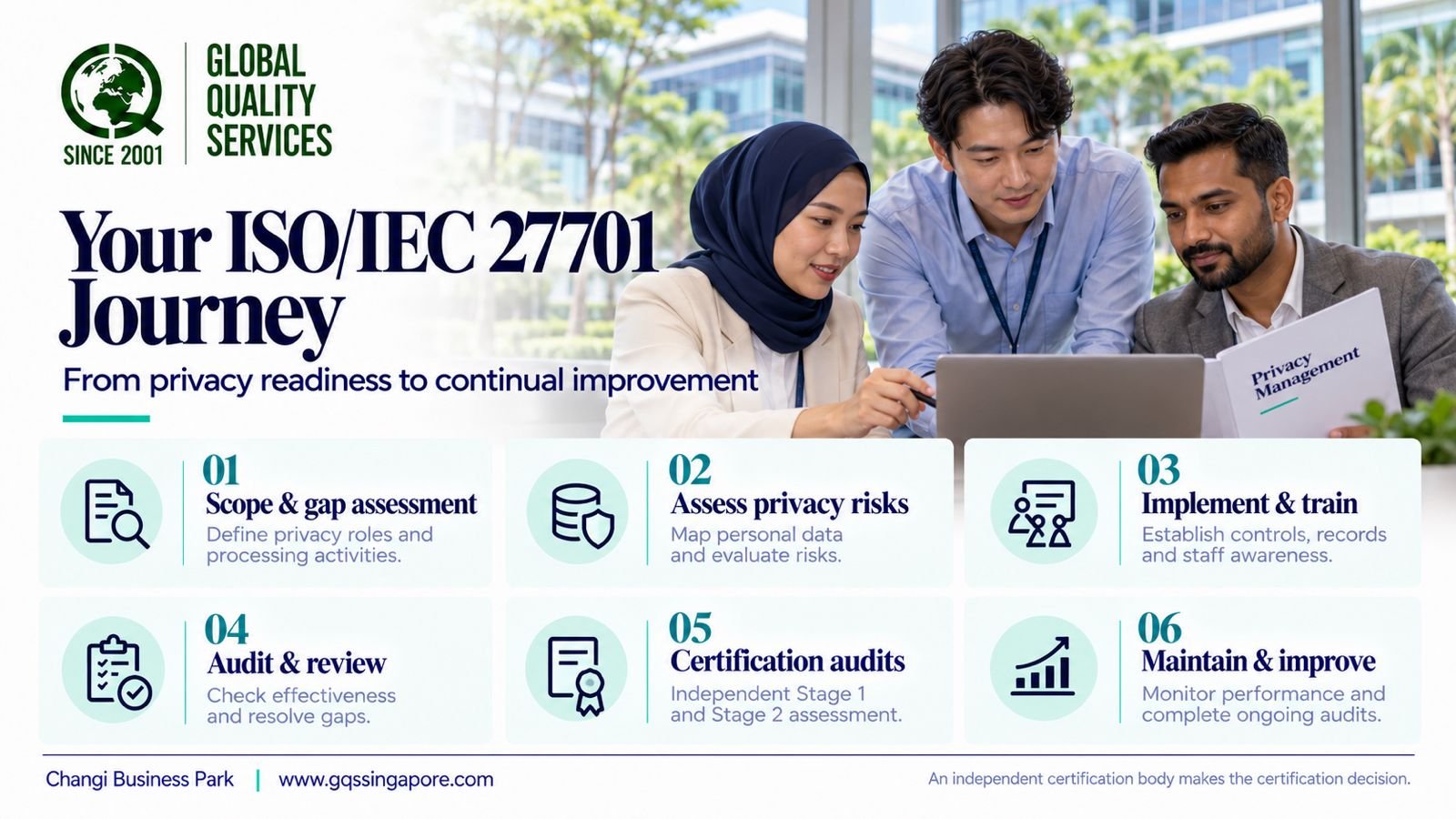
A well-defined scope and clear understanding of processing activities can make the certification assessment more focused.
1. Establish the Scope
Identify the legal entity, business functions, locations, systems, and personal information processing activities to be covered. For regional operations, clarify which activities are managed by the Singapore organization and which belong to other entities.
2. Identify Personal Information Flows
Map how personal information is collected, used, stored, shared, and deleted. Include relevant employee records, customer platforms, support systems, external services, and other processing activities within the proposed scope.
3. Review Existing Controls
Evaluate privacy policies, responsibilities, supplier agreements, access arrangements, retention procedures, incident processes, and relevant records against the applicable requirements of ISO/IEC 27701:2025.
4. Address Gaps
Assign responsibilities for corrective actions and establish or revise procedures where needed. Ensure that the documented system reflects actual business practices and that relevant personnel understand their responsibilities.
5. Undergo the Certification Assessment
The certification body evaluates the management system against the applicable requirements within the agreed scope. Any findings must be handled through the certification body’s established process before certification can be granted.
6. Maintain the PIMS
After certification, continue monitoring the system, reviewing changes in processing activities, addressing nonconformities, and meeting applicable surveillance and recertification requirements.
Why Choose Global Quality Services?
Global Quality Services provides certification services for organizations seeking independent assessment of their management systems. For businesses in Changi Business Park, the assessment scope should reflect the actual processing activities, organizational responsibilities, and privacy controls relevant to their operations.
A clearly defined scope helps establish what will be assessed and which requirements apply. When selecting a provider, organizations should also verify the certification body’s relevant accreditation and certification scope.
Contact Global Quality Services to discuss ISO/IEC 27701:2025 Certification in Changi Business Park and identify the appropriate certification scope for your organization.
Frequently Asked Questions
1. Can a technology company include its customer support platform in the certification scope?
Yes, if the platform and its related processing activities fall within the defined PIMS scope. The organization should identify the personal information the platform handles, the teams with access, and the responsibilities of any external provider operating it.
2. Does certification cover personal information used during software testing?
It can cover relevant testing activities when they are included in the certification scope. The organization should document how personal information is used, who can access it, and which controls apply to its handling, retention, and deletion.
3. Who is responsible for privacy when an external vendor processes customer information?
Responsibility depends on the parties’ roles, the processing arrangement, and applicable legal requirements. The organization should establish relevant contractual requirements and oversight rather than assuming that outsourcing removes its own obligations.
4. Can a company certify only its Singapore operations instead of its entire regional group?
A defined scope may cover Singapore operations without automatically including every overseas group entity. The proposed boundaries, relevant interfaces, and responsibilities should be clearly established and accepted as part of the certification process.
5. What should an organization prepare before requesting a certification assessment?
Start with the proposed scope, a record of personal information processing activities, relevant privacy policies, assigned responsibilities, risk assessments, supplier arrangements, and evidence that the management system is operating. The certification body can clarify the assessment process and applicable requirements.