For businesses in Raffles Place, environmental, social, and governance (ESG) considerations can shape investment decisions, corporate oversight, risk assessments, and stakeholder relationships. Financial institutions, investment firms, and professional services companies may need to demonstrate how sustainability issues are identified, evaluated, and incorporated into business decisions.
Global Quality Services provides ESG consulting services in Raffles Place to help organizations assess current practices, establish effective controls, and develop structured sustainability plans. Our approach focuses on practical improvements, reliable information, and clear accountability, not sustainability statements that are hard to measure.
Whether your organization is reviewing its existing ESG arrangements or preparing for new disclosure requirements, we can help identify the areas that need attention and establish a practical path forward.
What Should Businesses in Raffles Place Evaluate Before Developing an ESG Strategy?
Raffles Place is an established business and financial district with global headquarters and prominent commercial buildings. Its business environment makes ESG considerations relevant to organizations managing complex operations, financial relationships, and stakeholder expectations. The Urban Redevelopment Authority’s overview of Raffles Place provides additional context.
Before setting ESG targets or preparing disclosures, an organization should understand where it stands. This means looking beyond environmental performance alone.
Key areas to evaluate include:
- Business exposure: Which environmental, social, and governance issues could affect the organization’s operations, financial position, or reputation?
- Management accountability: Who is responsible for identifying ESG risks, approving policies, and monitoring progress?
- Information quality: Can the organization obtain reliable data and supporting records for its sustainability statements?
- Stakeholder expectations: What information do investors, customers, lenders, business partners, and employees need?
- Reporting obligations: Which disclosure requirements or sector-specific expectations apply to the organization?
The findings help management distinguish between immediate priorities, longer-term improvements, and issues that may not be material to the business.
ESG Consulting Services for Raffles Place Organizations
Global Quality Services can help organizations assess their ESG practices and identify opportunities to strengthen their sustainability approach. The scope of support depends on the organization’s activities, existing systems, and objectives.
ESG Assessment and Improvement Planning
An ESG assessment reviews the organization’s policies, procedures, performance data, and governance arrangements. It identifies gaps between current practices and the organization’s intended objectives or applicable requirements.
The assessment can produce a prioritized action plan that identifies needed changes, responsible parties, and required resources. This gives management a clearer basis for deciding where to focus its efforts.
Climate Risk and Business Resilience
Climate-related risks can affect organizations through physical events, changing regulations, market developments, and the transition to lower-emission business models.
A climate risk review can help management identify relevant exposures, evaluate their potential business implications, and determine how these issues should be reflected in existing risk management processes.
For financial institutions, the scope may also need to consider relevant supervisory expectations and the organization’s role in financing, investing, or managing financial risks. Guidance from the Monetary Authority of Singapore can inform this review.
Sustainability Data and Reporting Controls
ESG disclosures are only as dependable as the information used to prepare them. Data may be spread across finance, human resources, facilities, procurement, risk management, and regional business units.
Global Quality Services can help organizations review how this information is collected, checked, approved, and retained. This may involve defining data ownership, documenting calculation methods, establishing review procedures, and identifying gaps that need to be addressed before reporting.
ESG Policies and Governance
An ESG policy should reflect how an organization actually operates. A statement of intent is not sufficient if employees lack clear responsibilities or management cannot demonstrate how commitments are monitored.
Consulting support can help review governance arrangements, clarify accountability, and align relevant policies with business activities. Depending on the organization’s priorities, this may include business ethics, employee well-being, responsible procurement, environmental performance, and stakeholder engagement.
ESG Strategy and Performance Indicators
Once priorities have been established, organizations need a way to measure progress. An ESG strategy should identify objectives, define suitable performance indicators, assign responsibilities, and establish review dates.
For example, a company may monitor energy consumption, employee training, supplier assessments, or the completion of governance actions. The selected indicators should relate to its material issues and be supported by a consistent measurement method.
Supplier assessments and documented follow-up
The actions should be prioritized according to their relevance, urgency, and available resources. Not every organization needs the same controls or level of documentation.
How Global Quality Services Can Support ESG Implementation
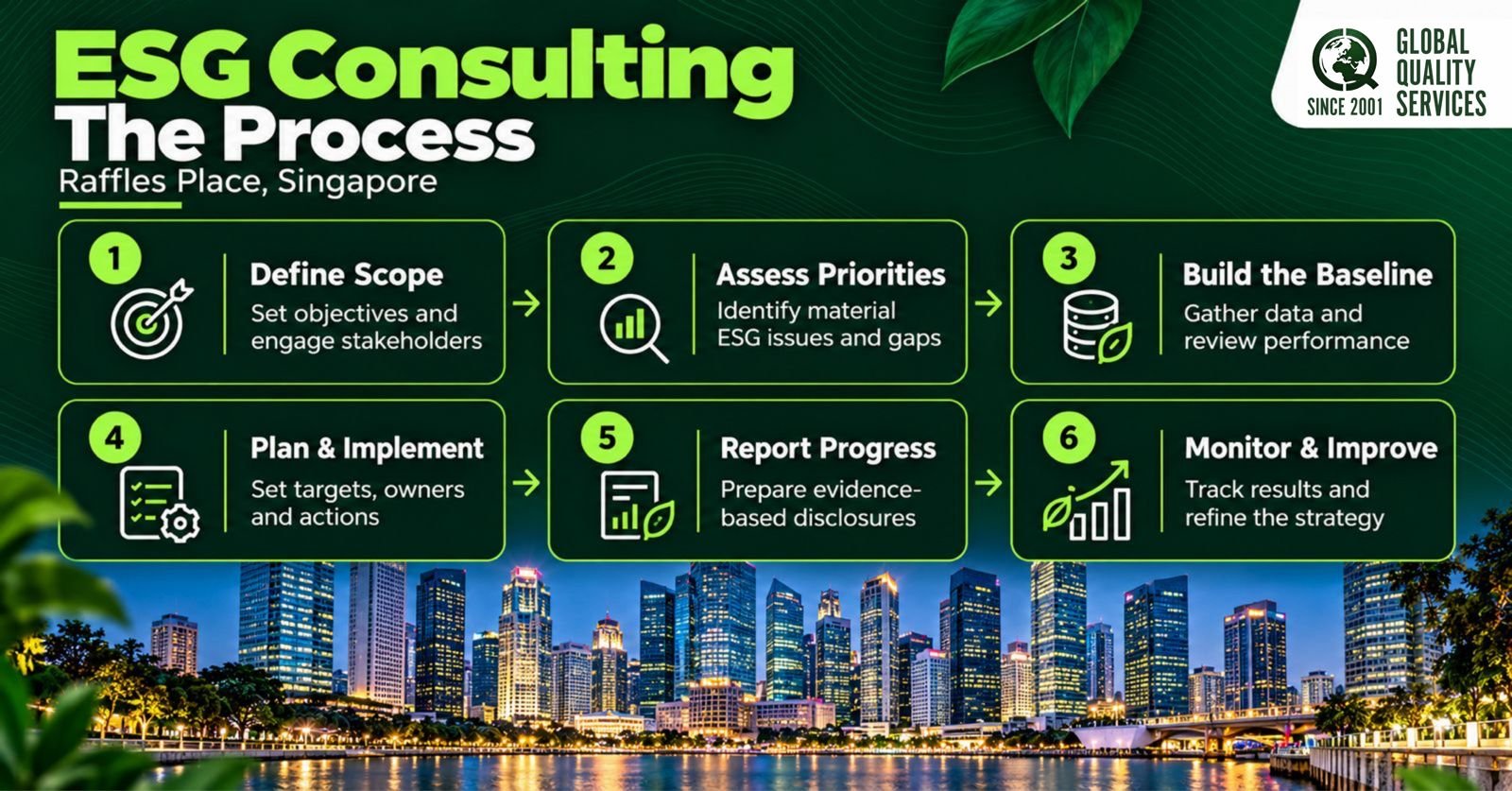
A practical ESG engagement should help management move from identifying gaps to deciding what needs to change.
Establish the Assessment Boundaries
First, define which business activities, locations, departments, and ESG topics will be included. This prevents the assessment from becoming too broad to manage effectively.
Examine Current Arrangements
Existing policies, reports, risk records, performance data, and internal procedures are reviewed to understand how sustainability issues are currently handled.
Evaluate Gaps and Priorities
The findings are assessed against the organization’s objectives, stakeholder expectations, and applicable reporting requirements. Areas requiring immediate attention are distinguished from longer-term improvements.
Prepare an Action Plan
Recommendations are organized into practical actions with proposed timelines, assigned responsibilities, and suitable performance indicators.
Review Implementation and Progress
The organization can use periodic reviews to assess completed actions, address outstanding gaps, and update priorities when its activities or reporting expectations change.
The engagement’s scope and duration depend on the organization’s size, complexity, existing documentation, and objectives.
Singapore’s Sustainability Reporting Requirements: What Companies Should Know
Businesses should confirm their reporting obligations before selecting a reporting framework or setting disclosure deadlines. Singapore’s requirements vary according to listing status, market capitalization, company size, financial year, and applicable exemptions.
According to the Accounting and Corporate Regulatory Authority (ACRA), all companies listed on the Singapore Exchange must report under a phased roadmap. Scope 1 and Scope 2 greenhouse gas emissions reporting began for financial years starting on or after January 1, 2025. Additional climate-related disclosures and Scope 3 reporting have different timelines depending on the listed company’s category.
Qualifying large non-listed companies, generally those meeting both the S$1 billion annual revenue and S$500 million total asset thresholds, are scheduled to begin ISSB-based climate-related reporting from FY2030 unless exempted. External limited assurance requirements also have separate implementation dates.
These timelines can change, so organizations should check the latest official guidance rather than rely on general summaries.
Global Quality Services can help businesses assess reporting readiness, review existing data processes, and plan improvements. Consulting support does not replace statutory reporting responsibilities or independent assurance where required.
How ESG Consulting Can Strengthen Business Decisions
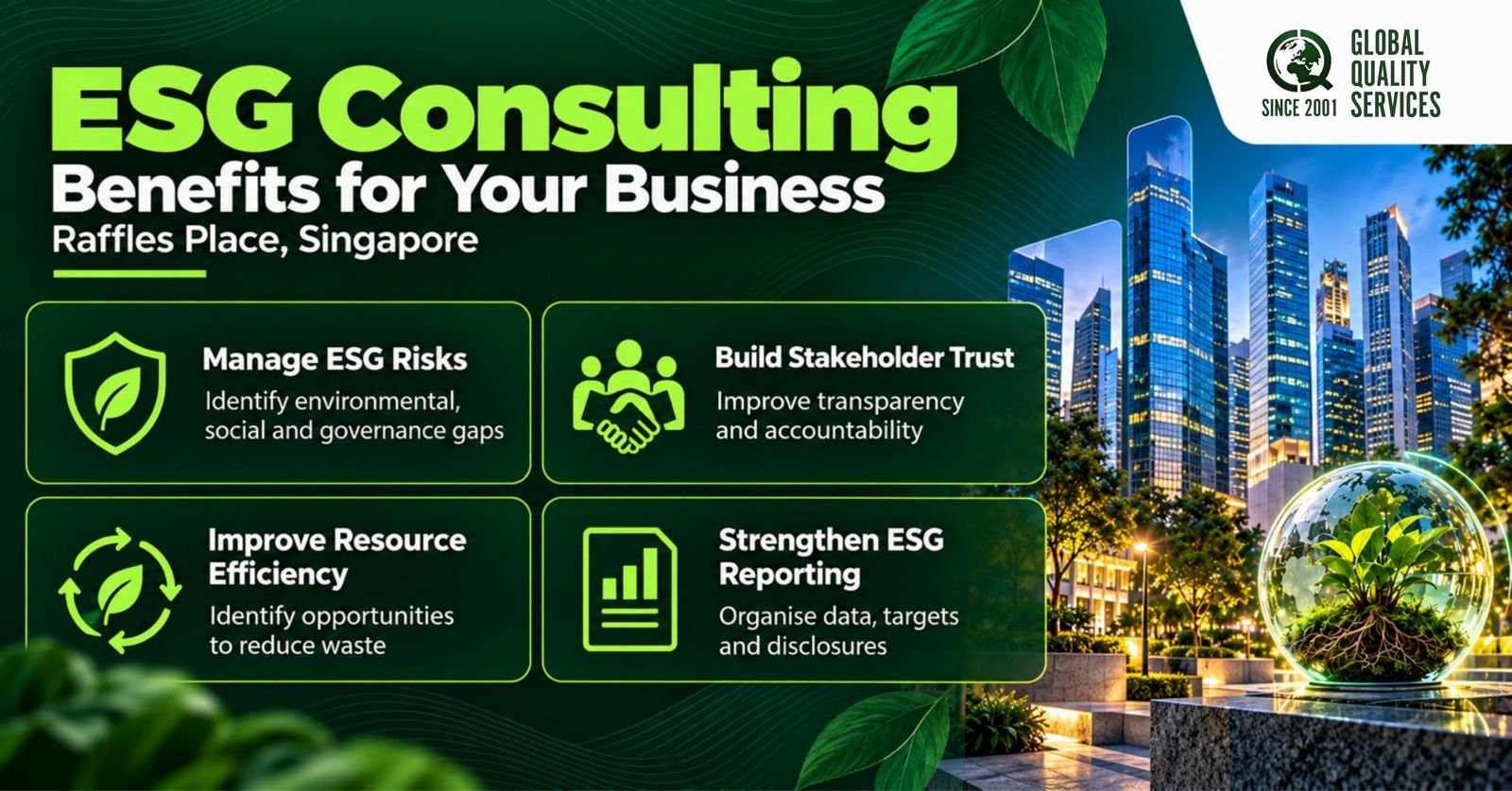
An effective ESG program should help management make better-informed decisions, not simply produce another report.
- Improved risk visibility: Management can consider relevant sustainability concerns alongside existing business risks, helping identify issues that may require further evaluation.
- Clearer accountability: Defined responsibilities and review procedures make it easier to determine who manages each ESG priority and how progress is monitored.
- More consistent information: Standardized data collection and documented calculations help reduce discrepancies across departments and reporting periods.
- Better resource allocation: Prioritizing material issues lets organizations direct time and investment to the areas most relevant to their objectives.
- More defensible disclosures: Supporting records and documented review procedures help organizations substantiate their sustainability statements and identify limitations before publication.
These outcomes depend on the quality of the assessment and the organization’s commitment to implementing and maintaining the agreed improvements.
Why Work With Global Quality Services?
Global Quality Services brings 26 years of experience supporting organizations with management- and compliance-related improvements. We recognize that ESG priorities vary according to business activities, operational complexity, stakeholder expectations, and applicable requirements.
Our approach starts with understanding your organization’s existing arrangements. We then help identify relevant gaps and develop practical recommendations that can be incorporated into established business processes.
For businesses in Raffles Place, this provides a structured way to evaluate ESG practices, strengthen information management, and plan improvements without assuming a single framework suits every organization.
Discuss ESG Consulting for Your Raffles Place Business
A clear understanding of your current ESG position can help you decide which improvements to prioritize and what information your organization needs to maintain.
Contact Global Quality Services to discuss ESG consulting services in Raffles Place. We can help you assess your priorities and develop a practical approach aligned with your business objectives and applicable reporting requirements.
Frequently Asked Questions
1. How can a company determine whether an ESG issue is material to its business?
A company should evaluate the issue in the context of its operations, business relationships, risks, opportunities, and relevant stakeholder expectations. The assessment method should reflect the reporting framework being used and distinguish between impacts on people and the environment and sustainability-related risks or opportunities relevant to the business. The resulting priorities should be documented and reviewed when circumstances change.
2. What records should a company retain to support its ESG disclosures?
The records depend on the disclosures being made but may include source data, calculation methods, invoices, utility records, supplier information, employee statistics, risk assessments, policy approvals, and management review records. Organizations should define who maintains each record, how the information is checked, and how long it is retained in accordance with applicable requirements.
3. How should a company handle ESG information that cannot be verified?
The organization should identify uncertain information, determine why supporting evidence is unavailable, and assess whether it can be improved or verified through another method. It should not present unsupported estimates as confirmed results. Handle any material limitations transparently, in accordance with the applicable reporting framework, and include a plan to improve the information over time.
4. When should a company review its ESG strategy after it has been established?
An ESG strategy should be reviewed periodically and whenever a significant change could affect its priorities. Examples include entering a new market, acquiring another business, changing major suppliers, introducing new operations, or facing new reporting requirements. A review helps confirm whether existing targets, responsibilities, and controls remain appropriate.
5. Can a company prepare for sustainability reporting before mandatory requirements apply?
Yes. Early preparation gives an organization time to identify relevant disclosures, establish data-collection processes, assign responsibilities, and close documentation gaps. The company should first confirm which requirements are expected to apply and when, then develop a proportionate preparation plan. Voluntary preparation does not mean every disclosure or assurance requirement applies before its effective date.