One-North is a major Singapore hub for technology, biomedical sciences, research, media, and innovation. Its business ecosystem includes start-ups, research organizations, technology companies, and established enterprises working with valuable digital information, intellectual property, research data, and confidential client records.
ISO 27001 Certification in One-North helps organizations establish a structured Information Security Management System (ISMS) to identify security risks, protect sensitive information, and demonstrate their commitment to information security. GQS Singapore provides ISO 27001 consultancy and certification readiness support for businesses looking to strengthen their information security practices.
What Is ISO 27001 Certification?
ISO 27001 is an international standard for information security management. It provides a framework for identifying risks to information confidentiality, integrity, and availability and implementing controls to manage them.
Certification demonstrates that an organization’s ISMS has been independently assessed against the applicable standard. It does not guarantee complete protection against cyberattacks or data breaches. Instead, it shows the organization has established a systematic approach to information security and continual improvement.
For One-North businesses, this framework can help protect research information, software assets, customer records, business plans, technical documentation, and other sensitive data.
Latest ISO 27001 Standard Updates
The current published standard is ISO/IEC 27001:2022, which specifies requirements for establishing, implementing, maintaining, and continually improving an ISMS. ISO/IEC 27001:2013 has been withdrawn.
In February 2024, ISO published Amendment 1:2024, Climate Action Changes. It introduces climate-related considerations into the management system context and interested-party requirements. Organizations must determine whether climate change is a relevant issue for their ISMS and consider relevant requirements from interested parties. This amendment is not a separate certification.
Which One-North Businesses Need ISO 27001 Certification?
ISO 27001 suits organizations of different sizes and sectors. Its value depends on the sensitivity of the information handled, contractual obligations, operational risks, and customer expectations.
Technology and Software Companies
Businesses developing software, digital platforms, cloud services, or enterprise applications may manage customer information, source code, system credentials, and proprietary technology. ISO 27001 helps them establish consistent controls for access management, development environments, supplier security, and incident response.
Biomedical and Life Sciences Organizations
Companies operating in Biopolis may handle research data, laboratory information, intellectual property, clinical development records, and confidential collaborations. An ISMS can help identify information security risks across research systems, internal teams, and external partners.
ISO 27001 focuses on information security management. It does not replace applicable laboratory quality, clinical, privacy, or regulatory requirements.
Research and Innovation Organizations
Research institutions and innovation teams often work with unpublished findings, experimental data, prototypes, and commercially sensitive research outputs. Appropriate information security controls can help protect these assets while supporting collaboration with universities, industry partners, and research organizations.
Start-ups and Growing Businesses
Companies operating at LaunchPad may be preparing to enter new markets, secure enterprise customers, or establish partnerships with larger organizations. ISO 27001 can help them formalize information security practices as their teams, technology environments, and customer base grow.
Media and Digital Content Businesses
Organizations working in media, digital production, and content technology may handle unreleased content, client files, licensing information, and confidential project materials. An ISMS can help define how this information is accessed, stored, shared, and protected.
Why Is ISO 27001 Important for One-North Businesses?
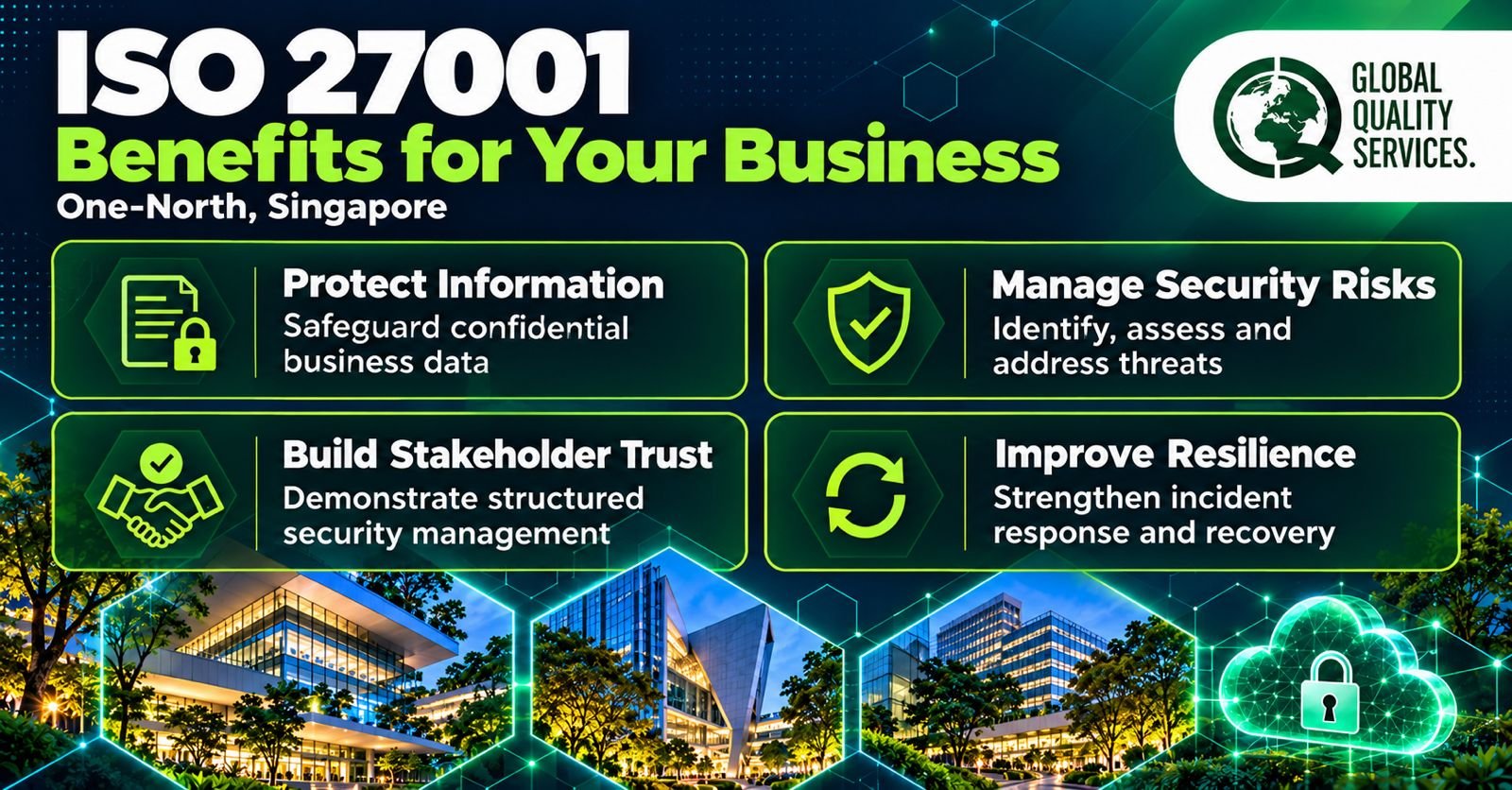
One-North’s focus on technology, research, and innovation creates an environment where valuable information frequently moves between employees, systems, collaborators, and external service providers. A consistent information security framework helps organizations manage these risks without relying solely on individual practices or isolated technical measures.
Protects Intellectual Property
Source code, research findings, product designs, and proprietary business information can be important commercial assets. ISO 27001 helps organizations identify where such information is held and establish appropriate safeguards against unauthorized access, alteration, or disclosure.
Supports Enterprise Customer Requirements
Large customers and business partners may evaluate suppliers before sharing confidential information or awarding contracts. ISO 27001 certification provides evidence of an independently assessed information security management system, helping businesses meet relevant procurement and vendor security requirements.
Strengthens Collaboration Across Research Networks
Research and technology projects often involve multiple organizations, departments, and external specialists. An ISMS clarifies information-handling responsibilities and establishes consistent controls for sharing data and managing access across collaborative projects.
Improves Security Governance
Risk assessments, defined responsibilities, internal audits, and management reviews help organizations identify weaknesses and track corrective actions. This provides management with a structured way to monitor information security performance.
Supports Business Expansion
As businesses add employees, launch products, adopt cloud services, or enter new markets, their information security risks can change. ISO 27001 provides a framework to review those risks and adapt controls as operations evolve.
What Are the Main ISO 27001 Requirements?
ISO/IEC 27001:2022 requires organizations to establish and maintain an ISMS that reflects their business context, security risks, and operational objectives.
Define the ISMS Scope
The organization must determine which business activities, locations, systems, services, and information assets fall within the ISMS. For a One-North company, the scope might cover a software product, research function, business unit, or wider operation, depending on how information is managed.
Assess Information Security Risks
The organization must identify and evaluate risks that could affect the confidentiality, integrity, or availability of information. The assessment should consider relevant threats, vulnerabilities, business impacts, and existing safeguards.
Establish Risk Treatment Measures
The organization must decide how to treat identified risks and select appropriate controls. The Statement of Applicability records the controls considered necessary, whether they are included or excluded, and their implementation status.
Establish Policies and Responsibilities
The ISMS should define information security responsibilities, management commitments, relevant policies, and employee obligations. Staff must understand the requirements that apply to their roles.
Implement and Monitor Controls
Depending on the organization’s risk profile, controls may address access management, information classification, cryptography, supplier relationships, incident management, vulnerability management, backup, and security monitoring.
Review and Improve the ISMS
Internal audits, management reviews, performance evaluation, and corrective actions help determine whether the ISMS remains effective. Organizations must maintain their system as risks, technologies, and business activities evolve.
How Does the ISO 27001 Certification Process Work in One-North?
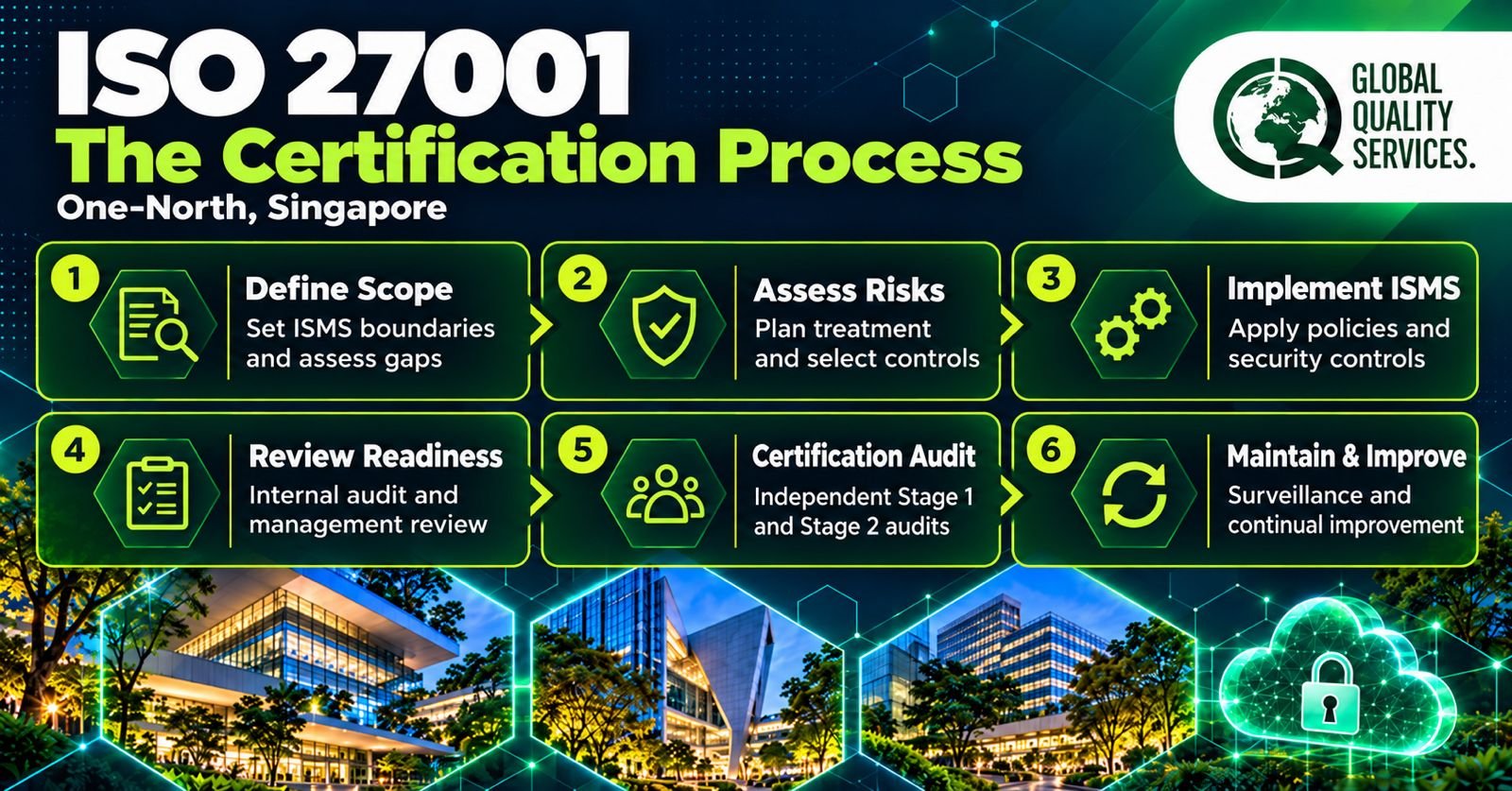
GQS Singapore can support organizations through a structured preparation process tailored to their operations and existing information security arrangements.
1. Define the Certification Scope
Identify the business functions, locations, systems, information assets, and external dependencies covered by the ISMS. The scope should reflect actual operations and the information security risks the organization needs to manage.
2. Conduct a Gap Assessment
Review existing policies, security controls, risk assessment practices, supplier arrangements, and documented information against ISO 27001 requirements. The assessment identifies areas that need improvement before the external audit.
3. Complete Risk Assessment and Treatment Planning
Evaluate information security risks and prioritize them by significance. Develop a risk treatment plan, select appropriate controls, and document decisions within the ISMS.
4. Implement the ISMS
Develop and apply relevant policies, procedures, records, and operational controls. Employees should understand their responsibilities, and the organization should retain appropriate evidence that its processes are working.
5. Conduct Internal Audit and Management Review
Evaluate whether the ISMS meets the applicable requirements and operates effectively. Address nonconformities and review outstanding risks before the external certification assessment.
6. Complete the External Certification Audit
An independent certification body generally conducts a Stage 1 audit to review readiness and documented arrangements, followed by a Stage 2 audit to evaluate implementation and effectiveness. The organization must address any nonconformities through the certification body’s process.
GQS Singapore provides consultancy and readiness support. The independent certification body conducts the certification audit and makes the certification decision.
How Long Does ISO 27001 Certification Take?
The implementation timeline depends on the organization’s size, the scope of its ISMS, existing security practices, and the complexity of its information systems.
A technology company with established security procedures may need less preparation than a start-up developing its information security framework for the first time. Research organizations may also need to coordinate controls across multiple teams, systems, and external collaborators.
A gap assessment helps establish a realistic plan based on the required work, available resources, and evidence needed before certification.
What Factors Affect ISO 27001 Certification Cost in One-North?
ISO 27001 certification costs vary according to the scope and complexity of the ISMS, the number of locations and employees covered, the maturity of existing controls, and the work needed to address identified gaps.
The overall budget may include consultancy, internal staff time, security improvements, employee awareness activities, and independent certification audit fees. These costs should be considered separately when planning the project.
Organizations can improve cost planning by defining a justified certification scope, assigning internal responsibilities early, and identifying gaps before committing to the external audit.
ISO 27001 and Singapore’s Personal Data Protection Act
Organizations in One-North that collect, use, or disclose personal data must consider their obligations under Singapore’s Personal Data Protection Act (PDPA), where applicable.
ISO 27001 and the PDPA serve different purposes. ISO 27001 establishes a management system for information security risks, while the PDPA sets legal obligations concerning personal data. An ISMS can support managing relevant security risks, but certification does not automatically ensure compliance with every PDPA requirement.
Businesses should assess their legal obligations separately and ensure their information security arrangements support applicable privacy requirements.
Our ISO 27001 Certification Support Services in One-North
GQS provides consultancy and readiness support to organizations preparing for ISO 27001 certification. We tailor our approach to the business’s activities, existing security controls, and intended certification scope.
Our support may include ISO 27001 gap assessments, ISMS scope definition, information security risk assessments, risk treatment planning, policy and procedure development, Statement of Applicability preparation, internal audit support, employee awareness guidance, and corrective action planning.
We help organizations prepare the necessary processes and evidence while developing an ISMS that can be maintained as part of everyday operations.
How Global Quality Services Can Help
With 26 years of experience, Global Quality Services supports organizations seeking to establish and improve management systems. Our ISO 27001 consultancy approach focuses on understanding your operations, identifying information security gaps, developing practical implementation plans, and preparing your team for an independent certification audit.
Contact GQS Singapore to discuss your requirements and plan your ISO 27001 certification readiness activities.
Frequently Asked Questions
1. How can a research organization protect confidential findings when collaborating with external institutions?
An organization should define who can access research information, how files may be shared, and which safeguards apply to external collaborators. Access permissions, information-sharing agreements, secure transfer methods, and periodic access reviews can help reduce the risk of unauthorized disclosure. ISO 27001 provides a framework for managing these risks within the organization’s ISMS.
2. Can ISO 27001 help a start-up meet information security requirements during investor due diligence?
Yes. An established ISMS helps a start-up demonstrate that it systematically identifies and manages information security risks. Investors may still request additional evidence about data protection, intellectual property safeguards, access controls, or incident handling. Certification can support due diligence, but it does not guarantee investment approval.
3. How should a company protect source code when employees use personal devices for work?
The company should establish clear rules for device use, access permissions, authentication, storage, and source code transfer. Depending on its risk assessment, controls may include managed devices, restricted repositories, multifactor authentication, encryption, and the ability to revoke access. The organization should document and monitor the controls appropriate to its ISMS.
4. Does ISO 27001 certification cover every application and product developed by a company?
Not necessarily. Certification applies to the defined ISMS scope, not automatically to every product or application associated with the organization. Customers should review the certificate’s scope and confirm whether it includes the relevant development activities, teams, locations, and supporting systems.
5. How can a company demonstrate that research data remains protected when a project ends?
The organization should follow defined procedures for retaining, archiving, transferring, or securely disposing of project information. It should consider contractual obligations, applicable retention requirements, access revocation, backup copies, and ownership of research records. These arrangements help ensure that information remains appropriately protected after a collaboration ends.