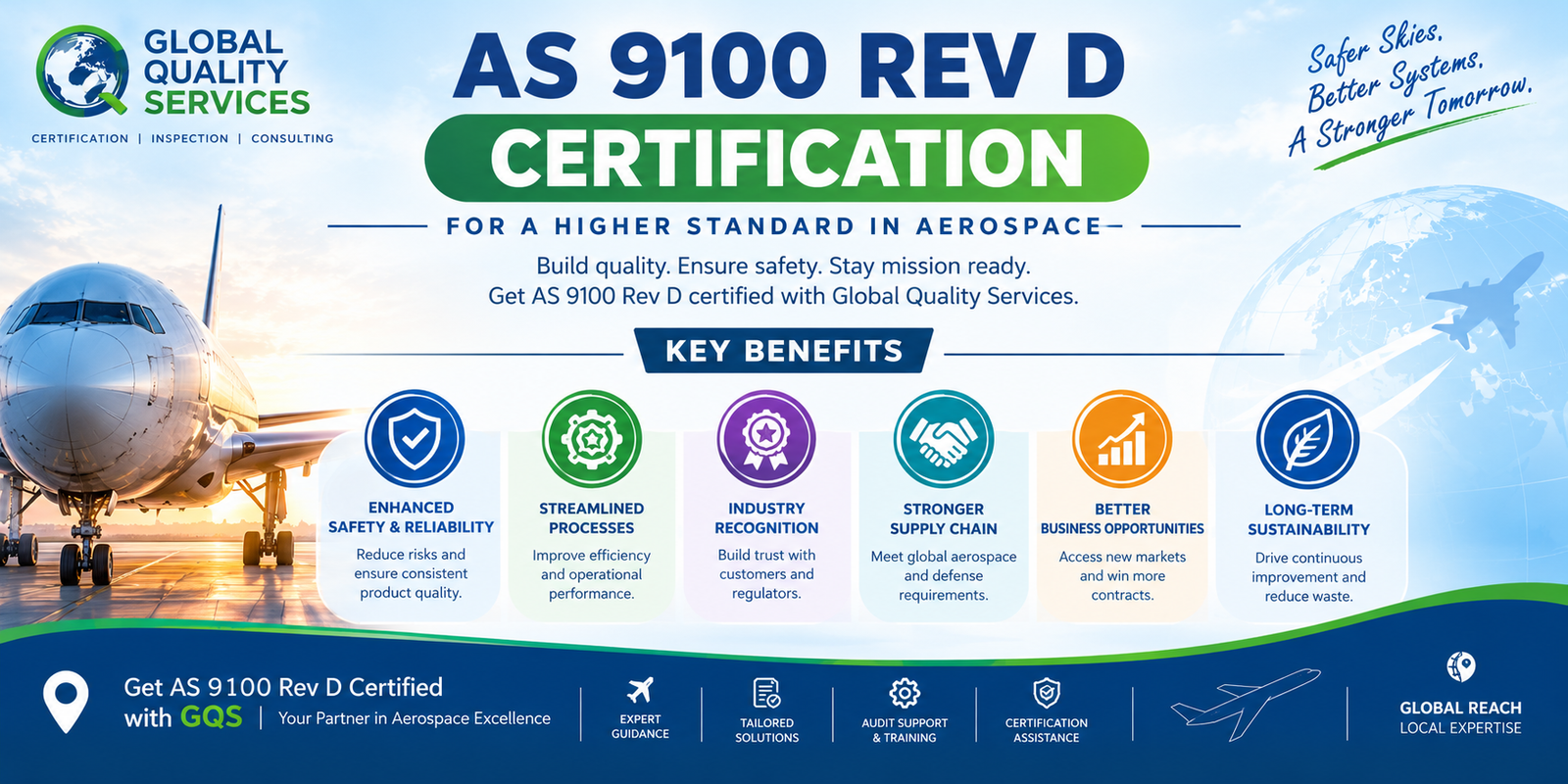
AS 9100 Rev D is an internationally recognized Quality Management System (QMS) standard developed specifically for organizations in the aviation, space, and defense industries. It builds on ISO 9001 and adds requirements that address the higher levels of product safety, traceability, risk management, configuration control, and supply-chain oversight expected in aerospace operations. The IAQG states that the 9100 standard can be applied across different levels of the aviation, space, and defense supply chain.
For aerospace manufacturers, component suppliers, engineering companies, MRO organizations, and defense suppliers in Singapore, AS 9100 Rev D can provide a structured quality framework for meeting customer and supply-chain requirements.
Global Quality Services helps organizations understand the requirements, develop and improve their quality systems, conduct readiness reviews, and prepare for certification audits.
What Is AS 9100 Rev D?
AS 9100 Rev D is the aerospace version of a quality management system built around ISO 9001 requirements. It addresses the additional controls needed where product quality, safety, reliability, and traceability can have significant consequences.
The standard places particular emphasis on:
- Product safety
- Risk management
- Configuration management
- Operational planning
- Supplier control
- Product and process monitoring
- Counterfeit part prevention
- Nonconformity and corrective action
- Traceability and documented information
The objective is not simply to create more documentation. The QMS should connect quality controls with the organization’s actual engineering, procurement, production, inspection, delivery, and customer-support processes.
Why Is AS 9100 Rev D Important for Singapore Aerospace Companies?
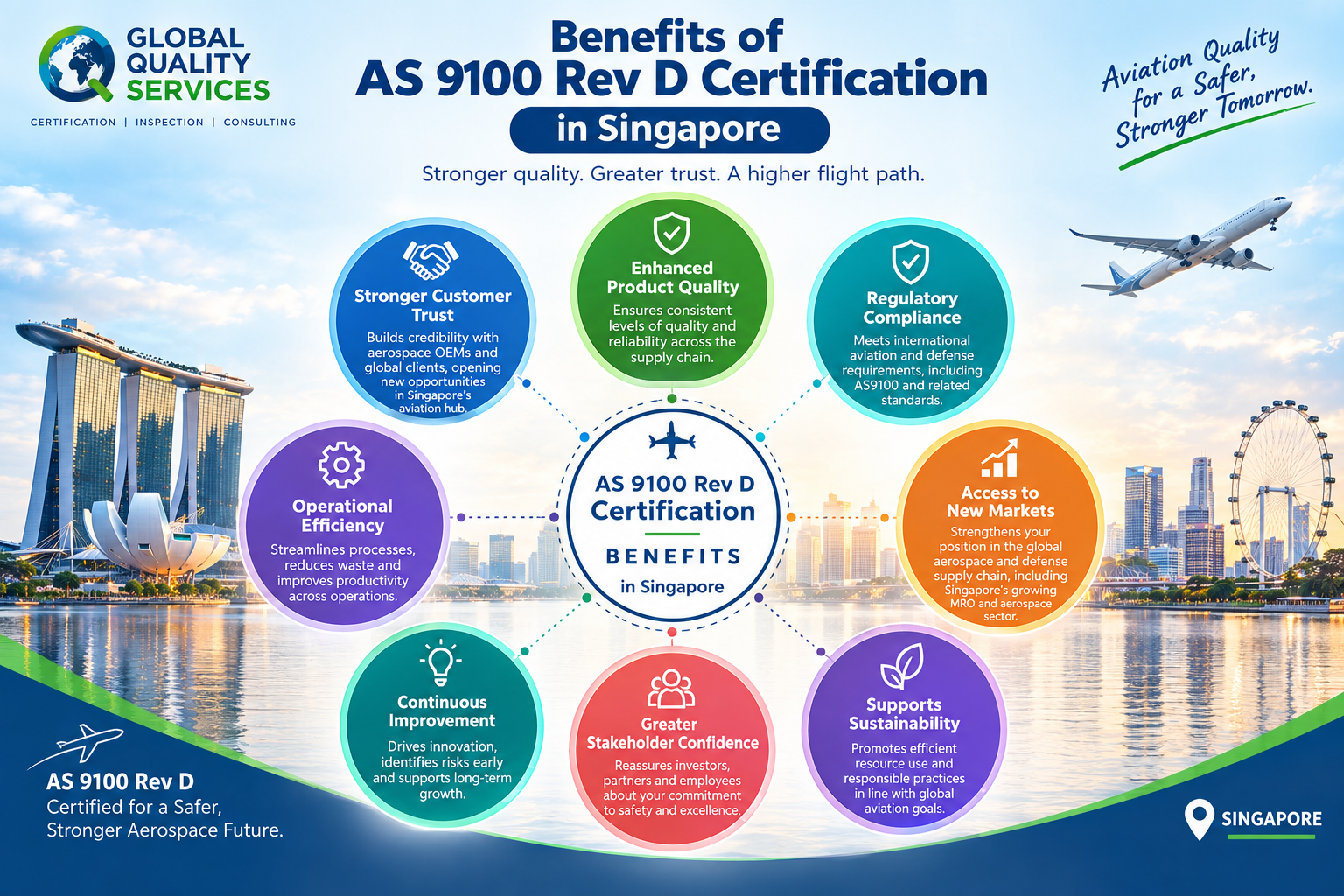
AS 9100 certification can be important for organizations that want to participate in aerospace and defense supply chains where customers require evidence of a robust aerospace quality management system.
Access to Aerospace Supply Chains
Aerospace OEMs, Tier 1 suppliers, and other customers may require suppliers to demonstrate certification to an applicable 9100-series standard.
Stronger Product Safety Controls
AS 9100 gives greater attention to product safety and the management of risks that can affect aerospace products throughout their lifecycle.
Better Process Control
The standard encourages organizations to control processes systematically rather than relying only on final product inspection.
Improved Traceability
Aerospace products often require detailed records showing what was produced, which materials and components were used, which processes were performed, and who approved the relevant activities.
Better Supplier Management
Organizations are expected to evaluate and monitor external providers according to the risks associated with their products, services, and processes.
Who Should Consider AS 9100 Rev D Certification?
AS 9100 is designed for organizations involved in the design, development, production, installation, and servicing of aviation, space, and defense products and related services.
This can include:
- Aerospace component manufacturers
- Aircraft parts suppliers
- Precision engineering companies
- Aerospace machining companies
- Defense manufacturers
- Electronics and avionics suppliers
- Aerospace engineering organizations
- Space and satellite component manufacturers
- Aerospace MRO support organizations
- Organizations supplying products or services to aerospace OEMs and Tier 1 suppliers
The appropriate aerospace QMS standard depends on the organization’s role in the supply chain.
What Are the Key Requirements of AS 9100 Rev D?
Let us take a look at the key requirements for AS 9100 Rev D certification in Singapore:
Risk-Based Thinking
Organizations need to identify and manage risks that could affect product conformity, customer requirements, delivery, and operational performance.
Product Safety
Product safety requirements need to be identified and controlled where they apply to the organization’s products and processes.
Configuration Management
Configuration controls help ensure that the correct product specifications, drawings, changes, and revisions are being used throughout production and delivery.
Counterfeit Part Prevention
Organizations need controls to reduce the risk of counterfeit or suspect parts entering the aerospace supply chain.
Supplier Management
External providers need to be evaluated and monitored based on relevant risks, requirements, and performance.
Operational Control
Production and service processes need to be planned, controlled, monitored, and supported by appropriate documented information.
Nonconformity and Corrective Action
Organizations must have processes for identifying nonconforming outputs, determining causes, taking corrective action, and checking whether those actions are effective.
What Are the Related Aerospace Standards?
AS 9100 Rev D is part of a wider family of aerospace quality standards. Depending on an organization’s role, other IAQG standards may also be relevant.
AS 9101: Quality Management Systems Audit Requirements
AS 9101 establishes requirements for conducting and reporting aerospace QMS audits. It helps standardize how audits are performed and how findings and results are reported across the aerospace supply chain. The IAQG currently identifies the 9101:2022 edition as the current published version.
AS 9102: Aerospace First Article Inspection
AS 9102 establishes requirements for First Article Inspection (FAI). It provides a structured method for verifying that the first production article conforms to the applicable engineering, design, and production requirements.
AS 9103: Variation Management of Key Characteristics
AS 9103 addresses the management of variation in key characteristics. It provides a methodology for identifying and controlling important product and process characteristics where variation can affect aerospace product performance. The IAQG standards register identifies AS 9103 Rev B.
AS 9145: APQP and PPAP
AS 9145 defines aerospace and defense requirements for Advanced Product Quality Planning (APQP) and Production Part Approval Process (PPAP). It connects product development, manufacturing planning, production, and customer requirements through a structured process.
AS 9146: Foreign Object Damage Prevention
AS 9146 provides requirements for a Foreign Object Damage (FOD) prevention program. It is designed to help aviation, space, and defense organizations prevent contamination or damage caused by foreign objects during relevant operations.
What Is AS 9120 Certification?
AS 9120 certification is designed for organizations that distribute aviation, space, and defense products without manufacturing or altering them. It is therefore relevant to stockists, distributors, resellers, brokers, and other organizations that purchase, store, and supply aerospace components and products.
AS 9120 is one of the three main IAQG aerospace QMS standards, alongside AS 9100 and AS 9110.
For these organizations, the focus is strongly connected to areas such as product identification, traceability, supplier control, purchasing, storage, preservation, and prevention of counterfeit or suspect parts.
What Is the AS 9100 Rev D Certification Process?

Certification involves assessing whether the organization’s quality management system meets the applicable aerospace requirements and is effectively implemented.
Step 1: Gap Assessment
GQS reviews the existing QMS against AS 9100 Rev D requirements and identifies areas that require improvement.
Step 2: Documentation and System Development
Required policies, procedures, process controls, risk management arrangements, supplier controls, and records are developed or updated.
Step 3: Implementation
The requirements are implemented across relevant departments such as engineering, procurement, production, quality, inspection, stores, and management.
Step 4: Internal Audit
Internal audits are performed to determine whether the system has been implemented effectively and to identify remaining gaps.
Step 5: Management Review
Management reviews the performance of the QMS, including risks, objectives, audit results, customer feedback, nonconformities, and opportunities for improvement.
Step 6: Certification Audit
An accredited third-party Certification Body conducts the certification audit. The IAQG certification scheme is based on accredited third-party auditing and certification.
Step 7: Corrective Action and Certification
Where audit findings are raised, the organization addresses them within the applicable certification process before certification is completed.
What Documents Are Needed for AS 9100 Rev D Certification?
The exact documentation depends on the organization’s activities and certification scope. Typical evidence can include:
- Quality policy and objectives
- Process documentation
- Risk assessments
- Product safety records
- Configuration management records
- Supplier evaluation records
- Purchase and supplier-control records
- Production and inspection records
- Calibration records
- Traceability records
- Nonconformity and corrective action records
- Internal audit records
- Management review records
- Training and competency records
- Customer requirement records
The important point is that documents should reflect how the organization actually operates. Creating procedures that are not followed in practice can create additional problems during an audit.
How Can Global Quality Services Help With AS 9100 Rev D?
Global Quality Services helps Singapore organizations prepare for AS 9100 Rev D certification through gap assessment, documentation support, implementation guidance, internal audit support, corrective action assistance, and certification-readiness reviews.
The focus is on translating aerospace requirements into practical controls across engineering, procurement, production, inspection, quality, supplier management, and management processes. GQS can also help organizations understand which related aerospace standards may be relevant to their specific role in the supply chain.
Formal certification is performed by an applicable accredited Certification Body under the IAQG certification scheme.
Aerospace quality management requires more than a basic ISO 9001 system. Organizations need to demonstrate control over product safety, risks, configuration, suppliers, traceability, and operational processes.
GQS takes a practical approach to AS 9100 Rev D readiness by reviewing the organization’s existing processes and helping align them with applicable aerospace requirements. The objective is to develop a system that supports both certification readiness and day-to-day operational control.
Frequently Asked Questions
Who needs AS 9100 Rev D certification?
AS 9100 is intended for organizations involved in aviation, space, and defense activities, including manufacturers, engineering organizations, component suppliers, and other relevant supply-chain organizations.
What is the difference between AS 9100 and ISO 9001?
AS 9100 incorporates the ISO 9001 quality management foundation and adds aerospace-specific requirements covering areas such as product safety, risk, configuration management, counterfeit-part prevention, and supply-chain controls.
What is AS 9102 used for?
AS 9102 provides requirements for First Article Inspection. It is used to verify that a production article meets applicable design and manufacturing requirements before or during the transition to regular production.
Is AS 9120 suitable for aerospace distributors?
Yes. AS 9120 is specifically intended for organizations involved in the distribution of aviation, space, and defense products, rather than organizations manufacturing or maintaining those products.
Does GQS issue AS 9100 certificates?
GQS provides consultancy and certification-readiness support. The formal AS 9100 certification audit and certification decision are performed by an applicable accredited Certification Body under the IAQG certification scheme.